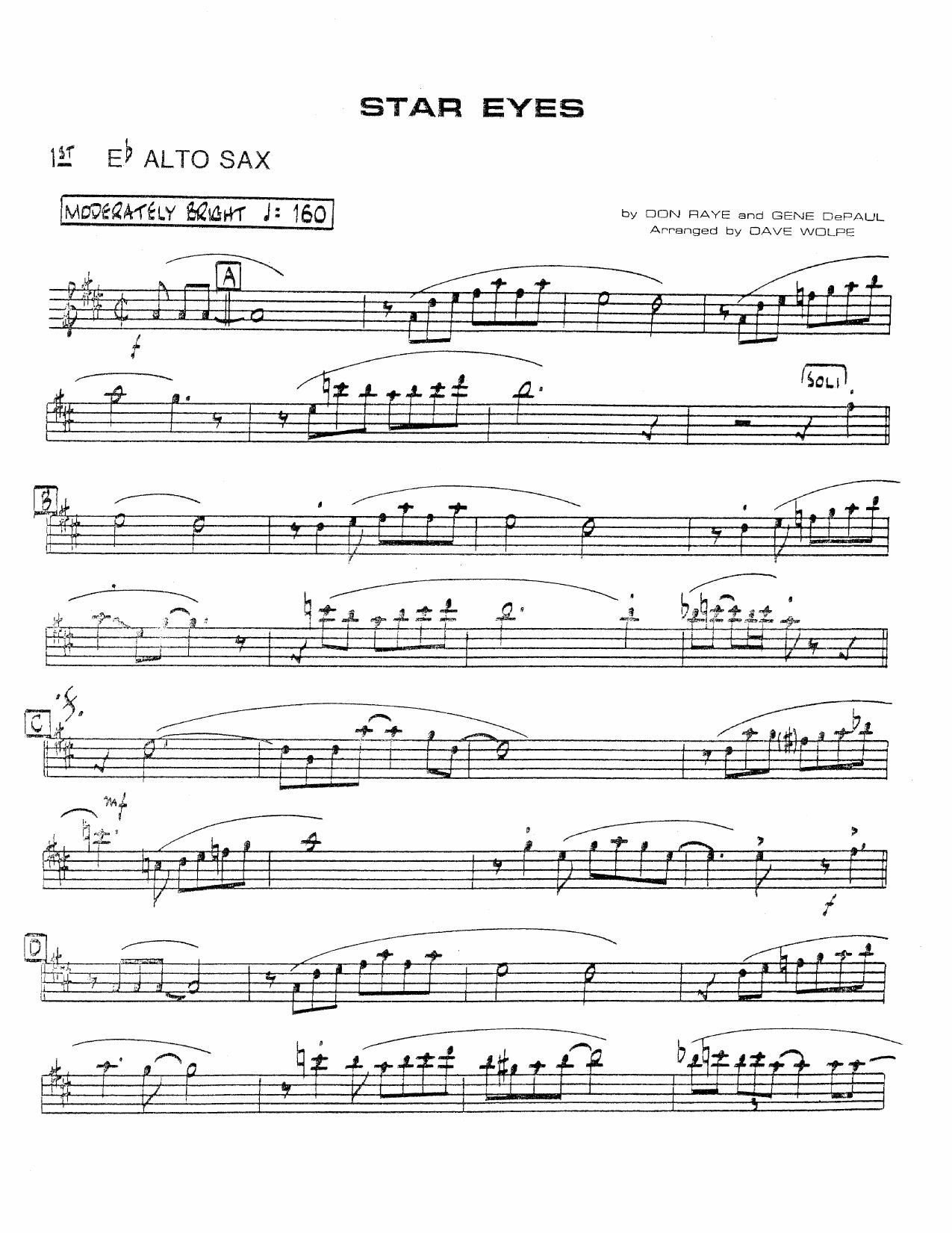
Star Eyes (D.Wolpe)
Composed by Gene de Paul
Arranged by Dave Wolpe
- Ensemble: Big Band
- Pages: 36
- Instruments (17): 1st Eb Alto Sax, 2nd Eb Alto Sax, 1st Bb Tenor Sax, 2nd Bb Tenor Sax, Eb Baritone Sax, 1st Bb Trumpet, 2nd Bb Trumpet, 3rd Bb Trumpet, 4th Bb Trumpet, 1st Trombone, 2nd Trombone, 3rd Trombone, Bass Trombone, Piano, Guitar, Bass, Drums
- Difficulty: medium
- Content: Individual Parts
- Format: PDF Download (Instant)
- Price: $24.99
Written by Gene de Paul with lyrics by Don Raye, "Star Eyes" first entered the American songbook through the 1943 MGM musical film *I Dood It*, starring Red Skelton and Eleanor Powell, before being quickly embraced by the bebop avant-garde. Instrumental luminaries such as Charlie Parker, Bud Powell, and later John Coltrane transformed the composition from a cinematic vocal tune into a harmonically sophisticated vehicle for jazz improvisation. Its intricate bridge and undulating modal-leaning chromaticism secure its status as a timeless jazz standard, requiring both lyrical sensitivity and harmonic acuity from any ensemble that tackles it. Dave Wolpe’s definitive big band adaptation captures the sophisticated essence of the classic swing and mainstream jazz tradition, operating at a comfortable medium-swing tempo that allows the groove to breathe while maintaining forward momentum. The arrangement opens with an inviting, atmospheric introduction that establishes a rich harmonic palette before launching into a driving, foot-tapping 4/4 swing feel. Wolpe masterfully balances lush, harmonically dense brass voicings with punchy, rhythmic saxophone solis, evoking the golden era of the Count Basie and Buddy Rich orchestras while injecting a contemporary freshness through extended chord extensions and crisp dynamic contrasts. Throughout the chart, melody duties are shared judiciously between the woodwind and brass families, creating a rich textural variety that keeps both performers and listeners engaged. The saxophone section is treated to tightly knit, harmonically rich soli passages that demand clean articulation and precise intonation, while the brass section interjects with crisp, authoritative stabs and warm, muted passages. A designated solo section provides a premier showcase for featured improvisers—typically adaptable for alto saxophone or trumpet—backed by a rhythm section chart that encourages authentic comping with clear chord symbols and tasteful driving figures. The climax arrives via a textbook Wolpe shout chorus, building layer by layer in intensity and dynamic range before resolving into a satisfying, high-energy final cadence. Advanced high school, collegiate, and community big bands will find this arrangement to be an ideal centerpiece for festival performance or formal concert programming. While the rhythmic figures are straightforward enough for developing ensembles with strong section playing, the subtle nuances of style, blend, and harmonic sophistication provide ample artistic reward for more seasoned professional groups looking to deliver a polished, crowd-pleasing jazz standard. Success with this Dave Wolpe chart hinges on maintaining a relaxed yet driving medium-swing feel, avoiding the common trap of rushing the tempo during louder ensemble sections. The rhythm section is the engine: the drummer should maintain a feather-light ride cymbal pattern with crisp hi-hat chicks on beats two and four, while the bassist walks a steady, acoustic-style line that anchors the sophisticated chord changes. Brass players must pay close attention to dynamic markings, ensuring that background figures never swamp the featured soloists or the lead alto melody. Pay special attention to articulation consistency across the saxophone section during fast eighth-note passages; short notes should be clipped and precise, while longer lines require a smooth, connected jazz legato. Encourage the ensemble to listen across sections to match vibrato width and tone color, particularly during the lush ballad-esque chord clusters in the introduction and transitional interludes. Q: What instruments and parts are included in this big band arrangement? A: The 36-page score and parts package is scored for a standard 17-instrument big band instrumentation, featuring 5 saxophones (Alto 1, Alto 2, Tenor 1, Tenor 2, Baritone), 4 trumpets, 4 trombones, and a full four-piece rhythm section consisting of piano, guitar, bass, and drums. Q: What is the difficulty level of this Dave Wolpe chart? A: This arrangement is graded as medium-advanced, making it exceptionally well-suited for high school jazz ensembles with strong section leaders, as well as collegiate and community big bands seeking a sophisticated mainstream chart. Q: What is the historical style and musical context of "Star Eyes"? A: Originally penned by Gene de Paul and Don Raye for a 1943 Hollywood musical, the tune evolved into a staple bebop and mainstream jazz standard championed by legends like Charlie Parker, offering rich harmonic contours ideal for swing adaptation. Q: What makes this specific arrangement by Dave Wolpe unique? A: Wolpe distinguishes his treatment through lush, modern chord voicings, tightly integrated saxophone soli sections, and a classic dynamically-layered shout chorus that elevates a standard melody into a masterclass of big band arranging. Q: What is the performance duration and recommended tempo for this piece? A: The arrangement is set at a comfortable medium-swing tempo (approximately quarter note = 120-126 BPM) and typically runs around 3.5 to 4.5 minutes depending on the length of the open improvised solos.
Questions and answers
- What is included in the Star Eyes (D.Wolpe) PDF?
- The verified current file contains individual parts across 36 pages.
- How many instruments or parts are listed for Star Eyes (D.Wolpe)?
- The verified instrumentation list contains 17 entries for this Big Band arrangement.
- Who is credited for Star Eyes (D.Wolpe)?
- Composer: Gene de Paul. Arranger: Dave Wolpe.
- What difficulty is listed for Star Eyes (D.Wolpe)?
- The verified difficulty level is medium.
- Can I preview Star Eyes (D.Wolpe) before buying?
- Yes. The product page provides a preview generated from the current PDF file.
- How is Star Eyes (D.Wolpe) delivered?
- After successful payment, the digital PDF is made available for download. The displayed price is $24.99.
Musicians Also Search For
Star Eyes Dave Wolpe PDF • Star Eyes Dave Wolpe sheet music • Star Eyes arranged by Dave Wolpe • Dave Wolpe big band charts • Dave Wolpe jazz arrangements PDF • Star Eyes Gene de Paul sheet music • Star Eyes Gene de Paul big band arrangements • Gene de Paul big band charts • Star Eyes big band arrangements • Star Eyes big band PDF download • Star Eyes jazz sheet music • big band sheet music download • Star Eyes individual parts download • Star Eyes sheet music PDF • buy Star Eyes sheet music • download Star Eyes PDF • Star Eyes jazz charts • best Dave Wolpe big band arrangements • Gene de Paul arranged by Dave Wolpe • Star Eyes printable sheet music • big band repertoire PDF