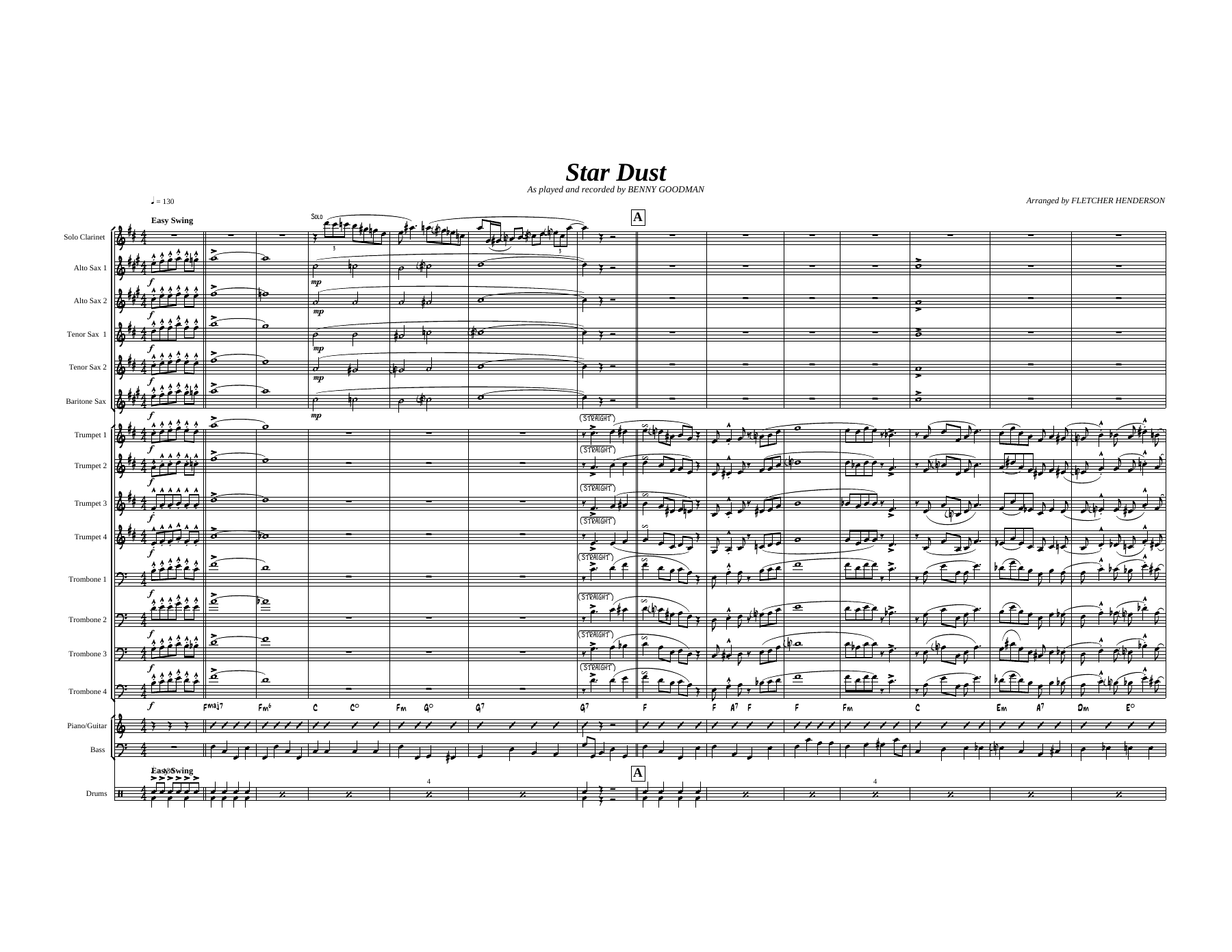
Star Dust (F.Henderson)
Composed by Hoagy Carmichael
Arranged by Benny Goodman
- Ensemble: Big Band
- Style: Jazz Standard
- Pages: 34
- Instruments (17): Solo Clarinet, Alto Sax 1, Alto Sax 2, Tenor Sax 1, Tenor Sax 2, Baritone Sax, Trumpet 1, Trumpet 2, Trumpet 3, Trumpet 4, Trombone 1, Trombone 2, Trombone 3, Trombone 4, Piano/Guitar, Bass, Drums
- Difficulty: medium
- Content: Individual Parts
- Format: PDF Download (Instant)
- Price: $24.99
"Star Dust," Hoagy Carmichael's timeless ballad, stands as one of the most beloved and frequently recorded jazz standards of all time. Composed in 1927, initially as an instrumental, it gained widespread fame with Mitchell Parish's lyrics in 1929, capturing the melancholic beauty and nostalgic longing that defined the era. Its enduring appeal lies in its sophisticated harmonic progression and lyrical melody, making it a cornerstone of the Great American Songbook. This particular arrangement, attributed to Benny Goodman's orchestra, transports listeners directly into the heart of the Swing Era, showcasing the polished ensemble sound and sophisticated musicality that characterized Goodman's "King of Swing" reign. Goodman's treatment of "Star Dust" is a masterclass in big band balladry, presenting the piece as a slow, reflective swing ballad, typically performed around 60-70 beats per minute. The arrangement is set in a key that allows for rich, warm voicings, likely Eb or F major, which enhances its inherently romantic and wistful mood. The overall energy is one of controlled passion and elegant restraint, evoking the sophisticated dance halls and concert stages of the 1930s and 40s. The arrangement's character is defined by its lush saxophone section writing, often featuring close-voiced harmonies that create a velvety texture, contrasting beautifully with the brass. Distinctive to Benny Goodman's approach, this arrangement emphasizes clarity, precision, and a seamless blend across the sections. Expect beautifully crafted soli passages, particularly in the saxophone section, where the melody is often passed between voices or harmonized with exquisite taste. The brass sections provide supportive, often sustained, backings, punctuated by carefully placed melodic fragments or gentle swells. While Goodman's bands were known for their soloists, this arrangement prioritizes the ensemble's collective artistry, with any featured solo likely being a lyrical, expressive statement, perhaps from the lead clarinet (Goodman's own instrument) or a tenor saxophone, maintaining the ballad's contemplative mood. Technical challenges include achieving a unified, expressive dynamic range, maintaining a consistent, relaxed swing feel at a slow tempo, and executing the precise articulations and blend required for the intricate voicings. The reward lies in performing a historically significant arrangement with profound emotional depth, allowing the ensemble to showcase its sensitivity and musical maturity. This arrangement is ideally suited for college-level jazz ensembles, advanced community bands, or professional groups. While high school bands with strong lead players and a solid understanding of swing ballad interpretation could tackle it, the nuanced dynamics, sophisticated harmonies, and demand for exceptional ensemble blend make it a significant undertaking. It offers invaluable opportunities to develop musicianship in phrasing, balance, and the art of collective storytelling, making it a truly rewarding addition to any big band's repertoire. Approaching "Star Dust (F.Henderson)" requires a focus on ensemble blend and dynamic sensitivity. The primary technical challenge lies in maintaining a consistent, relaxed slow swing feel (quarter note = 60-70 BPM) without dragging or rushing, ensuring a fluid, legato phrasing throughout. Particular attention should be paid to the saxophone soli sections, where precise intonation, balanced voicings, and unified articulation are paramount to achieving the signature Goodman sound. Brass players should aim for warm, sustained tones, avoiding harsh attacks, especially in accompanying figures. Dynamics are crucial; guide the ensemble to explore a wide yet controlled range, from hushed pianissimos to rich fortissimos, always serving the emotional arc of the piece. No special techniques like plunger mutes or falls are explicitly indicated, emphasizing a clean, classic big band aesthetic. Rehearsal time should be dedicated to sectional work on voicings and blend, followed by full ensemble run-throughs focusing on transitions and overall musicality. Q: What instruments and parts are included in this arrangement? A: This arrangement includes parts for a standard 17-piece big band: Alto Saxophone 1, Alto Saxophone 2, Tenor Saxophone 1, Tenor Saxophone 2, Baritone Saxophone, Trumpet 1, Trumpet 2, Trumpet 3, Trumpet 4, Trombone 1, Trombone 2, Trombone 3, Trombone 4, Piano, Bass, Drums, and Guitar. Q: What is the difficulty level of this arrangement? A: This arrangement is rated as advanced intermediate to advanced, making it suitable for college-level jazz ensembles, advanced community bands, or professional groups. It demands strong ensemble blend, precise intonation, and a mature understanding of ballad interpretation. Q: What is the musical style and historical context of this arrangement? A: This is a classic Swing Era big band arrangement of Hoagy Carmichael's jazz standard "Star Dust," reflecting the sophisticated, polished sound of Benny Goodman's orchestra from the 1930s and 40s. It embodies the melancholic beauty and romanticism characteristic of the Great American Songbook during that period. Q: What makes this specific arrangement by Benny Goodman unique? A: Goodman's arrangement is distinguished by its lush, close-voiced saxophone soli passages, elegant brass writing that supports rather than dominates, and an emphasis on ensemble precision and blend over extended individual solos. It showcases the orchestra's collective artistry in a slow, expressive swing ballad setting. Q: What is the typical performance duration and tempo for this piece? A: Given its nature as a slow swing ballad, the typical performance duration is approximately 4 to 6 minutes, depending on any improvised solos. The recommended tempo is a relaxed slow swing, generally around 60-70 beats per minute (quarter note).
Questions and answers
- What is included in the Star Dust (F.Henderson) PDF?
- The verified current file contains a conductor score and individual parts across 34 pages.
- How many instruments or parts are listed for Star Dust (F.Henderson)?
- The verified instrumentation list contains 17 entries for this Big Band arrangement.
- Who is credited for Star Dust (F.Henderson)?
- Composer: Hoagy Carmichael. Arranger: Benny Goodman.
- What difficulty is listed for Star Dust (F.Henderson)?
- The verified difficulty level is medium.
- What style is listed for Star Dust (F.Henderson)?
- The catalog lists the style as Jazz Standard.
- Can I preview Star Dust (F.Henderson) before buying?
- Yes. The product page provides a preview generated from the current PDF file.
- How is Star Dust (F.Henderson) delivered?
- After successful payment, the digital PDF is made available for download. The displayed price is $24.99.
Musicians Also Search For
Star Dust Benny Goodman PDF • Star Dust Benny Goodman sheet music • Star Dust arranged by Benny Goodman • Benny Goodman big band charts • Benny Goodman jazz arrangements PDF • Star Dust Hoagy Carmichael sheet music • Star Dust Hoagy Carmichael big band arrangements • Hoagy Carmichael big band charts • Star Dust big band arrangements • Star Dust big band PDF download • Star Dust jazz sheet music • big band sheet music download • Star Dust conductor score PDF • Star Dust individual parts download • Star Dust sheet music PDF • Star Dust Jazz Standard charts • Jazz Standard big band arrangements • buy Star Dust sheet music • download Star Dust PDF • Star Dust jazz charts • best Benny Goodman big band arrangements • Hoagy Carmichael arranged by Benny Goodman • Star Dust printable sheet music • big band repertoire PDF