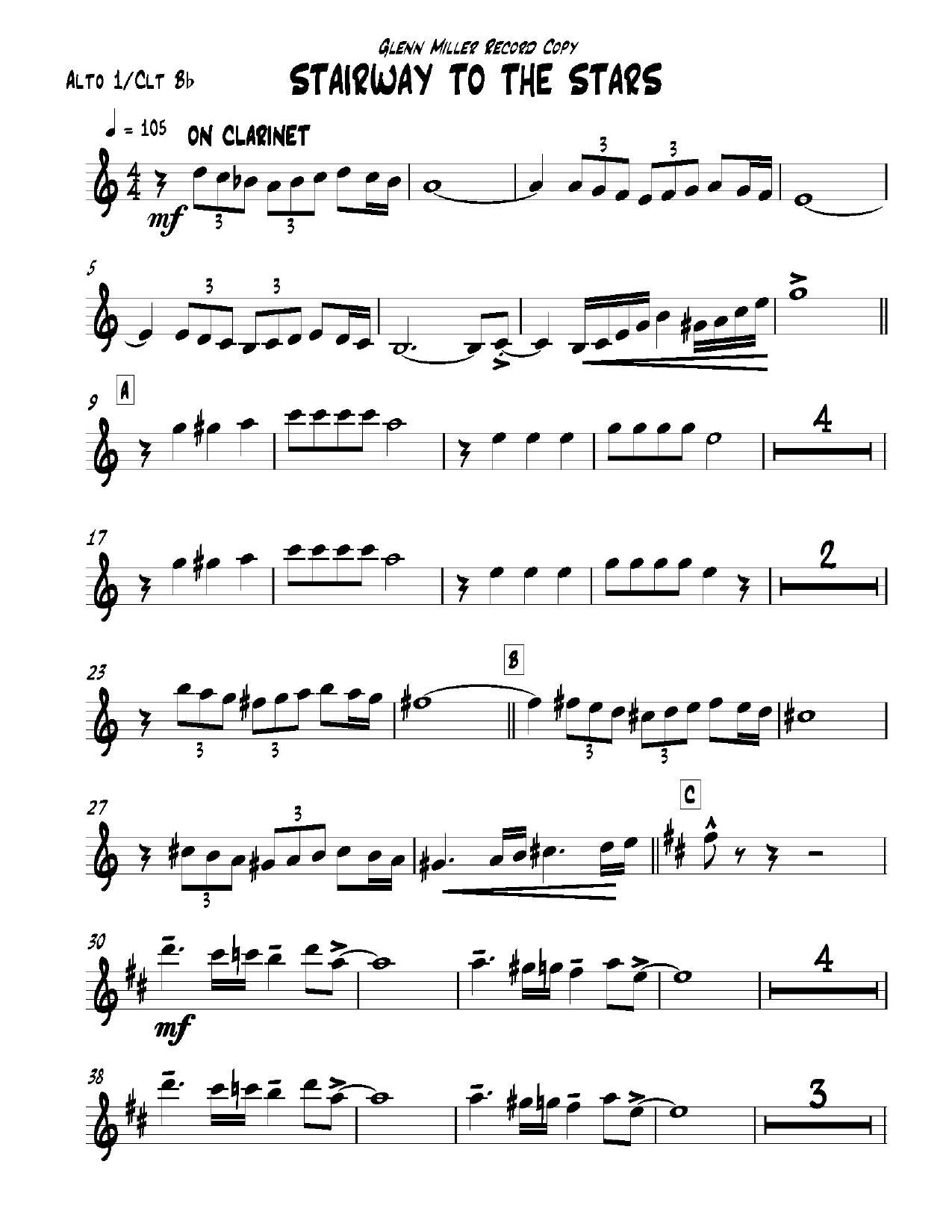
Stairway To The Stars G.Miller vocal. (G.Miller)
Composed by Glenn Miller
Arranged by Glen Miller
- Ensemble: Big Band
- Pages: 37
- Instruments (19): Alto 1/Clt Bb, Alto Sax 2, Tenor Sax 1, Tenor Sax 2, Baritone Saxophone, Trumpet 1, Trumpet 2, Trumpet 3, Trumpet 4, Trombone 1, Trombone 2, Trombone 3, Trombone 4, Piano, Electric Guitar, String Bass, Drums, Leadsheet, Vibraphone/Vocal
- Difficulty: medium
- Content: Individual Parts
- Format: PDF Download (Instant)
- Price: $24.99
"Stairway to the Stars," built upon the lush melodic framework of Matty Malneck and Frank Signorelli’s 1934 composition "Park Avenue Fantasy" with added lyrics by Mitchell Parish, stands as one of the defining romantic ballad touchstones of the late swing era. Immortalized most famously by Glenn Miller and His Orchestra in their classic 1939 Bluebird recording featuring vocalists Ray Eberle and Marion Hutton, the tune captures the dreamy, cinematic atmosphere that dominated the airwaves just prior to the outbreak of the Second World War. As a quintessential vocal feature of the swing era, the piece bridges the gap between sophisticated sweet band orchestration and subtle, warm jazz harmonization, relying on rich textures to evoke a sense of nocturnal elegance and sentimental yearning. The musical character of this arrangement unfolds as a lush, romantic slow ballad in 4/4 time, anchored by Glenn Miller’s signature voicing technique where the clarinet carries the lead an octave above a muted tenor saxophone, creating a velvety, distinct timbre. The harmonic language is steeped in sophisticated extended chords, rolling piano arpeggios, and warm brass pads that maintain a gentle, floating momentum. Rather than high-octane energy, the mood is contemplative, deeply nostalgic, and emotionally resonant, requiring the ensemble to sustain a continuous, breath-driven legato line even underneath the vocal delivery. Glen Miller’s approach to this arrangement emphasizes textural clarity and vocal support, utilizing tight reed voicings and subtle dynamic swells that never overpower the singer. The arrangement features the vocal soloist prominently at the forefront, seamlessly weaving the ensemble around the lyric line through delicate counter-melodies in the trumpet and trombone sections. The rhythm section, particularly the piano, maintains a sparse, tasteful harmonic foundation with rolling chordal accompaniment that mimics the original 1939 recording’s cinematic sheen. While there are no frantic up-tempo shout choruses, the technical demand lies entirely in intonation, balance, and the precise execution of delicate dynamic shifts. Ensembles ranging from advanced high school jazz bands to collegiate, community, and professional big bands will find this 37-page, 8-instrument chart a rewarding addition to their repertoire. It serves as an ideal vehicle for showcasing a talented guest vocalist or instrumental soloist while giving the horn sections a masterclass in ensemble blend, breath control, and classic swing-era ballad phrasing. Performing this arrangement offers modern bands a rare opportunity to authentically recreate the sophisticated, pastel-shaded ambiance of the golden age of American big bands. Achieving an authentic reading of this Glenn Miller arrangement requires meticulous attention to balance, intonation, and ultra-smooth phrasing. The primary technical challenge lies in sustaining a warm, connected sound at a slow ballad tempo without allowing the horns to drag or push the beat. Conductors should emphasize a gentle, pulsing swing feel where the underlying quarter notes remain fluid and supportive rather than rigid. The brass section must utilize subtle cup or straight mutes where indicated, blending their sound so that no single voice sticks out against the vocal line. Reeds need to focus on flawless intonation within Miller's tight, parallel-voiced chord structures, particularly when the clarinet is doubling the lead octave. During rehearsals, isolate the vocal accompaniment sections first, ensuring the band listens backward to the rhythm section's foundational pulse while maintaining extreme dynamic control underneath the soloist. Pay close attention to the breath marks and crescendo swells written into the dynamic architecture; these micro-dynamics are what transform a standard ballad reading into an authentic recreation of the 1939 Miller sound. Q: What instruments and parts are included in this arrangement? A: This 37-page arrangement is scored for an 8-instrument ensemble format, specifically featuring parts for Alto Saxophone, Tenor Saxophone, Trumpet, Trombone, Piano, and accompanying rhythm/vocal support elements tailored to the classic Glenn Miller sweet band instrumentation. Q: What is the difficulty level of this chart? A: This arrangement is well-suited for intermediate to advanced ensembles (high school varsity, collegiate, and professional groups) primarily due to its high demand for delicate intonation, breath control, and precise ballad balance rather than extreme technical facility. Q: What is the historical style and context of this piece? A: Written in the classic late-1930s swing ballad style, this arrangement mirrors the aesthetic popularized by Glenn Miller and His Orchestra, drawing upon the sophisticated romanticism of the pre-WWII big band era. Q: What makes this specific arrangement unique? A: It features Glenn Miller's signature voicing approach—notably the clarinet-led reed configuration over a muted tenor saxophone—providing the authentic pastel-shaded harmonic texture and vocal-backing style of the original 1939 Bluebird recording. Q: What is the performance tempo and duration? A: The piece is performed at a relaxed, romantic slow ballad tempo in 4/4 time, typically lasting around 3 to 4 minutes depending on the vocal pacing and rubato freedoms taken by the soloist.
Questions and answers
- What is included in the Stairway To The Stars G.Miller vocal. (G.Miller) PDF?
- The verified current file contains individual parts across 37 pages.
- How many instruments or parts are listed for Stairway To The Stars G.Miller vocal. (G.Miller)?
- The verified instrumentation list contains 19 entries for this Big Band arrangement.
- Who is credited for Stairway To The Stars G.Miller vocal. (G.Miller)?
- Composer: Glenn Miller. Arranger: Glen Miller.
- What difficulty is listed for Stairway To The Stars G.Miller vocal. (G.Miller)?
- The verified difficulty level is medium.
- Can I preview Stairway To The Stars G.Miller vocal. (G.Miller) before buying?
- Yes. The product page provides a preview generated from the current PDF file.
- How is Stairway To The Stars G.Miller vocal. (G.Miller) delivered?
- After successful payment, the digital PDF is made available for download. The displayed price is $24.99.
Musicians Also Search For
Stairway To The Stars G.Miller vocal. Glen Miller PDF • Stairway To The Stars G.Miller vocal. Glen Miller sheet music • Stairway To The Stars G.Miller vocal. arranged by Glen Miller • Glen Miller big band charts • Glen Miller jazz arrangements PDF • Stairway To The Stars G.Miller vocal. Glenn Miller sheet music • Stairway To The Stars G.Miller vocal. Glenn Miller big band arrangements • Glenn Miller big band charts • Stairway To The Stars G.Miller vocal. big band arrangements • Stairway To The Stars G.Miller vocal. big band PDF download • Stairway To The Stars G.Miller vocal. jazz sheet music • big band sheet music download • Stairway To The Stars G.Miller vocal. individual parts download • Stairway To The Stars G.Miller vocal. sheet music PDF • buy Stairway To The Stars G.Miller vocal. sheet music • download Stairway To The Stars G.Miller vocal. PDF • Stairway To The Stars G.Miller vocal. jazz charts • best Glen Miller big band arrangements • Glenn Miller arranged by Glen Miller • Stairway To The Stars G.Miller vocal. printable sheet music • big band repertoire PDF