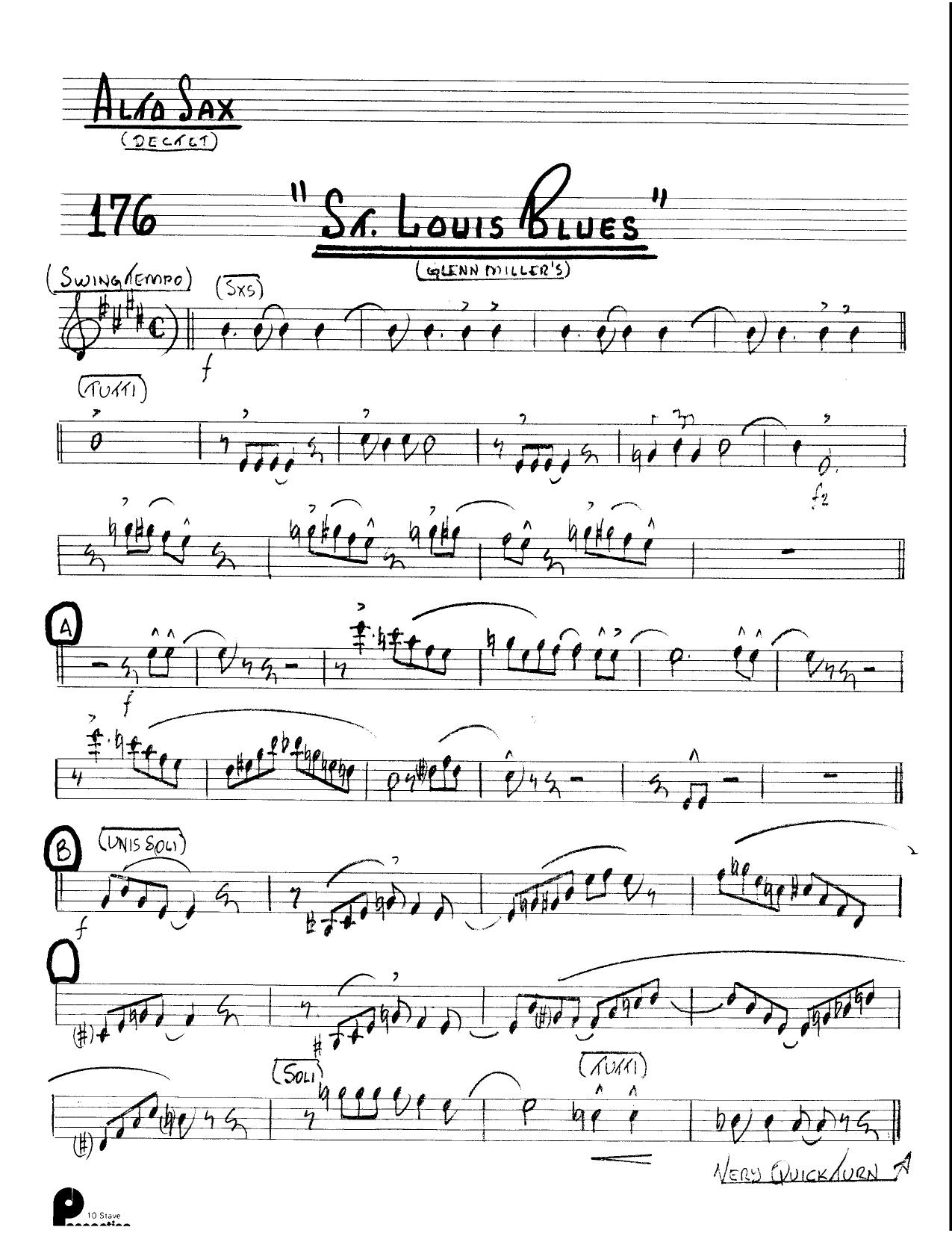
St. Louis Blues - 6 horns + Rhythm - Stan Kenton Dectet (G.Miller)
Composed by Glenn Miller
Arranged by Glenn Miller
- Ensemble: Small Ensemble
- Style: Blues
- Pages: 43
- Instruments (9): Alto Sax, Tenor Sax, Baritone Sax, Trumpet 1, Trumpet 2, Trombone, Piano, Bass, Drums
- Difficulty: easy
- Content: Individual Parts
- Format: PDF Download (Instant)
- Price: $12.99
W.C. Handy's "St. Louis Blues," published in September 1914, stands as one of the most enduring and influential compositions in American music, often hailed as "the jazzman's Hamlet" for its iconic status and widespread adoption across genres. While Handy aimed to blend ragtime syncopation with spiritual melodies, the piece quickly became a cornerstone of the burgeoning jazz and blues repertoire. It gained immense popularity through early recordings by artists like Prince's Orchestra in 1916 and, most famously, Bessie Smith with Louis Armstrong on cornet in 1925, solidifying its place as a jazz standard. The song's unique structure, moving beyond the simple 12-bar blues to incorporate a 16-bar bridge with a tango-like habanera rhythm, offered a sophistication that appealed to both dancers and musicians, contributing to its lasting appeal. Its lyrics, often depicting themes of lost love and hardship, resonate with the core emotional landscape of the blues. This particular arrangement presents "St. Louis Blues" in a medium swing tempo, maintaining the original's melancholic yet resilient mood while infusing it with a vibrant, driving energy characteristic of the swing era. The primary key is G minor, which allows for rich blues inflections and expressive harmonic movement. The arrangement evokes a classic big band sound, scaled down for a small ensemble, creating an intimate yet powerful musical experience. The energy is consistently engaging, building through ensemble figures and solo features, culminating in a spirited and satisfying conclusion. Glenn Miller's distinctive arranging style is evident throughout this treatment, even when adapted for a Stan Kenton Dectet instrumentation. Miller was a perfectionist known for his meticulous voicings and ability to create a "smooth and rich sound" that defined his orchestra. Here, his signature approach to blending woodwinds and brass is adapted for the 6-horn lineup, likely featuring a clarinet-led saxophone section or carefully balanced brass voicings that create a full sound despite the smaller forces. Expect tightly woven soli sections that showcase the ensemble's precision and a powerful shout chorus that builds excitement, reflecting Miller's mastery of orchestral dynamics. His arrangements often featured clear melodies and smooth rhythms, which are beautifully applied to Handy's timeless blues. The arrangement typically features the melody carried initially by the lead alto saxophone or trumpet, often with harmonized lines from the other horns. There are ample opportunities for featured solos, providing improvisational space for trumpet, trombone, and saxophone. Technical challenges include maintaining precise articulation and blend within the close voicings, navigating rhythmic intricacies inherent in the swing feel, and executing dynamic contrasts effectively. The rewarding aspect of performing this chart lies in its authentic swing feel, the interplay between the horn sections, and the chance to bring a fresh, yet classic, interpretation to a beloved standard. Specific musical moments that stand out include the call-and-response figures between the brass and saxophones, and the dynamic build-up into the final chorus. This arrangement is ideally suited for advanced high school, college, community, and semi-professional jazz ensembles. Its demands for precise ensemble playing, stylistic authenticity, and improvisational skill make it an excellent vehicle for developing musicianship, while its inherent musicality ensures a rewarding performance for more experienced groups. The small ensemble format also offers flexibility for groups that may not have a full big band roster but still desire a rich, arranged sound. To achieve the authentic swing feel, conductors should emphasize a relaxed, yet forward-moving medium swing groove, avoiding a rigid straight eighth-note interpretation. The rhythm section is crucial in establishing this feel, with the drummer focusing on a consistent ride cymbal pattern and the bass providing a strong, walking foundation. Horn players must pay close attention to articulation, aiming for a light, detached swing eighth-note feel on melodic lines and sharp, unified attacks on ensemble figures. Sections with plunger mutes, falls, or doits should be rehearsed carefully to ensure stylistic accuracy and expressive timing. Rehearsal tips include isolating soli sections to perfect intonation and balance, and working on dynamic shaping across phrases to build tension and release. Encourage soloists to draw inspiration from classic blues and swing improvisers to maintain stylistic integrity. **Q: What instruments are included in this arrangement?** A: This arrangement is scored for a 6-horn small ensemble plus rhythm section. The specific horn instrumentation typically includes two alto saxophones, two tenor saxophones, one baritone saxophone, two trumpets, one trombone, and a standard rhythm section (piano, bass, drums). **Q: What is the difficulty level of this arrangement?** A: This arrangement is considered intermediate to advanced. It requires solid instrumental technique, a good understanding of jazz articulation and swing rhythm, and experience with ensemble playing and improvisation. **Q: What is the musical style and historical context of "St. Louis Blues"?** A: "St. Louis Blues" is a foundational blues and early jazz standard composed by W.C. Handy in 1914. It blends traditional 12-bar blues forms with a unique 16-bar tango-inspired bridge, representing a pivotal moment in the development of American popular music. **Q: What makes this specific arrangement unique?** A: This arrangement by Glenn Miller uniquely adapts the iconic "St. Louis Blues" for a Stan Kenton Dectet (6 horns + rhythm) format. It showcases Miller's signature meticulous voicings and smooth ensemble sound within a smaller, agile setting, offering a fresh perspective on a classic while retaining its authentic swing-era character. **Q: What is the approximate performance duration and tempo of this arrangement?** A: The performance duration typically ranges from 3 to 4 minutes, depending on the number and length of improvised solos. It is designed to be performed at a medium swing tempo, allowing for a comfortable yet energetic groove.
Questions and answers
- What is included in the St. Louis Blues - 6 horns + Rhythm - Stan Kenton Dectet (G.Miller) PDF?
- The verified current file contains individual parts across 43 pages.
- How many instruments or parts are listed for St. Louis Blues - 6 horns + Rhythm - Stan Kenton Dectet (G.Miller)?
- The verified instrumentation list contains 9 entries for this Small Ensemble arrangement.
- Who is credited for St. Louis Blues - 6 horns + Rhythm - Stan Kenton Dectet (G.Miller)?
- Composer: Glenn Miller. Arranger: Glenn Miller.
- What difficulty is listed for St. Louis Blues - 6 horns + Rhythm - Stan Kenton Dectet (G.Miller)?
- The verified difficulty level is easy.
- What style is listed for St. Louis Blues - 6 horns + Rhythm - Stan Kenton Dectet (G.Miller)?
- The catalog lists the style as Blues.
- Can I preview St. Louis Blues - 6 horns + Rhythm - Stan Kenton Dectet (G.Miller) before buying?
- Yes. The product page provides a preview generated from the current PDF file.
- How is St. Louis Blues - 6 horns + Rhythm - Stan Kenton Dectet (G.Miller) delivered?
- After successful payment, the digital PDF is made available for download. The displayed price is $12.99.
Musicians Also Search For
St. Louis Blues - 6 horns + Rhythm - Stan Kenton Dectet Glenn Miller PDF • St. Louis Blues - 6 horns + Rhythm - Stan Kenton Dectet Glenn Miller sheet music • St. Louis Blues - 6 horns + Rhythm - Stan Kenton Dectet arranged by Glenn Miller • Glenn Miller small ensemble charts • Glenn Miller jazz arrangements PDF • St. Louis Blues - 6 horns + Rhythm - Stan Kenton Dectet Glenn Miller small ensemble arrangements • St. Louis Blues - 6 horns + Rhythm - Stan Kenton Dectet small ensemble arrangements • St. Louis Blues - 6 horns + Rhythm - Stan Kenton Dectet small ensemble PDF download • St. Louis Blues - 6 horns + Rhythm - Stan Kenton Dectet jazz sheet music • small ensemble sheet music download • St. Louis Blues - 6 horns + Rhythm - Stan Kenton Dectet individual parts download • St. Louis Blues - 6 horns + Rhythm - Stan Kenton Dectet sheet music PDF • St. Louis Blues - 6 horns + Rhythm - Stan Kenton Dectet Blues charts • Blues small ensemble arrangements • buy St. Louis Blues - 6 horns + Rhythm - Stan Kenton Dectet sheet music • download St. Louis Blues - 6 horns + Rhythm - Stan Kenton Dectet PDF • St. Louis Blues - 6 horns + Rhythm - Stan Kenton Dectet jazz charts • best Glenn Miller small ensemble arrangements • St. Louis Blues - 6 horns + Rhythm - Stan Kenton Dectet printable sheet music • small ensemble repertoire PDF