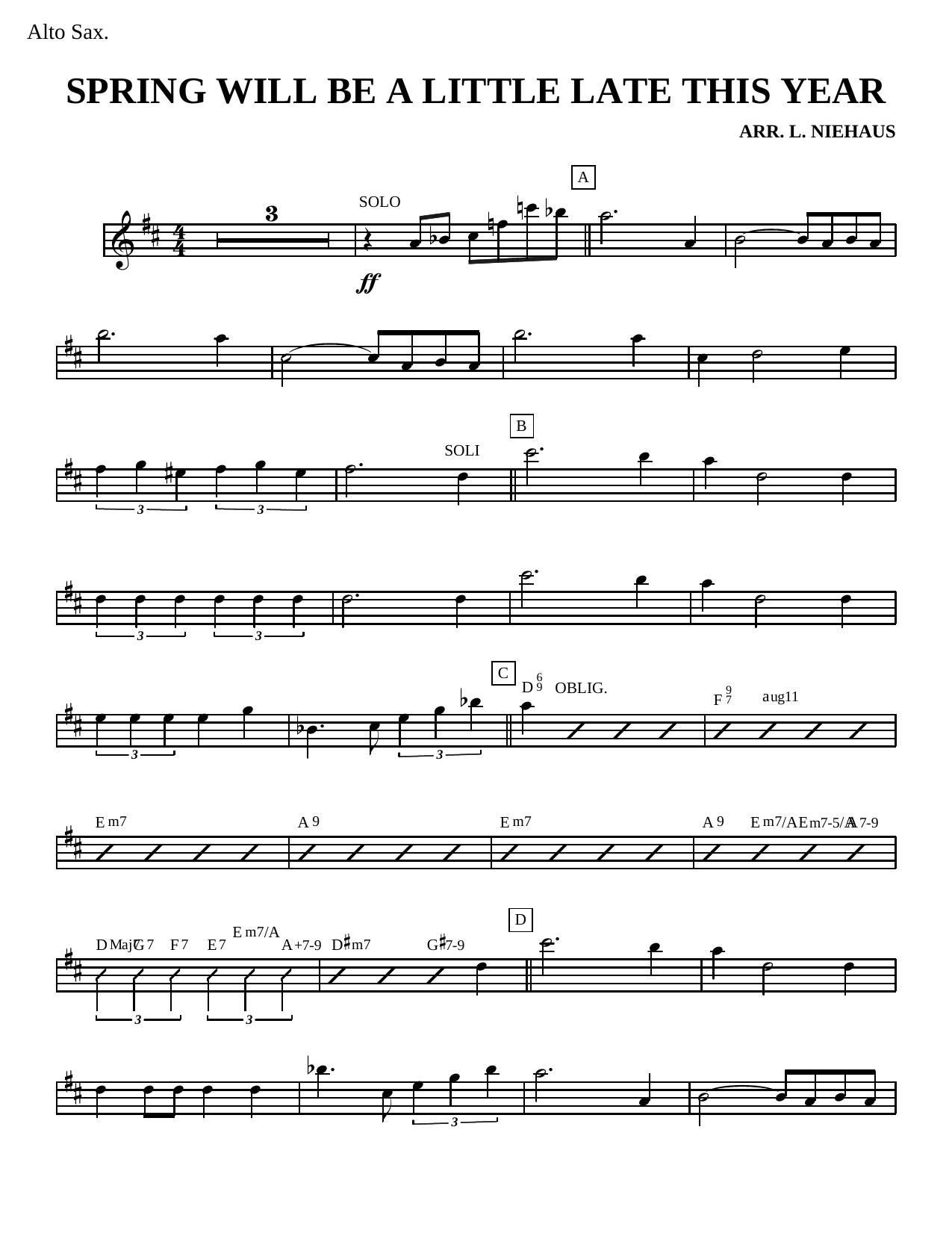
Spring Will Be A Little Late This Year (L.Niehaus)
Composed by Frank Loesser
Arranged by Lennie Niehaus
- Ensemble: Big Band
- Pages: 44
- Instruments (18): Alto Saxophone, Tenor Saxophone 1, Tenor Saxophone 2, Baritone Saxophone 1, Baritone Saxophone 2, Trumpet in Bb 1, Trumpet in Bb 2, Trumpet in Bb 3, Trumpet in Bb 4, Trumpet in Bb 5, Trombone 1, Trombone 2, Trombone 3, Trombone 4, Trombone 5, Piano, Bass, Drum Set
- Difficulty: medium
- Content: Individual Parts
- Format: PDF Download (Instant)
- Price: $24.99
Frank Loesser originally penned "Spring Will Be A Little Late This Year" for the 1944 musical film *Christmas Holiday*, where it was memorably introduced by Deanna Durbin. Over the decades, this poignant, bittersweet composition transitioned seamlessly from Hollywood cinema into the core jazz canon, embraced by instrumentalists and vocalists alike for its sophisticated harmonic structure and melancholic lyricism. The song captures a deeply reflective mood, turning a seasonal shift into an emotional metaphor for delayed heartbreak and cautious hope, making it a timeless vehicle for expressive jazz interpretation. Lennie Niehaus—an alto saxophonist, prolific West Coast jazz pioneer, and master arranger renowned for his work with the Stan Kenton Orchestra—approaches this standard with a refined, West Coast cool sensibility. Scored for a standard 18-piece big band configuration featuring expanded saxophone duties, the arrangement balances rich, linear counterpoint with lush, harmonically advanced block voicings. Niehaus steers clear of aggressive, high-octane shout choruses, opting instead for an introspective, texturally nuanced landscape. The arrangement unfolds at a relaxed, contemplative medium-slow ballad or lazy swing tempo, allowing the rich chord extensions and subtle dynamic shifts to breathe. The emotional core of the piece relies heavily on the saxophone section, which carries much of the thematic weight through delicate solis and interlocking counter-melodies. The brass section is utilized with great restraint and sophisticated coloring, employing warm mutes and soft pads that support rather than overwhelm the woodwinds. Solos are strategically placed to maintain the narrative arc, providing a designated soloist ample room to stretch out over tasteful, modern harmonic changes without breaking the nocturnal, moody atmosphere. Technical challenges in this chart do not stem from breakneck velocity or extreme altissimo ranges, but rather from the demand for pristine intonation, exceptional breath control, and a unified ensemble concept of swing phrasing at a slower subdivision. Advanced high school ensembles, collegiate jazz orchestras, and professional repertory bands will find this arrangement an exceptional vehicle for developing stylistic maturity and dynamic control. Because it eschews sheer volume in favor of sophisticated voicings and emotional subtlety, it serves as an ideal masterclass in ensemble balance and lyrical phrasing. Performing this Niehaus chart rewards musicianship that prioritizes tone quality, architectural transparency, and deep stylistic cohesion over flash, offering audiences a refreshing contrast to the high-volume predictability of standard big band programming. Navigating this Lennie Niehaus arrangement successfully requires an acute focus on ensemble balance, lyrical phrasing, and intonation, particularly given the slower tempo framework. Conductor and band members must treat the work with the delicacy of a chamber ensemble while maintaining a steady, internal jazz pulse. * **Tempo & Feel:** Establish a relaxed, flowing medium-slow groove. Avoid dragging by keeping the eighth-note triplet feel alive even at slower subdivisions; the swing must remain horizontal and legato rather than vertical and punchy. * **Technical Challenges:** The primary hurdle lies in the sophisticated, close-interval harmonic voicings across the saxophones and muted brass. Horn players must practice section tuning rigorously to ensure the complex extensions lock into place without beating. * **Articulation & Dynamics:** Keep articulations soft and rounded. Accents should be warm rather than sharp. Muted brass parts must blend seamlessly into the woodwind texture without cutting through aggressively. * **Rehearsal Tips:** Isolate the saxophone section first to balance internal voicings before integrating the rhythm section and horns. Ensure the rhythm section maintains an ultra-transparent, feather-light accompaniment—especially the ride cymbal and hi-hat on beats two and four—to keep the ballad framework buoyant. Q: What instruments and parts are included in this big band arrangement? A: The chart is scored for a standard 18-piece big band lineup, featuring parts for Alto Saxophone, two Tenor Saxophones, two Baritone Saxophones, plus standard brass and rhythm sections, accompanied by a comprehensive 44-page conductor score. Q: What is the difficulty level of this arrangement? A: It is well-suited for advanced high school, collegiate, and professional big bands, presenting technical demands rooted in subtle dynamic control, precise intonation, and mature lyrical phrasing rather than extreme velocity. Q: What is the historical style and background of the piece? A: Originally composed by Frank Loesser for the 1944 film *Christmas Holiday*, this arrangement reframes the standard through Lennie Niehaus’s sophisticated West Coast cool jazz aesthetic, emphasizing rich harmonies and introspective moods. Q: What makes this specific arrangement by Lennie Niehaus unique? A: Niehaus avoids traditional high-energy shout choruses, instead utilizing lush, linear counterpoint, sophisticated chord extensions, and muted brass textures to create a deeply reflective and texturally nuanced interpretation. Q: What is the performance duration and tempo feel of the arrangement? A: It is designed to be performed at a relaxed, contemplative medium-slow swing or ballad tempo, offering an evocative narrative arc that typically spans around 4 to 5 minutes.
Questions and answers
- What is included in the Spring Will Be A Little Late This Year (L.Niehaus) PDF?
- The verified current file contains a conductor score and individual parts across 44 pages.
- How many instruments or parts are listed for Spring Will Be A Little Late This Year (L.Niehaus)?
- The verified instrumentation list contains 18 entries for this Big Band arrangement.
- Who is credited for Spring Will Be A Little Late This Year (L.Niehaus)?
- Composer: Frank Loesser. Arranger: Lennie Niehaus.
- What difficulty is listed for Spring Will Be A Little Late This Year (L.Niehaus)?
- The verified difficulty level is medium.
- Can I preview Spring Will Be A Little Late This Year (L.Niehaus) before buying?
- Yes. The product page provides a preview generated from the current PDF file.
- How is Spring Will Be A Little Late This Year (L.Niehaus) delivered?
- After successful payment, the digital PDF is made available for download. The displayed price is $24.99.
Musicians Also Search For
Spring Will Be A Little Late This Year Lennie Niehaus PDF • Spring Will Be A Little Late This Year Lennie Niehaus sheet music • Spring Will Be A Little Late This Year arranged by Lennie Niehaus • Lennie Niehaus big band charts • Lennie Niehaus jazz arrangements PDF • Spring Will Be A Little Late This Year Frank Loesser sheet music • Spring Will Be A Little Late This Year Frank Loesser big band arrangements • Frank Loesser big band charts • Spring Will Be A Little Late This Year big band arrangements • Spring Will Be A Little Late This Year big band PDF download • Spring Will Be A Little Late This Year jazz sheet music • big band sheet music download • Spring Will Be A Little Late This Year conductor score PDF • Spring Will Be A Little Late This Year individual parts download • Spring Will Be A Little Late This Year sheet music PDF • buy Spring Will Be A Little Late This Year sheet music • download Spring Will Be A Little Late This Year PDF • Spring Will Be A Little Late This Year jazz charts • best Lennie Niehaus big band arrangements • Frank Loesser arranged by Lennie Niehaus • Spring Will Be A Little Late This Year printable sheet music • big band repertoire PDF