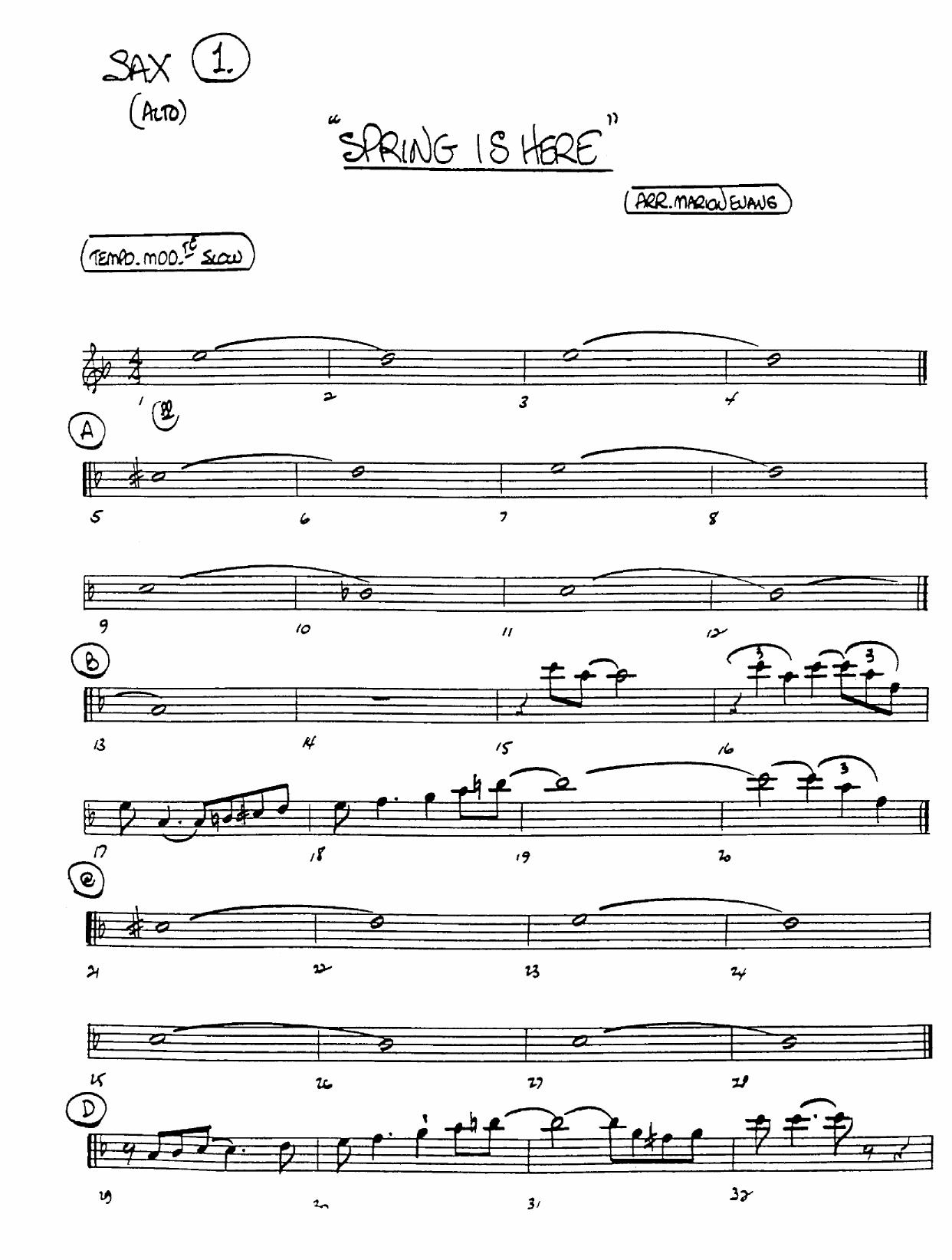
Spring Is Here (M.Evans)
Composed by Richard Rodgers
Arranged by Marion Evans
- Ensemble: Big Band
- Pages: 33
- Instruments (15): Alto Saxophone 1, Alto Saxophone 2, Tenor Saxophone 1, Tenor Saxophone 2, Baritone Saxophone, Trumpet 1, Trumpet 2, Trumpet 3, Trumpet 4, Trombone 1, Trombone 2, Trombone 3, Trombone 4, Master Rhythm, Drums
- Difficulty: medium
- Content: Individual Parts
- Format: PDF Download (Instant)
- Price: $24.99
Richard Rodgers and Lorenz Hart originally penned "Spring Is Here" for their 1938 Broadway musical *I Married an Angel*, but the tune quickly transcended its theatrical origins to become a cornerstone of the Great American Songbook. Immortalized by definitive jazz interpretations from artists like Billie Holiday, Chet Baker, and John Coltrane, the composition relies on a poignant, descending harmonic progression that captures a bittersweet, melancholic yearning. Rather than celebrating the season with unbridled joy, the song treats spring as a reminder of loneliness, giving jazz artists a rich canvas for deep emotional expression and sophisticated reharmonization. Legendary arranger Marion Evans takes this introspective standard and reimagines it as a lush, atmospheric ballad driven by a delicate, sustained swing pulse. Evans, celebrated for his exquisite vocal and instrumental writing for icons like Dinah Washington and Count Basie, brings a cinematic sensibility to the big band format. The arrangement unfolds like a late-night confession, moving through shifting tonal centers and utilizing rich, extended chord voicings that maximize the expressive capabilities of the brass and reed sections. The mood is deeply evocative, alternating between fragile, exposed woodwind textures and sweeping, cinematic climaxes that swell with restrained passion. The melodic weight is distributed artfully across the ensemble, opening with a haunting saxophone soli that establishes the tune's reflective atmosphere before the muted brass step forward to converse with the woodwinds. Evans builds tension masterfully through subtle harmonic colorations and counter-melodies in the trombone section, leading toward a dramatic, dynamic peak that tests the band's control over rubato pacing and dynamic shading. A featured improvised solo—ideally suited for a sensitive tenor saxophone or flugelhorn player—sits at the heart of the chart, supported by a warm, rolling chordal background from the rhythm section. Technical demands lie less in high-velocity execution and more in intonation, breath control, blend, and the ability to sustain intense emotional focus across slow, deliberate tempos. Advanced high school ensembles, collegiate jazz orchestras, and professional big bands will find this 15-instrument arrangement an exceptional vehicle for developing ensemble maturity and ballad-playing sensitivity. Because it rewards meticulous attention to balance, phrasing, and rubato transitions, it serves as a powerful centerpiece for a formal concert program, offering audiences a masterclass in modern big band arranging traditions. Conductors should approach "Spring Is Here" with an emphasis on seamless transitions between strict time and expressive, rubato-influenced phrasing. The primary technical challenge rests in maintaining pristine intonation across dense, extended cluster voicings, particularly in the muted brass and close-harmony saxophones. Establish a relaxed, breath-driven ballad feel where the eighth-note subdivisions remain internal rather than mechanically articulated. Rehearsal should begin by isolating the chordal balance within the saxophone section to ensure the rich voicings speak evenly before introducing the brass. Advise the rhythm section to treat accompaniment figures as a continuous, shimmering cushion of sound; the piano and guitar should avoid heavy comping, favoring sparse, atmospheric voicings that leave space for the horns. Pay close attention to dynamic extremes, ensuring that the ensemble's climactic peaks sound full and resonant rather than forced or shrill. Q: What instruments and parts are included in this big band arrangement? A: The arrangement is scored for a 15-instrument ensemble, featuring the standard big band instrumentation including Alto Saxophone 1, Alto Saxophone 2, Tenor Saxophone 1, Tenor Saxophone 2, Baritone Saxophone, and associated brass and rhythm sections across 33 comprehensive pages. Q: What is the difficulty level of Marion Evans's arrangement of "Spring Is Here"? A: This arrangement is tailored for advanced high school, collegiate, and professional big bands, demanding high-level ensemble listening, precise intonation, and sophisticated control over slow-tempo ballad dynamics rather than fast technical dexterity. Q: What is the musical style and historical background of this piece? A: Originating as a 1938 Broadway tune by Richard Rodgers and Lorenz Hart, this arrangement frames the composition as a sophisticated jazz ballad, drawing on the rich harmonic and expressive traditions associated with Marion Evans's iconic big band writing. Q: What makes this specific Marion Evans arrangement unique? A: Evans transforms a classic vocal standard into an instrumental tone poem, utilizing lush, extended chord voicings, a captivating saxophone soli, and cinematic dynamic swells that elevate the melancholic character of the original melody. Q: What is the performance duration and tempo framework for this arrangement? A: Designed as a feature ballad, the piece is performed at a slow, expressive tempo with flexible rubato sections, typically running between 4 and 5 minutes depending on the length of the featured improvised solo and the conductor's pacing.
Questions and answers
- What is included in the Spring Is Here (M.Evans) PDF?
- The verified current file contains individual parts across 33 pages.
- How many instruments or parts are listed for Spring Is Here (M.Evans)?
- The verified instrumentation list contains 15 entries for this Big Band arrangement.
- Who is credited for Spring Is Here (M.Evans)?
- Composer: Richard Rodgers. Arranger: Marion Evans.
- What difficulty is listed for Spring Is Here (M.Evans)?
- The verified difficulty level is medium.
- Can I preview Spring Is Here (M.Evans) before buying?
- Yes. The product page provides a preview generated from the current PDF file.
- How is Spring Is Here (M.Evans) delivered?
- After successful payment, the digital PDF is made available for download. The displayed price is $24.99.
Musicians Also Search For
Spring Is Here Marion Evans PDF • Spring Is Here Marion Evans sheet music • Spring Is Here arranged by Marion Evans • Marion Evans big band charts • Marion Evans jazz arrangements PDF • Spring Is Here Richard Rodgers sheet music • Spring Is Here Richard Rodgers big band arrangements • Richard Rodgers big band charts • Spring Is Here big band arrangements • Spring Is Here big band PDF download • Spring Is Here jazz sheet music • big band sheet music download • Spring Is Here individual parts download • Spring Is Here sheet music PDF • buy Spring Is Here sheet music • download Spring Is Here PDF • Spring Is Here jazz charts • best Marion Evans big band arrangements • Richard Rodgers arranged by Marion Evans • Spring Is Here printable sheet music • big band repertoire PDF