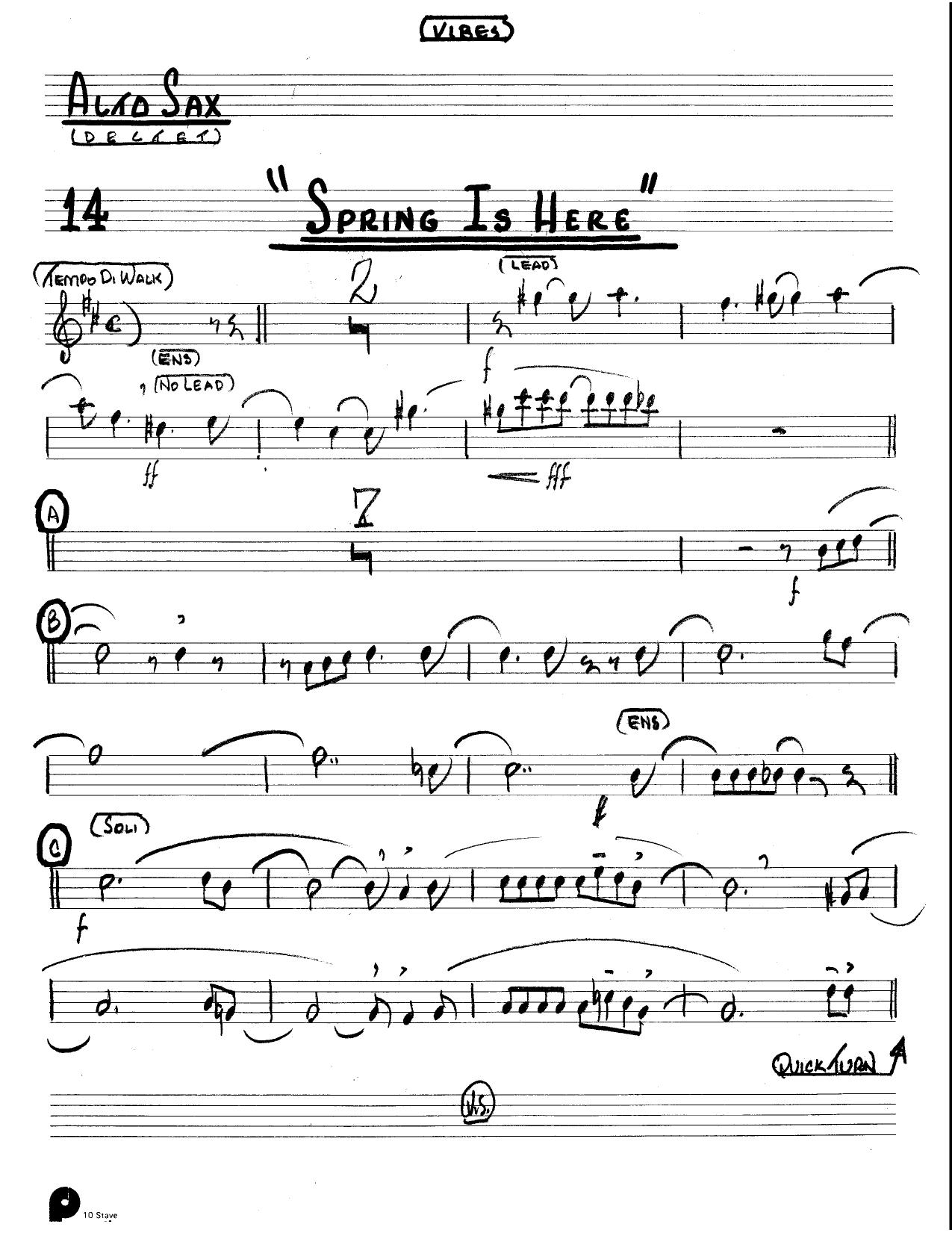
Spring Is Here (Kenton Dectet #14)
Composed by Richard Rodgers
Arranged by Kenton Dectet #14
- Ensemble: Small Ensemble
- Style: Jazz Standard
- Pages: 30
- Instruments (10): Alto Sax, Tenor Sax, Baritone Sax, Trumpet 1, Trumpet 2, Trombone, Piano, Bass, Drums, Vibes
- Difficulty: easy
- Content: Individual Parts
- Format: PDF Download (Instant)
- Price: $12.99
Richard Rodgers' timeless ballad, "Spring Is Here," first graced the American songbook in 1938 as part of the musical *I Married an Angel*. While initially a stage tune, its melancholic beauty and sophisticated harmonic structure quickly resonated with jazz musicians, solidifying its status as a beloved standard. The piece rose to prominence through iconic interpretations by vocalists like Frank Sinatra and instrumentalists such as Miles Davis, whose 1958 recording on *Milestones* is particularly revered for its introspective and lyrical approach. "Spring Is Here" embodies the golden age of American songwriting, characterized by rich melodies and poignant lyrics, offering a canvas for jazz artists to explore emotional depth and harmonic invention. Its enduring appeal lies in its ability to evoke both the tender promise of a new season and the bittersweet ache of unfulfilled love, making it a staple in the jazz repertoire for improvisational exploration and heartfelt expression. This distinctive arrangement by Kenton Dectet #14 reinterprets "Spring Is Here" as a medium-slow swing ballad in the key of F major, imbued with a sophisticated, yet accessible, harmonic palette. The mood is one of contemplative introspection, evolving into a gently swinging optimism. The arrangement opens with a lush, harmonically rich introduction featuring interwoven lines between the brass and saxophones, immediately establishing a warm, inviting soundscape. The melody is initially presented by the lead alto saxophone, supported by a carefully crafted blend of sustained chords and subtle counter-melodies from the other horns, creating a sense of intimate dialogue. As the piece progresses, the energy builds incrementally, culminating in a beautifully voiced soli section that showcases the Dectet's signature blend of precision and expressive warmth. Kenton Dectet #14's approach to this standard is marked by its intelligent use of voicings and dynamic contrasts. Expect rich, often dense, harmonic clusters that maintain clarity, a hallmark of the Dectet's style. The arrangement features a compelling solo section over the form, typically allocated to a tenor saxophone or trumpet, providing ample space for improvisation while maintaining the piece's overall character. A short, impactful shout chorus follows, building tension and release before returning to a more subdued, reflective mood for the final melodic statement. Technical challenges include precise ensemble blend and intonation within the close voicings, as well as maintaining a consistent, flowing medium-slow swing feel. The rewarding aspects lie in the opportunity to explore profound musicality, nuanced phrasing, and the sheer beauty of the Dectet's signature sound. This arrangement is ideally suited for college-level jazz ensembles, advanced community bands, or professional small groups seeking a sophisticated and emotionally resonant ballad. The intricate voicings and demands for blend and balance require experienced musicians comfortable with reading complex harmonies and executing subtle dynamic shifts. High school ensembles with exceptionally strong lead players and a dedicated rhythm section could also tackle this piece as a challenging yet highly rewarding project, fostering growth in ensemble precision and expressive interpretation. Its detailed scoring and thoughtful construction provide an excellent vehicle for developing advanced ensemble skills and musical maturity. Conductors should emphasize a consistent, relaxed medium-slow swing feel at approximately quarter note = 88-92 BPM, ensuring the rhythm section provides a solid, yet supple, foundation. The primary technical challenge lies in achieving precise intonation and balance within the Dectet's characteristic close voicings, particularly in the saxophone and brass soli sections. Encourage musicians to listen across sections and blend their individual sounds into a cohesive whole, focusing on the top voice of each chord. Dynamics are crucial; the arrangement calls for a wide dynamic range, from delicate pianissimo passages to full-bodied forte statements, all executed with control and warmth. Rehearsal time should be dedicated to shaping phrases, especially in the melodic lines, allowing for expressive rubato within the established tempo. Pay close attention to the articulation markings, which are meticulously notated to guide the desired Kenton-esque sound. Q: What instruments are included in this arrangement? A: This arrangement for Kenton Dectet #14 typically includes alto saxophone, tenor saxophone, baritone saxophone, 2 trumpets, 2 trombones, piano, bass, and drums. Specific instrumentation may vary slightly but adheres to the Dectet format. Q: What is the difficulty level of "Spring Is Here (Kenton Dectet #14)"? A: This arrangement is rated as Advanced (Grade 5), making it suitable for college-level jazz ensembles, advanced community bands, or professional small groups due to its intricate voicings and demands for ensemble precision. Q: What musical style and historical context does this arrangement represent? A: This arrangement is a sophisticated jazz standard ballad, reinterpreted in the style of a mid-20th century jazz dectet, drawing on the harmonic richness and expressive qualities of the original Richard Rodgers composition from 1938. Q: What makes this specific arrangement unique compared to other versions of "Spring Is Here"? A: Kenton Dectet #14's treatment is distinguished by its lush, often dense, harmonic voicings, intelligent counter-melodies, and a carefully structured dynamic arc that builds from introspective quietude to a gently swinging, expressive peak. Q: What is the approximate performance duration and recommended tempo for this piece? A: The approximate performance duration is 4-5 minutes, depending on the solo length. The recommended tempo is a medium-slow swing at approximately quarter note = 88-92 BPM.
Questions and answers
- What is included in the Spring Is Here (Kenton Dectet #14) PDF?
- The verified current file contains individual parts across 30 pages.
- How many instruments or parts are listed for Spring Is Here (Kenton Dectet #14)?
- The verified instrumentation list contains 10 entries for this Small Ensemble arrangement.
- Who is credited for Spring Is Here (Kenton Dectet #14)?
- Composer: Richard Rodgers. Arranger: Kenton Dectet #14.
- What difficulty is listed for Spring Is Here (Kenton Dectet #14)?
- The verified difficulty level is easy.
- What style is listed for Spring Is Here (Kenton Dectet #14)?
- The catalog lists the style as Jazz Standard.
- Can I preview Spring Is Here (Kenton Dectet #14) before buying?
- Yes. The product page provides a preview generated from the current PDF file.
- How is Spring Is Here (Kenton Dectet #14) delivered?
- After successful payment, the digital PDF is made available for download. The displayed price is $12.99.
Musicians Also Search For
Spring Is Here Kenton Dectet #14 PDF • Spring Is Here Kenton Dectet #14 sheet music • Spring Is Here arranged by Kenton Dectet #14 • Kenton Dectet #14 small ensemble charts • Kenton Dectet #14 jazz arrangements PDF • Spring Is Here Richard Rodgers sheet music • Spring Is Here Richard Rodgers small ensemble arrangements • Richard Rodgers small ensemble charts • Spring Is Here small ensemble arrangements • Spring Is Here small ensemble PDF download • Spring Is Here jazz sheet music • small ensemble sheet music download • Spring Is Here individual parts download • Spring Is Here sheet music PDF • Spring Is Here Jazz Standard charts • Jazz Standard small ensemble arrangements • buy Spring Is Here sheet music • download Spring Is Here PDF • Spring Is Here jazz charts • best Kenton Dectet #14 small ensemble arrangements • Richard Rodgers arranged by Kenton Dectet #14 • Spring Is Here printable sheet music • small ensemble repertoire PDF