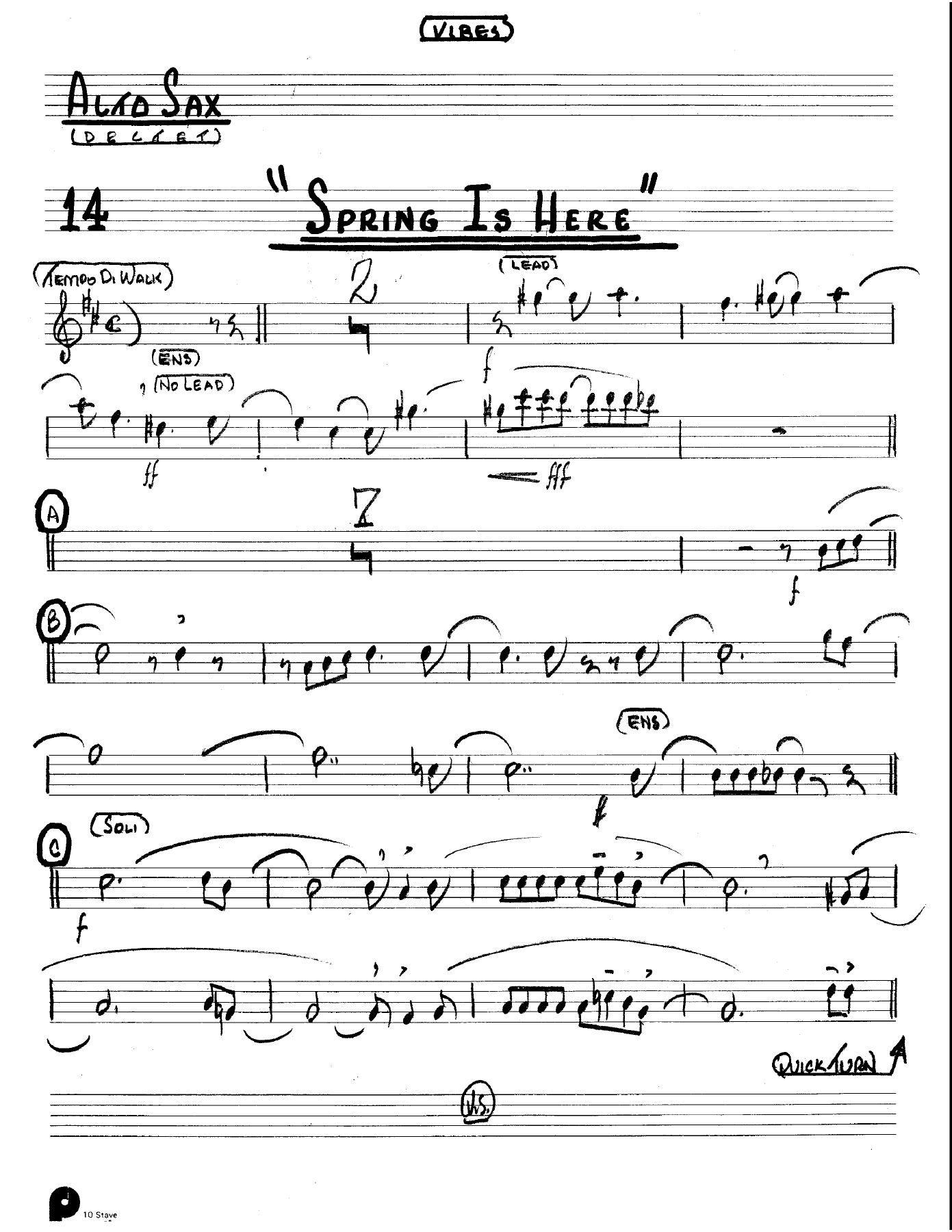
Spring Is Here (Kenton Dectet #14)
Composed by Richard Rodgers
Arranged by Stan Kenton Dected 176
- Ensemble: Small Ensemble
- Style: Jazz Standard
- Pages: 30
- Difficulty: easy
- Content: Sheet Music
- Format: PDF Download (Instant)
- Price: $12.99
Richard Rodgers and Lorenz Hart's timeless ballad, "Spring Is Here," first debuted in the 1938 Broadway musical *I Married an Angel*, quickly establishing itself as a poignant entry in the Great American Songbook. While the original stage production featured its debut, it was through the interpretations of jazz vocalists and instrumentalists that the tune truly blossomed into a beloved jazz standard. Its lyrical, melancholic melody and sophisticated harmonic progression, often characterized by its journey through various minor keys and unexpected modulations, perfectly capture the bittersweet essence of nascent love and the fleeting beauty of the season. The song's enduring appeal lies in its capacity for profound emotional expression, making it a favorite for improvisers and arrangers seeking a canvas for harmonic exploration and lyrical interpretation. This particular arrangement, "Spring Is Here (Kenton Dectet #14)," bears the unmistakable stamp of Stan Kenton's innovative approach to small ensemble jazz, specifically tailored for his Dectet. The musical character is a sophisticated, medium-slow ballad, primarily in the key of C minor, though it navigates through a rich tapestry of related keys and altered dominant chords. The mood is introspective and tender, evoking a sense of yearning and elegant melancholy rather than overt sadness. Kenton's signature harmonic language, characterized by dense, often dissonant voicings and a preference for lower brass and woodwind colors, imbues the piece with a lush, almost orchestral quality despite its compact instrumentation. The energy is subtle yet deeply expressive, building through carefully crafted countermelodies and harmonic suspensions. Stan Kenton Dectet 176's treatment of "Spring Is Here" is a masterclass in small ensemble arranging. The arrangement opens with a beautifully voiced introduction, establishing the contemplative mood before the melody is presented, often shared or fragmented between different voices to create a sense of dialogue. Expect rich, often close-voiced harmonies that are characteristic of Kenton's writing, frequently utilizing extensions like 9ths, 11ths, and 13ths, and altered chords to add color and tension. Soli sections are meticulously crafted, showcasing the ensemble's blend and precision. While a dedicated improvised solo section is present, often over a reharmonized form of the tune, the arrangement also features intricate counterpoint and obbligato lines that require individual musicianship. The technical challenges lie in achieving precise intonation within the dense voicings, navigating complex harmonic changes, and maintaining a consistent, expressive ballad feel. The reward is a deeply moving and harmonically rich performance that showcases the ensemble's maturity and musicality. This arrangement is ideally suited for college-level jazz ensembles, advanced community bands, or professional small groups seeking to explore sophisticated jazz repertoire. The demands on individual players, particularly in terms of harmonic understanding, blend, and expressive phrasing, make it less suitable for high school groups unless they possess exceptional talent and guidance. Its depth and nuance offer a rewarding challenge, allowing musicians to delve into the intricacies of Kenton's arranging style and the profound beauty of a true jazz standard. The detailed voicings and interplay between instruments provide an excellent opportunity for developing ensemble listening skills and achieving a refined, polished sound. Approaching "Spring Is Here (Kenton Dectet #14)" requires a focus on blend, balance, and harmonic awareness. The tempo should be a consistent medium-slow ballad, around quarter note = 60-66, emphasizing a smooth, legato feel rather than a strict metronomic pulse. Conductors should guide the ensemble to prioritize intonation within the often-dense, close-voiced harmonies, particularly in the brass and saxophone sections. Encourage players to listen across the ensemble, ensuring that no single voice dominates unless explicitly carrying the melody or a prominent counterline. Technical challenges include navigating the frequent harmonic shifts and altered chords with precision. Rehearsal should involve isolating these complex harmonic passages slowly, ensuring each player understands their role within the chord. Phrasing is paramount; encourage long, singing lines and expressive dynamics, utilizing subtle crescendos and diminuendos to shape the musical narrative. While no special techniques like plunger mutes or falls are explicitly notated, the overall Kenton aesthetic implies a sophisticated, controlled approach to articulation and tone. The improvised solo section should be approached with a deep understanding of the underlying harmonic progression, encouraging melodic and harmonic sophistication over technical flash. Q: What instruments are included in the "Spring Is Here (Kenton Dectet #14)" arrangement? A: This arrangement is scored for a small jazz ensemble, typically consisting of trumpet, trombone, French horn, tuba, alto saxophone, tenor saxophone, baritone saxophone, piano, bass, and drums, reflecting the classic Kenton Dectet instrumentation. Q: What is the difficulty level of this arrangement? A: This arrangement is considered advanced, suitable for college-level jazz ensembles, advanced community bands, or professional small groups due to its complex harmonies, intricate voicings, and demands on individual musicianship and blend. Q: What is the musical style and historical context of this piece? A: This is a sophisticated jazz ballad arrangement of the classic Richard Rodgers standard "Spring Is Here," originally from the 1938 Broadway musical *I Married an Angel*. It reflects the innovative, harmonically rich small ensemble style of Stan Kenton's Dectet era. Q: What makes this particular arrangement unique compared to other versions of "Spring Is Here"? A: This arrangement is distinctive for its Stan Kenton Dectet 176 scoring, featuring his signature dense, often dissonant voicings, sophisticated harmonic reinterpretation, and intricate counterpoint tailored for a specific ten-piece instrumentation, offering a unique blend of orchestral richness and small group intimacy. Q: What is the typical performance duration and tempo for this arrangement? A: The performance duration typically ranges from 4 to 6 minutes, depending on the length of the improvised solo sections. The tempo should be a consistent medium-slow ballad, around quarter note = 60-66, emphasizing a smooth, legato and expressive feel.
Musicians Also Search For
Spring Is Here Stan Kenton Dected 176 PDF • Spring Is Here Stan Kenton Dected 176 sheet music • Spring Is Here arranged by Stan Kenton Dected 176 • Stan Kenton Dected 176 small ensemble charts • Stan Kenton Dected 176 jazz arrangements PDF • Spring Is Here Richard Rodgers sheet music • Spring Is Here Richard Rodgers small ensemble arrangement • Richard Rodgers small ensemble charts • Spring Is Here small ensemble arrangement • Spring Is Here small ensemble PDF download • Spring Is Here jazz ensemble sheet music • small ensemble sheet music instant download • Spring Is Here sheet music with parts • Spring Is Here Jazz Standard chart • Jazz Standard small ensemble arrangements • buy Spring Is Here sheet music online • download Spring Is Here PDF • Spring Is Here jazz chart • best Stan Kenton Dected 176 small ensemble arrangements • Richard Rodgers songs arranged by Stan Kenton Dected 176 • Spring Is Here printable sheet music • small ensemble repertoire PDF