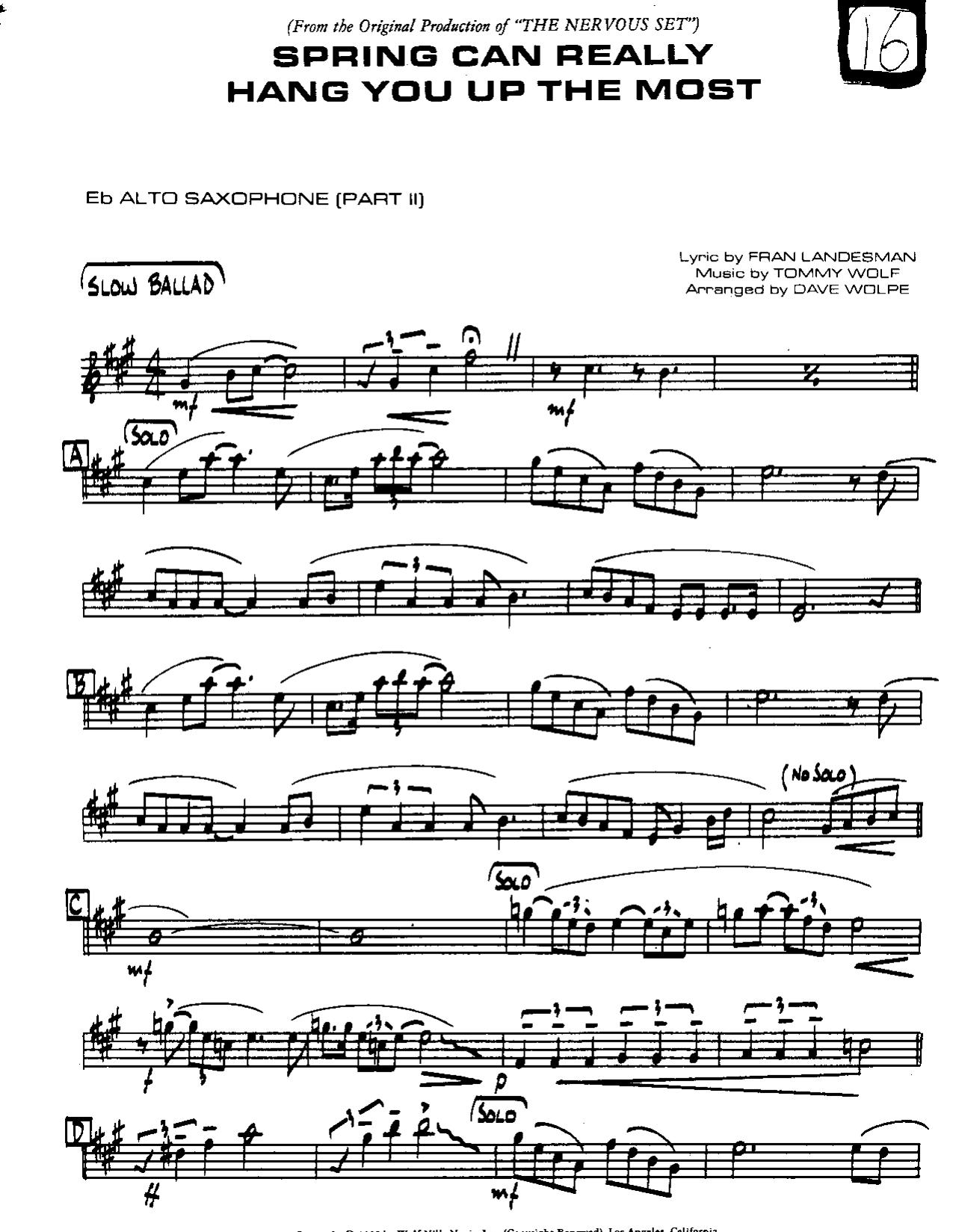
Spring can really Hang you (D.Wolpe)
Composed by TOMMY WOLF
Arranged by Dave Wolpe
- Ensemble: Small Ensemble
- Style: Jazz Standard
- Pages: 17
- Instruments (7): Eb Alto Saxophone (Part II), Bb Tenor Saxophone (Part III), Bb Trumpet (Part I), Trombone (Part IV), Piano, Bass, Guitar
- Difficulty: easy
- Content: Individual Parts
- Format: PDF Download (Instant)
- Price: $12.99
"Spring Can Really Hang You Up The Most," penned by composer Tommy Wolf and lyricist Fran Landesman, emerged in the late 1950s, a poignant reflection of post-bop jazz sensibilities and the burgeoning cool jazz movement. This melancholic yet sophisticated ballad quickly found its way into the repertoires of vocal giants like June Christy, who recorded it in 1955, and later Carmen McRae and Barbra Streisand, solidifying its status as a quintessential jazz standard. The song's enduring appeal lies in its evocative lyrics, which capture the bittersweet essence of spring's arrival juxtaposed with lingering heartbreak, and its harmonically rich structure, providing ample ground for improvisation and nuanced interpretation. It represents an era where jazz songwriting embraced lyrical depth and complex emotional landscapes, moving beyond pure instrumental virtuosity to explore narrative and sentiment. Dave Wolpe's arrangement of "Spring Can Really Hang You Up The Most" for small ensemble masterfully captures the introspective and slightly wistful mood of the original, typically rendered as a slow, expressive ballad. Wolpe's signature is evident in his sophisticated yet accessible harmonic language, often employing extended chords and subtle reharmonizations that add depth without obscuring the melody's inherent beauty. The arrangement likely features a primary key that allows for comfortable brass and woodwind voicings, maintaining a delicate balance between lushness and clarity. The overall energy is one of tender reflection, inviting listeners into a contemplative space, making it an ideal choice for a concert's more intimate moments or a sophisticated club setting. Wolpe's distinctive approach to this jazz standard emphasizes lyrical precision and ensemble blend. Expect meticulously crafted voicings that allow each instrument to contribute to a cohesive, warm sound, particularly in the brass and saxophone sections. While specific soli sections might be present to showcase the ensemble's dexterity, the focus remains on supporting the lead melody, which often rotates between instruments like tenor saxophone or trumpet, ensuring varied textures throughout. The arrangement will likely feature a featured solo section, providing an opportunity for a soloist to explore the song's rich harmonic changes, which are typically presented with clear chord symbols. Technical challenges might include maintaining a consistent, expressive slow tempo, achieving precise intonation in sustained chords, and navigating Wolpe's characteristic harmonic subtleties. The reward, however, is a deeply moving performance that resonates with both musicians and audience members. This arrangement is ideally suited for college-level jazz ensembles, advanced high school groups, or community bands with strong lead players and a solid understanding of jazz ballad interpretation. The demands on intonation, blend, and rhythmic precision at a slow tempo require mature musicianship. Ensembles will find it particularly rewarding for developing their expressive capabilities, collective phrasing, and ability to convey profound emotion through music. The arrangement offers a superb vehicle for showcasing a band's sensitivity and musicality, elevating it beyond a mere technical exercise to a truly artistic statement. Approaching "Spring Can Really Hang You Up The Most" requires a focus on expressive phrasing and meticulous intonation at a slow ballad tempo, typically around 50-60 BPM. The primary technical challenge lies in sustaining long tones with warmth and consistency, particularly in the brass and saxophone sections, ensuring chords bloom rather than sound static. Encourage musicians to listen across the ensemble for blend and balance, especially during the rich harmonic passages characteristic of Wolpe's writing. Dynamic control is paramount; subtle swells and decays will enhance the emotional arc. While no special techniques like plunger mutes are explicitly required, musicians should be prepared for nuanced articulations, including gentle falls and scoops that add to the jazz aesthetic. Rehearsal time should be dedicated to shaping melodic lines, perfecting chord voicings, and ensuring the rhythm section provides a supportive, unhurried foundation that allows the melody to breathe. Q: What instruments are typically included in this small ensemble arrangement? A: This arrangement is designed for a standard small jazz ensemble, commonly featuring a rhythm section (piano, bass, drums), and a horn section that might include trumpet, alto saxophone, tenor saxophone, and trombone. Q: What is the difficulty level of Dave Wolpe's "Spring Can Really Hang You Up The Most" arrangement? A: This arrangement is considered advanced intermediate to advanced, suitable for college-level ensembles, skilled high school bands, or experienced community jazz groups due to its demands on intonation, expressive playing, and harmonic understanding. Q: What musical style and historical context does this arrangement represent? A: This piece is a classic jazz standard from the late 1950s, embodying the cool jazz and post-bop ballad style, known for its melancholic yet sophisticated mood and rich harmonic structure. Q: What makes Dave Wolpe's arrangement of this standard unique? A: Wolpe's arrangement is distinguished by his sophisticated yet accessible harmonic voicings, lyrical emphasis, and meticulous attention to ensemble blend, creating a deeply expressive and musically rewarding experience. Q: What is the typical performance duration and tempo for this arrangement? A: As a slow ballad, the performance duration typically ranges from 4 to 6 minutes, depending on the number and length of solos, with a tempo generally set between 50-60 beats per minute.
Questions and answers
- What is included in the Spring can really Hang you (D.Wolpe) PDF?
- The verified current file contains individual parts across 17 pages.
- How many instruments or parts are listed for Spring can really Hang you (D.Wolpe)?
- The verified instrumentation list contains 7 entries for this Small Ensemble arrangement.
- Who is credited for Spring can really Hang you (D.Wolpe)?
- Composer: TOMMY WOLF. Arranger: Dave Wolpe.
- What difficulty is listed for Spring can really Hang you (D.Wolpe)?
- The verified difficulty level is easy.
- What style is listed for Spring can really Hang you (D.Wolpe)?
- The catalog lists the style as Jazz Standard.
- Can I preview Spring can really Hang you (D.Wolpe) before buying?
- Yes. The product page provides a preview generated from the current PDF file.
- How is Spring can really Hang you (D.Wolpe) delivered?
- After successful payment, the digital PDF is made available for download. The displayed price is $12.99.
Musicians Also Search For
Spring can really Hang you Dave Wolpe PDF • Spring can really Hang you Dave Wolpe sheet music • Spring can really Hang you arranged by Dave Wolpe • Dave Wolpe small ensemble charts • Dave Wolpe jazz arrangements PDF • Spring can really Hang you TOMMY WOLF sheet music • Spring can really Hang you TOMMY WOLF small ensemble arrangements • TOMMY WOLF small ensemble charts • Spring can really Hang you small ensemble arrangements • Spring can really Hang you small ensemble PDF download • Spring can really Hang you jazz sheet music • small ensemble sheet music download • Spring can really Hang you individual parts download • Spring can really Hang you sheet music PDF • Spring can really Hang you Jazz Standard charts • Jazz Standard small ensemble arrangements • buy Spring can really Hang you sheet music • download Spring can really Hang you PDF • Spring can really Hang you jazz charts • best Dave Wolpe small ensemble arrangements • TOMMY WOLF arranged by Dave Wolpe • Spring can really Hang you printable sheet music • small ensemble repertoire PDF