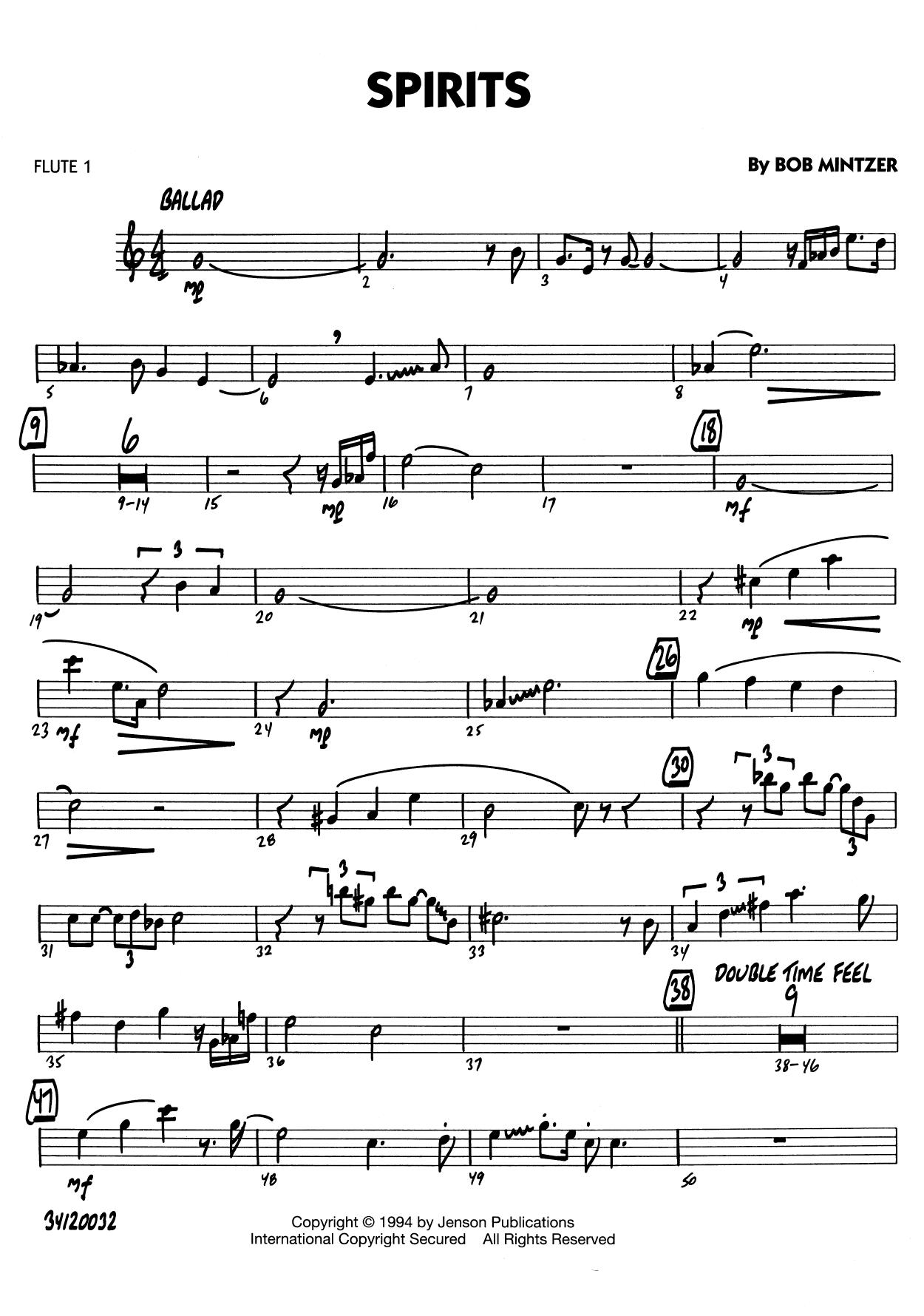
Spirits (B.Mintzer) sheet music preview

Spirits (B.Mintzer)

Composed by Bob Mintzer

Arranged by Bob Mintzer

  • Ensemble: Big Band
  • Pages: 42
  • Instruments (22): Flute 1, Flute 2, Flute 3, Flute 4, Flute 5, Alto Sax 1 (Fl. 1 Substitute), Alto Sax 2 (Fl. 2 Substitute), Tenor Sax 1 (Fl. 3 Substitute), Tenor Sax 2 (Fl. 4 Substitute), Baritone Sax (Fl. 5 Substitute), Trumpet 1, Trumpet 2, Trumpet 3, Trumpet 4, Trumpet 5, Trombone 1, Trombone 2, Trombone 3, Trombone 4, Piano, Bass, Drums
  • Difficulty: medium
  • Content: Individual Parts
  • Format: PDF Download (Instant)
  • Price: $24.99

Crafted during the height of the contemporary jazz-orchestral revival, "Spirits" stands as a premier example of Bob Mintzer’s signature compositional architecture. Originally recorded for the critically acclaimed album *Big Band Trane*—a landmark 1996 release paying homage to the lineage of John Coltrane—this composition bridges post-bop intensity with modern big band sophistication. Mintzer, renowned for his work with the Yellowjackets and the Thad Jones/Mel Lewis Orchestra, conceived the piece as an energetic, modern-leaning vehicle that honors modal jazz traditions while pushing ensemble interaction to contemporary boundaries. It captures a vibrant intersection of complex harmonic movement and driving rhythmic momentum, cementing its place as a staple of advanced contemporary large-ensemble repertoire. Driven by an infectious, propulsive swing groove, the piece unfolds in a bright, energetic tempo characterized by intricate modal harmonies and a relentlessly optimistic mood. The musical landscape shifts fluidly between dense, harmonically rich chord clusters and explosive, cascading linear writing that demands absolute rhythmic precision from every section. Texturally, Mintzer weaves the woodwinds deeply into the brass framework, utilizing an expanded palette that prominently features multiple flute parts. This creates an ethereal yet muscular sonic profile, contrasting soaring, breezy woodwind countermelodies with punchy, aggressive brass stabs that evoke an atmosphere of soaring elevation and unyielding drive. Mintzer’s arranging approach on this chart relies heavily on interlocking sectional writing, sophisticated chord extensions (utilizing sharp 11ths, altered dominants, and suspended voicings), and conversational counterpoint. Rather than treating the rhythm section and horns as separate entities, the chart integrates them into a unified organism where rhythm section figures dictate horn phrasing. The woodwinds—specifically the multi-part flute configuration—act as a shimmering veil over the heavy brass and saxes, building tension through continuous motion before resolving into massive, textbook Mintzer shout choruses that expand dynamically across the entire ensemble. The melodic burden is shared dynamically across the ensemble, moving swiftly from rich woodwind solis to dominant brass declarations. Solo sections provide ample space for featured improvisers—typically tenor saxophone and trumpet—to stretch out over sophisticated changes, supported by interlocking comping figures from the rhythm section. Technical challenges abound, particularly in the rapid articulation required for the woodwind lines, the high-register stamina demanded of the trumpet section, and the complex syncopations shared across the rhythm department. Nevertheless, the payoff is immense: the chart offers a masterclass in modern big band phrasing, making it deeply rewarding for players who relish intricate modern jazz styles. Advanced college ensembles, top-tier high school bands with exceptional lead players, community jazz orchestras, and professional groups will find this arrangement an exhilarating challenge. Because of its demanding woodwind doubling and intricate ensemble blend requirements, it serves as an ideal showcase for mature bands looking to stretch their technical boundaries and explore the sophisticated vocabulary of modern post-bop big band literature. Conductors should approach "Spirits" with a primary focus on time feel and rhythmic crispness. The tempo must remain steady and driving; avoid rushing the syncopated figures, especially during transitions between heavy brass blocks and delicate woodwind lines. Key technical hurdles involve the rapid scalar passages in the multi-part flute and saxophone sections. Rehearsal should begin slowly, utilizing a metronome on beats two and four to lock in the swing eighth-note feel. Ensure that articulation markings—staccatos, accents, and slurs—are strictly uniform across sections to achieve the signature Mintzer sheen. Brass players should balance projection with warmth, avoiding forced tones during high-register shout choruses. The rhythm section acts as the primary engine: the drummer should maintain a buoyant, interactive ride cymbal pattern while locking tightly with the bass player on crisp ensemble hits. Balance is critical when the flutes carry the primary thematic material over heavy ensemble backing. Q: What instruments and parts are included in this arrangement? A: This chart is scored for a 22-instrument big band, featuring a comprehensive woodwind section including four to five flute parts alongside standard saxes, four trumpets, trombones, and a full rhythm section. Q: What is the difficulty level of this arrangement? A: It is graded as advanced (Level 5), best suited for collegiate, professional, and elite high school jazz ensembles with strong lead players and proficient woodwind doublers. Q: What is the musical style and historical context of "Spirits"? A: "Spirits" is a contemporary post-bop jazz arrangement written by Bob Mintzer, originally recorded for his 1996 Coltrane-tribute project *Big Band Trane*, blending modal jazz traditions with modern orchestral swing. Q: What makes this particular Mintzer arrangement unique? A: Its distinctive use of a multi-flute configuration interwoven with traditional big band instrumentation creates an unusual hybrid texture that balances airy woodwind voicings with punchy, modern brass shout choruses. Q: What is the performance tempo and duration of the piece? A: The arrangement is set at a brisk, energetic swing tempo and runs approximately 5 to 6 minutes, offering a substantial featured vehicle for concert programs or festival performances.

Questions and answers

What is included in the Spirits (B.Mintzer) PDF?
The verified current file contains individual parts across 42 pages.
How many instruments or parts are listed for Spirits (B.Mintzer)?
The verified instrumentation list contains 22 entries for this Big Band arrangement.
Who is credited for Spirits (B.Mintzer)?
Composer: Bob Mintzer. Arranger: Bob Mintzer.
What difficulty is listed for Spirits (B.Mintzer)?
The verified difficulty level is medium.
Can I preview Spirits (B.Mintzer) before buying?
Yes. The product page provides a preview generated from the current PDF file.
How is Spirits (B.Mintzer) delivered?
After successful payment, the digital PDF is made available for download. The displayed price is $24.99.

Musicians Also Search For

Spirits Bob Mintzer PDFSpirits Bob Mintzer sheet musicSpirits arranged by Bob MintzerBob Mintzer big band chartsBob Mintzer jazz arrangements PDFSpirits Bob Mintzer big band arrangementsSpirits big band arrangementsSpirits big band PDF downloadSpirits jazz sheet musicbig band sheet music downloadSpirits individual parts downloadSpirits sheet music PDFbuy Spirits sheet musicdownload Spirits PDFSpirits jazz chartsbest Bob Mintzer big band arrangementsSpirits printable sheet musicbig band repertoire PDF

All arrangements by Bob Mintzer All Bob Mintzer sheet music