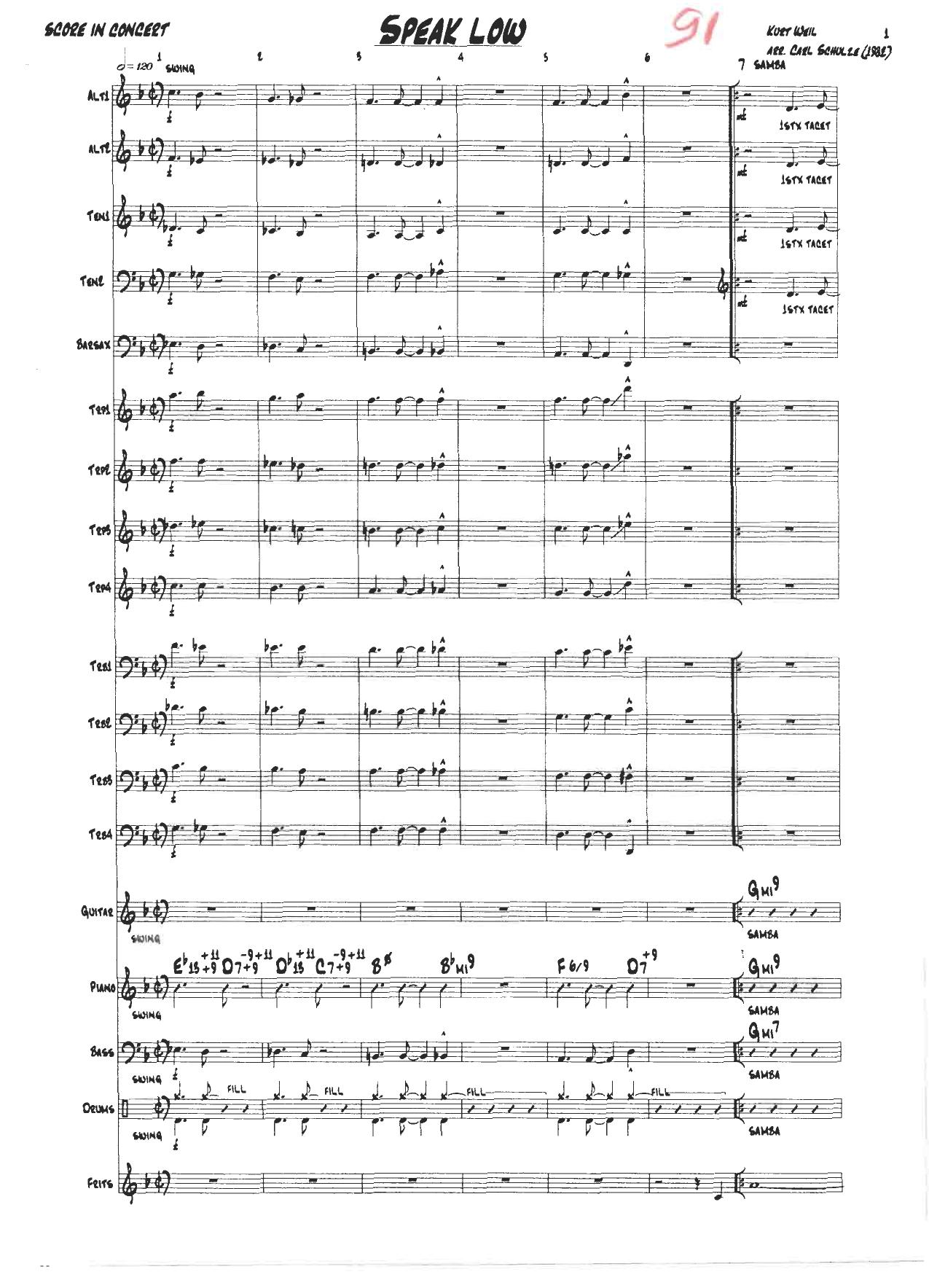
Speak Low (C.Schulze) sheet music preview

Speak Low (C.Schulze)

Composed by Kurt Weill

Arranged by C.Schulze

  • Ensemble: Big Band
  • Style: Jazz Standard
  • Pages: 96
  • Instruments (18): Alto Saxophone 1, Alto Saxophone 2, Tenor Saxophone 1, Tenor Saxophone 2, Baritone Saxophone, Trumpet 1, Trumpet 2, Trumpet 3, Trumpet 4, Trombone 1, Trombone 2, Trombone 3, Trombone 4, Guitar, Piano, Bass, Drums, Frits (Lead/Vocal)
  • Difficulty: advanced
  • Content: Individual Parts
  • Format: PDF Download (Instant)
  • Price: $24.99

Kurt Weill and Ogden Nash originally crafted "Speak Low" for the 1943 Broadway musical *One Touch of Venus*, but it swiftly transcended its theatrical origins to become a cornerstone of the modern jazz repertoire. Immortally recorded by jazz icons like Sarah Vaughan, Bill Evans, and Sonny Rollins, the composition balances a hauntingly modal European cabaret aesthetic with an inherent cyclical rhythm that begs for jazz interpretation. Its distinct AABA form and undulating harmonic shifts make it a quintessential vehicle for sophisticated ensemble arranging, allowing modern big bands to explore a rich spectrum of tension and release. C.Schulze’s masterful big band adaptation reimagines Weill’s timeless melody through a lens of contemporary modal jazz and driving swing. Built around a supple, forward-driving medium-up swing groove, the chart opens with an atmospheric, tension-building intro before settling into a cool, confident pocket. The mood shifts effortlessly between sultry, understated lyricism and explosive, brass-heavy outbursts. Schulze infuses the standard with extended harmonies, utilizing lush, contemporary voicings in the saxes and subtle chromatic counterpoint that elevate the sophistication without losing the infectious pulse that audiences expect from a classic standard. Throughout the 96-page complete conductor score and 17-instrument set, the arrangement distributes melodic interest brilliantly across the entire ensemble. The woodwinds take charge of the initial thematic statements with intricate, intertwined soli lines that demand immaculate blend and articulation. Trumpets and trombones act as dynamic colorists, providing warm cushion pads and sharp, punchy interjections. A designated open solo section invites featured improvisers—ideally on tenor saxophone or piano—to stretch out over standard changes before the chart builds inexorably toward a towering, harmonically adventurous shout chorus. This climactic section showcases the full power of the big band, featuring layered cross-rhythms and soaring brass peaks that resolve into a breathtaking, whisper-quiet coda. Advanced high school, collegiate, and professional jazz orchestras will find this chart an exceptionally rewarding centerpiece for festival performances or formal concerts. While the rhythm section must maintain an unwavering, sophisticated swing propulsion and the horn sections require polished section cohesion, the rewards lie in the sheer depth of Schulze's orchestration. It is a sophisticated, highly engaging arrangement that honors the dramatic roots of the composition while pushing the big band sound into fresh, harmonically vibrant territory. Success with C.Schulze's arrangement of "Speak Low" hinges on precise dynamic control and stylistic contrast between the sultry modal sections and the swinging ensemble passages. The ideal tempo sits at a comfortable medium-up swing (approx. quarter note = 160 BPM), ensuring the eighth-note lines feel linear and relaxed rather than rushed. The rhythm section should anchor the groove with a persistent, walking acoustic bass line and subtle, conversational ride cymbal patterns, avoiding heavy-handed comping that might clutter Schulze's transparent harmonic voicings. Horns must pay close attention to articulation markings: keep the background figures light and detached, contrasting sharply with the legato, flowing phrases of the primary melody. In the ensemble soli sections, ensure the inner voices of the saxophone section balance carefully against the lead alto. During the shout chorus, brass players should utilize controlled, resonant tones rather than forced volume, allowing the complex upper-structure extensions to speak clearly. Rehearsal should initially isolate the rhythm changes under the solo section to ensure smooth navigation before integrating the dynamic shifts of the full ensemble crescendos. Q: What instruments and parts are included in this publication? A: This complete 17-instrument big band arrangement includes parts for two alto saxophones, two tenor saxophones, baritone saxophone, standard brass instrumentation, a full rhythm section, and a comprehensive 96-page conductor score. Q: What is the difficulty level of this C.Schulze arrangement? A: This chart is pitched at an advanced high school to collegiate and professional level, primarily due to its sophisticated harmonic extensions, required section blend, and the need for tight stylistic control during dynamic shifts. Q: What is the musical style and historical background of this piece? A: Originally written by Kurt Weill and Ogden Nash for Broadway in 1943, this arrangement recasts the classic standard into a contemporary jazz big band idiom, drawing inspiration from legendary modal and swinging interpretations. Q: What makes this specific arrangement by C.Schulze unique? A: It stands out through its artful blend of European cabaret atmosphere and modern modal jazz harmony, featuring intricate saxophone solis, rich chromatic counterpoint, and a powerhouse shout chorus that builds maximum dramatic tension. Q: What is the recommended performance tempo and duration for this arrangement? A: The arrangement is designed for a medium-up swing feel at approximately 160 BPM, yielding a performance duration of roughly 5 to 6 minutes depending on the length of the open solo section.

Questions and answers

What is included in the Speak Low (C.Schulze) PDF?
The verified current file contains a conductor score and individual parts across 96 pages.
How many instruments or parts are listed for Speak Low (C.Schulze)?
The verified instrumentation list contains 18 entries for this Big Band arrangement.
Who is credited for Speak Low (C.Schulze)?
Composer: Kurt Weill. Arranger: C.Schulze.
What difficulty is listed for Speak Low (C.Schulze)?
The verified difficulty level is advanced.
What style is listed for Speak Low (C.Schulze)?
The catalog lists the style as Jazz Standard.
Can I preview Speak Low (C.Schulze) before buying?
Yes. The product page provides a preview generated from the current PDF file.
How is Speak Low (C.Schulze) delivered?
After successful payment, the digital PDF is made available for download. The displayed price is $24.99.

Musicians Also Search For

Speak Low C.Schulze PDFSpeak Low C.Schulze sheet musicSpeak Low arranged by C.SchulzeC.Schulze big band chartsC.Schulze jazz arrangements PDFSpeak Low Kurt Weill sheet musicSpeak Low Kurt Weill big band arrangementsKurt Weill big band chartsSpeak Low big band arrangementsSpeak Low big band PDF downloadSpeak Low jazz sheet musicbig band sheet music downloadSpeak Low conductor score PDFSpeak Low individual parts downloadSpeak Low sheet music PDFSpeak Low Jazz Standard chartsJazz Standard big band arrangementsbuy Speak Low sheet musicdownload Speak Low PDFSpeak Low jazz chartsbest C.Schulze big band arrangementsKurt Weill arranged by C.SchulzeSpeak Low printable sheet musicbig band repertoire PDF

All arrangements by C.Schulze All Kurt Weill sheet music