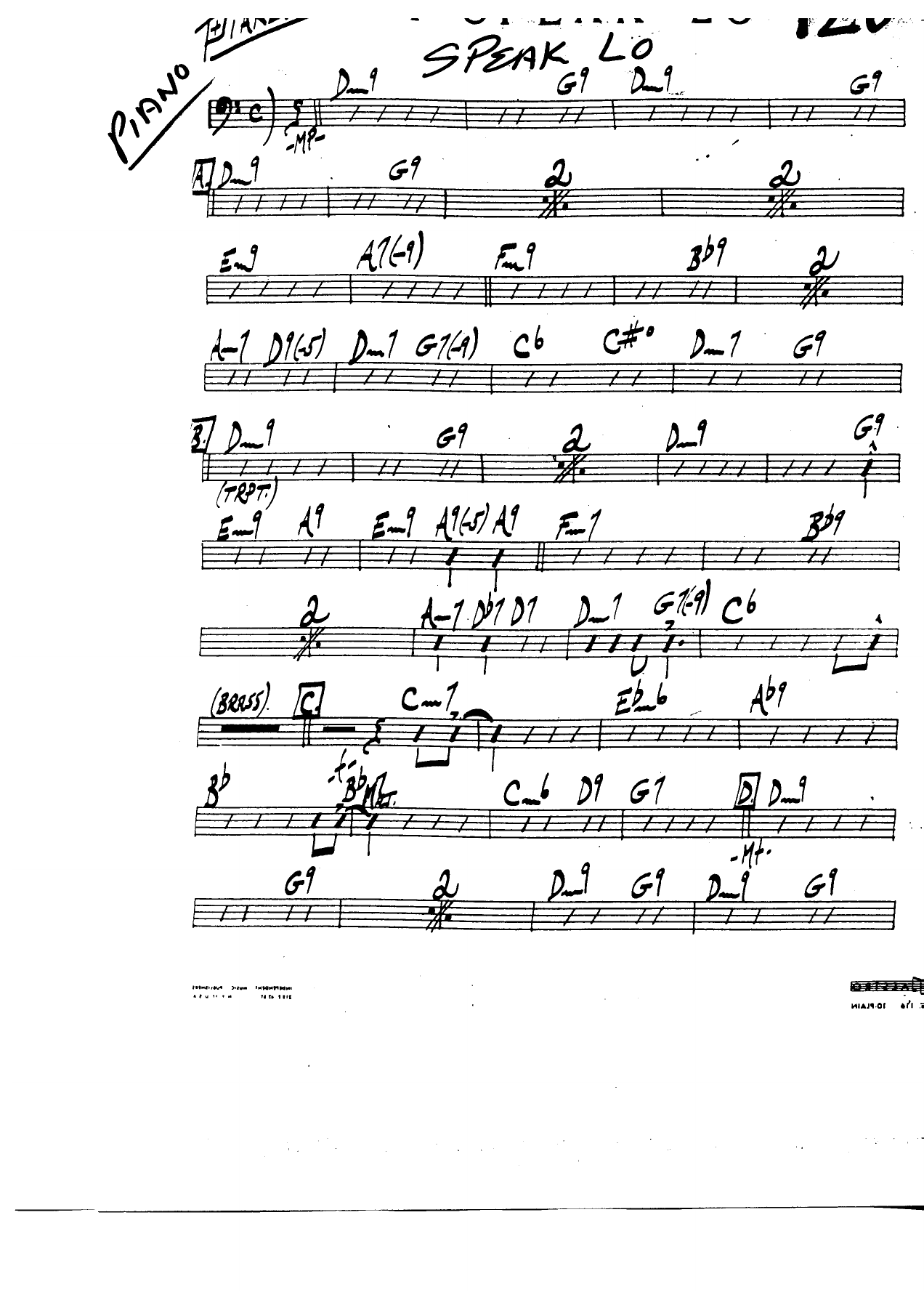
Speak Low (B.Eberhardt)
Composed by Kurt Weill
Arranged by B.Eberhardt
- Ensemble: Big Band
- Style: Jazz Standard
- Pages: 36
- Instruments (17): PIANO, BASS, DRUMS, GUITAR, I ALTO, II ALTO, TENOR I, TENOR II, BARY, I TRPT, 2ND TRPT, 3RD TRPT, 4TH TRPT, I BONE, II BONE, III BONE, 4TH BONE
- Difficulty: medium
- Content: Individual Parts
- Format: PDF Download (Instant)
- Price: $24.99
Kurt Weill's timeless composition, "Speak Low," first introduced in the 1943 Broadway musical *One Touch of Venus*, quickly transcended its theatrical origins to become an enduring jazz standard. Penned during the Golden Age of American Musical Theater, its sophisticated harmonic structure and poignant melody captured the hearts of audiences and musicians alike. The song's melancholic beauty and lyrical depth have made it a favorite vehicle for countless jazz luminaries, from Billie Holiday and Chet Baker to Ella Fitzgerald and Sarah Vaughan, solidifying its place in the jazz canon as a quintessential ballad that speaks to the bittersweet nature of love and fleeting moments. Its enduring appeal lies in its elegant simplicity coupled with a harmonic richness that invites diverse interpretations. B. Eberhardt's big band arrangement of "Speak Low" reimagines this classic with a sophisticated, medium swing feel, setting it firmly in the key of C minor. The arrangement masterfully balances the tune's inherent introspection with moments of expansive big band power, evoking a mood that is at once reflective and subtly energetic. It opens with an ethereal, almost cinematic quality, gradually building in intensity before settling into a relaxed, yet propulsive groove. Eberhardt's signature approach often involves meticulously crafted voicings that highlight the rich textures of the big band, and here, he employs dense, warm brass and saxophone harmonies that provide a lush backdrop for the melody. The emotional arc of the piece is carefully sculpted, moving from tender intimacy to a powerful, full-ensemble expression, then back to a contemplative close. This arrangement features the melody initially carried by the alto saxophone, offering a lyrical and expressive interpretation before transitioning to a full saxophone section soli that showcases Eberhardt's intricate counterpoint and harmonic ingenuity. A featured solo spot is provided for the trumpet, allowing for improvisation over the familiar changes, followed by a dynamic shout chorus that builds with increasing intensity, utilizing layered brass and saxophone figures to create a thrilling climax. Technical challenges include precise ensemble articulation, maintaining a consistent medium swing feel, and navigating some of the more intricate harmonic voicings in the soli sections. However, the rewarding experience comes from the opportunity to perform a beloved standard with a fresh, compelling big band treatment, allowing each section to shine while contributing to a cohesive and emotionally resonant performance. This arrangement is ideally suited for advanced high school, college, community, and professional big bands. Its demanding yet accessible nature provides ample opportunity for developing ensemble precision, stylistic interpretation, and improvisational skills. The depth of the scoring and the nuanced emotional journey it offers make it a standout piece for concert programs, providing both a challenge for the musicians and a deeply satisfying experience for the audience. Conductors should emphasize a relaxed, yet precise medium swing feel throughout, ensuring a consistent pulse without rushing. The opening section requires careful attention to blend and balance, particularly in the sustained chords, to establish the melancholic mood. For the saxophone soli, focus on unified articulation and intonation, ensuring the intricate lines are clear and well-defined. The trumpet soloist should be encouraged to explore the melodic possibilities of the changes while maintaining the overall mood of the piece. During the shout chorus, dynamic contrasts are crucial; build intensity gradually, paying close attention to brass attacks and releases to achieve maximum impact without overblowing. Rehearsal time should be dedicated to sectional work on voicings and rhythmic precision, especially in the brass figures leading into and out of the shout chorus. No special techniques like plunger mutes or doits are explicitly required, but expressive phrasing and dynamic shaping are paramount. Q: What instruments and parts are included in this arrangement? A: This arrangement is scored for a standard 16-instrument big band lineup, including Piano, Guitar, Bass, Drum Set, Alto Saxophone 1, Alto Saxophone 2, Tenor Saxophone 1, Tenor Saxophone 2, Baritone Saxophone, Trumpet 1, Trumpet 2, Trumpet 3, Trumpet 4, Trombone 1, Trombone 2, Trombone 3, and Bass Trombone. Q: What is the difficulty level of B. Eberhardt's "Speak Low" arrangement? A: This arrangement is rated as advanced high school to college level, suitable for experienced community bands and professional ensembles. It presents challenges in ensemble precision, stylistic interpretation, and harmonic understanding. Q: What is the musical style and historical context of "Speak Low"? A: "Speak Low" is a classic jazz standard composed by Kurt Weill in 1943 for the Broadway musical *One Touch of Venus*. This big band arrangement maintains its sophisticated jazz standard character with a medium swing feel, reflecting the rich harmonic and melodic traditions of the era. Q: What makes B. Eberhardt's arrangement of "Speak Low" unique? A: Eberhardt's treatment stands out for its sophisticated voicings, a compelling medium swing feel, and a well-crafted emotional arc that includes a lyrical alto saxophone lead, an intricate saxophone soli, a featured trumpet solo, and a dynamic shout chorus, all while maintaining the original's poignant mood. Q: What is the typical performance duration and tempo for this arrangement? A: The performance duration for this arrangement is approximately 4-5 minutes, depending on the length of the improvised trumpet solo. It is designed to be performed at a consistent medium swing tempo, typically around 120-130 beats per minute.
Questions and answers
- What is included in the Speak Low (B.Eberhardt) PDF?
- The verified current file contains individual parts across 36 pages.
- How many instruments or parts are listed for Speak Low (B.Eberhardt)?
- The verified instrumentation list contains 17 entries for this Big Band arrangement.
- Who is credited for Speak Low (B.Eberhardt)?
- Composer: Kurt Weill. Arranger: B.Eberhardt.
- What difficulty is listed for Speak Low (B.Eberhardt)?
- The verified difficulty level is medium.
- What style is listed for Speak Low (B.Eberhardt)?
- The catalog lists the style as Jazz Standard.
- Can I preview Speak Low (B.Eberhardt) before buying?
- Yes. The product page provides a preview generated from the current PDF file.
- How is Speak Low (B.Eberhardt) delivered?
- After successful payment, the digital PDF is made available for download. The displayed price is $24.99.
Musicians Also Search For
Speak Low B.Eberhardt PDF • Speak Low B.Eberhardt sheet music • Speak Low arranged by B.Eberhardt • B.Eberhardt big band charts • B.Eberhardt jazz arrangements PDF • Speak Low Kurt Weill sheet music • Speak Low Kurt Weill big band arrangements • Kurt Weill big band charts • Speak Low big band arrangements • Speak Low big band PDF download • Speak Low jazz sheet music • big band sheet music download • Speak Low individual parts download • Speak Low sheet music PDF • Speak Low Jazz Standard charts • Jazz Standard big band arrangements • buy Speak Low sheet music • download Speak Low PDF • Speak Low jazz charts • best B.Eberhardt big band arrangements • Kurt Weill arranged by B.Eberhardt • Speak Low printable sheet music • big band repertoire PDF