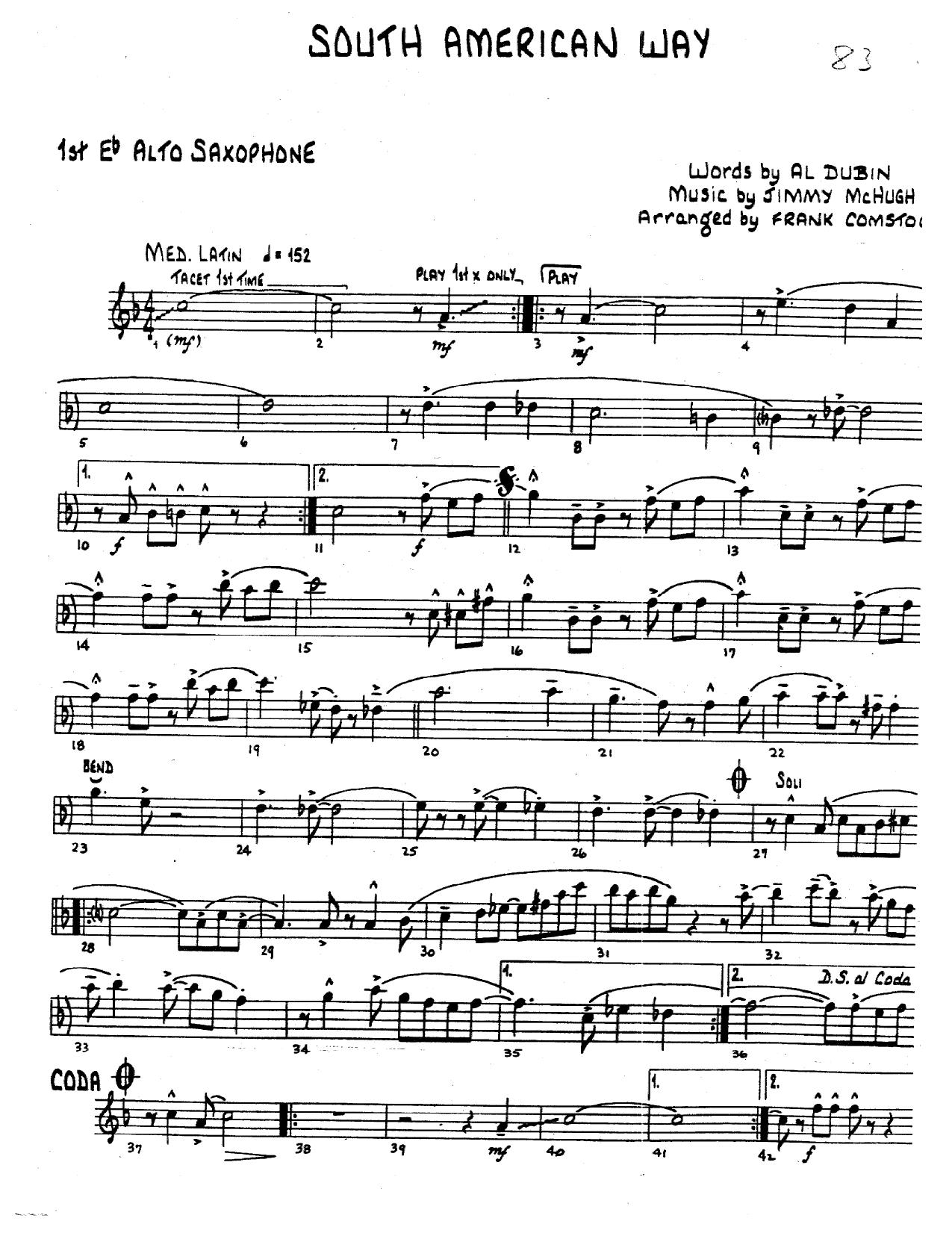
South American Way (F.Comstock)
Composed by Jimmy McHugh
Arranged by Frank Comstock
- Ensemble: Big Band
- Pages: 17
- Instruments (16): 1st Eb Alto Saxophone, 2nd Eb Alto Saxophone, 1st Bb Tenor Saxophone, 2nd Bb Tenor Saxophone (Optional), Baritone Saxophone (Optional), 1st Trombone, 3rd Trombone (Optional), 4th Trombone (Optional), 1st Bb Trumpet, 2nd Bb Trumpet, 3rd Bb Trumpet (Optional), 4th Bb Trumpet, Drums, Bass, Guitar (Optional), Piano
- Difficulty: easy
- Content: Individual Parts
- Format: PDF Download (Instant)
- Price: $24.99
Jimmy McHugh and Al Dubin’s vibrant Latin-infused standard "South American Way" originally captured the public imagination in the late 1930s, most famously associated with the iconic performances of Carmen Miranda in the Broadway revue *The Streets of Paris* and subsequent Hollywood musical films. This infectious tune represents a fascinating era when American popular song embraced tropical, syncopated rhythms, blending traditional Latin American dance pulses with sophisticated Broadway harmony. Within the jazz idiom, the composition serves as a brilliant vehicle for rhythmic exploration, bridging the gap between exotic dance crazes and swinging big band sophistication. Frank Comstock’s masterful big band adaptation injects this classic melody with an unmistakable mid-century modern jazz vitality. Driven by an infectious, buoyant Latin-swing groove in 4/4 meter, the arrangement radiates warmth, high-energy charm, and rhythmic propulsion. The mood is celebratory and effervescent, shifting dynamically between lush, tropical harmonic textures and punchy, brass-led counterlines. Comstock expertly harnesses the tonal colors of a streamlined nine-instrument ensemble, proving that a smaller big band footprint can achieve the massive, multi-layered punch of a full-scale seventeen-piece orchestra through clever voicing and efficient counterpoint. Comstock’s signature arranging style shines through brilliant sectional writing, featuring tight saxophone solis that intertwine fluidly with crisp, rhythmic interjections from the brass. The arrangement balances accessible melodic statements with sophisticated extended harmonies, utilizing rich maj9 and altered dominant voicings that elevate the tune above standard novelty fare. The primary melodic weight shifts dynamically between the alto and tenor saxophones, while the baritone sax anchors the lower register with a robust, driving ostinato. Featured solo space allows individual players to stretch out over changes that seamlessly blend traditional swing phrasing with Latin syncopation, culminating in an exhilarating shout chorus that builds relentless momentum right up to the final chord. Advanced high school, collegiate, and professional gigging ensembles will find this 17-page publication exceptionally rewarding. Because it is scored for a flexible nine-piece instrumentation (including Alto Sax, Tenor Sax, Baritone Sax, Trumpet, Trombone, and rhythm section support), it provides an ideal challenge for bands looking to maximize ensemble transparency without sacrificing authentic big band heft. Precision in articulation—particularly managing the snappy syncopated figures between the brass and reeds—will be the primary focus for performers, making it an absolute standout crowd-pleaser for concert programs, festival sets, and sophisticated jazz club performances. Succeeding with Frank Comstock’s chart requires strict attention to rhythmic crispness and stylistic versatility. The tempo should maintain a steady, driving Latin-swing pulse; avoid dragging the quarter notes, as the arrangement relies heavily on forward momentum to keep the tropical groove authentic. The primary technical challenge lies in the tight ensemble interplay between the reeds and brass, particularly during syncopated figures that cross the bar line. Horn players should focus on clean, articulated tongue placements—avoiding heavy, sluggish accents—to ensure the punchy counterlines pop cleanly through the texture. Trumpets and trombones should utilize bright, focused tones with minimal heavy vibrato to capture the polished mid-century studio sound. In rehearsal, isolate the rhythm section first to lock in the underlying percussion feel before layering the horns. Ensure the baritone sax and bass player are locked tightly on the low-end ostinatos, as they serve as the rhythmic anchor for the entire ensemble's harmonic shifts. Q: What specific instruments and parts are included in this 17-page arrangement? A: This arrangement is scored for a 9-instrument big band lineup consisting of Alto Saxophone, Tenor Saxophone, Baritone Saxophone, Trumpet, Trombone, and a complete rhythm section, distributed across 17 comprehensive pages of score and parts. Q: What is the overall difficulty level of this Frank Comstock chart? A: It is ideally suited for advanced high school, collegiate, and professional community big bands that possess strong reading skills and tight sectional cohesion, particularly regarding syncopated Latin-swing rhythms. Q: What is the historical style and background of "South American Way"? A: Originally written by Jimmy McHugh and Al Dubin for the 1939 Broadway revue *The Streets of Paris* and popularized by Carmen Miranda, this piece represents the era's fascination with Latin-infused American popular song adapted for jazz ensemble. Q: What makes Frank Comstock’s arrangement unique compared to other versions? A: Comstock brilliantly condenses the power of a full big band into a nimble 9-instrument framework, utilizing signature close-interval voicings, sharp sectional solis, and sophisticated harmonic extensions. Q: What is the performance duration and tempo feel for this piece? A: The arrangement runs approximately 3 to 4 minutes and is performed at an energetic, buoyant medium-up tempo featuring a hybrid Latin-swing groove in 4/4 time.
Questions and answers
- What is included in the South American Way (F.Comstock) PDF?
- The verified current file contains individual parts across 17 pages.
- How many instruments or parts are listed for South American Way (F.Comstock)?
- The verified instrumentation list contains 16 entries for this Big Band arrangement.
- Who is credited for South American Way (F.Comstock)?
- Composer: Jimmy McHugh. Arranger: Frank Comstock.
- What difficulty is listed for South American Way (F.Comstock)?
- The verified difficulty level is easy.
- Can I preview South American Way (F.Comstock) before buying?
- Yes. The product page provides a preview generated from the current PDF file.
- How is South American Way (F.Comstock) delivered?
- After successful payment, the digital PDF is made available for download. The displayed price is $24.99.
Musicians Also Search For
South American Way Frank Comstock PDF • South American Way Frank Comstock sheet music • South American Way arranged by Frank Comstock • Frank Comstock big band charts • Frank Comstock jazz arrangements PDF • South American Way Jimmy McHugh sheet music • South American Way Jimmy McHugh big band arrangements • Jimmy McHugh big band charts • South American Way big band arrangements • South American Way big band PDF download • South American Way jazz sheet music • big band sheet music download • South American Way individual parts download • South American Way sheet music PDF • buy South American Way sheet music • download South American Way PDF • South American Way jazz charts • best Frank Comstock big band arrangements • Jimmy McHugh arranged by Frank Comstock • South American Way printable sheet music • big band repertoire PDF