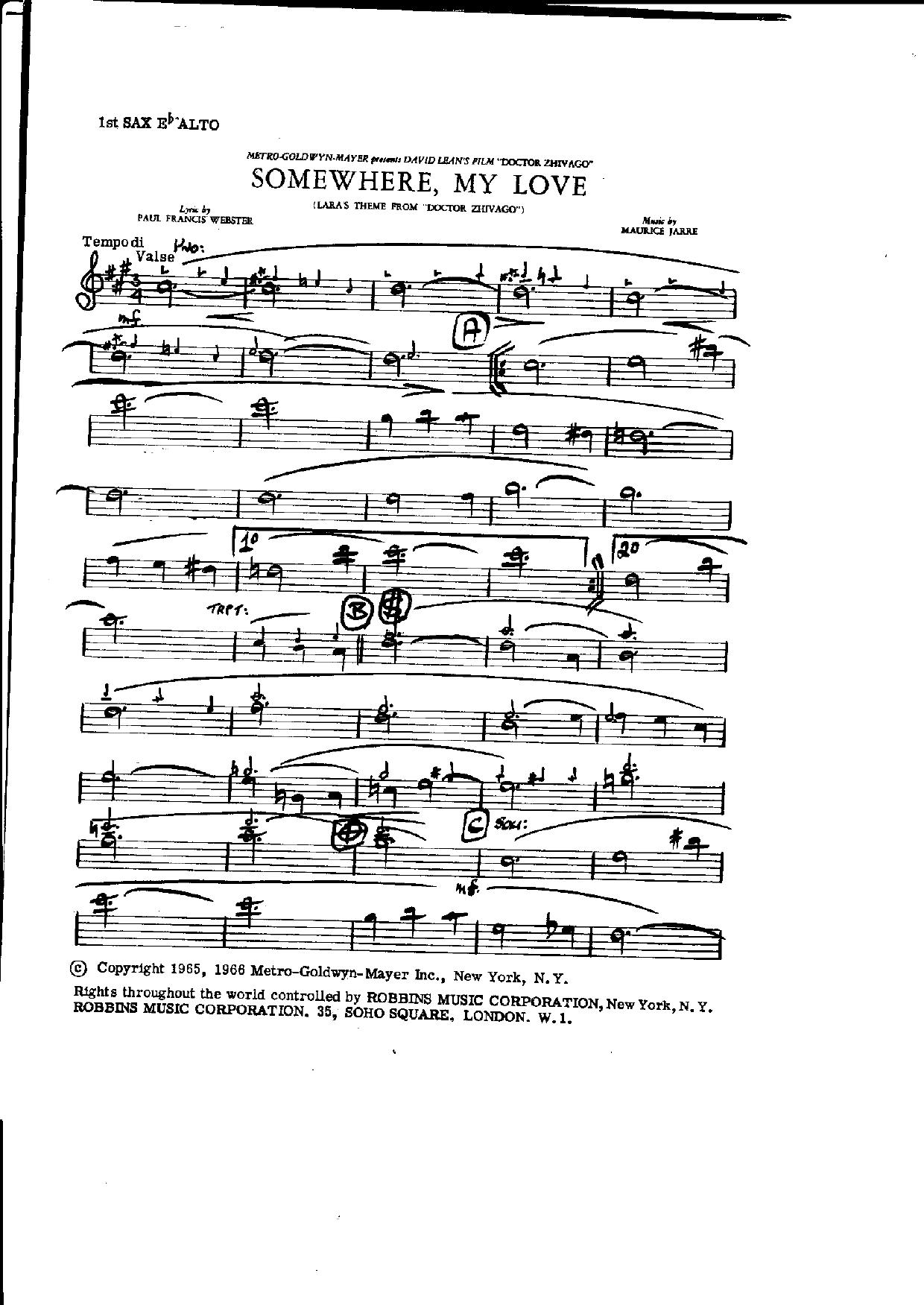
Somewhere, My Love (M.Jarre)
Composed by Maurice Jarre
Arranged by M.Jarre
- Ensemble: Big Band
- Style: Jazz Standard
- Pages: 28
- Instruments (16): 1st Sax Eb Alto, 2nd Sax Bb Tenor, 3rd Sax Eb Alto, 4th Sax Bb Tenor, 5th Sax Eb Baritone, 1st Bb Trumpet, 2nd Bb Trumpet, 3rd Bb Trumpet, 1st Trombone, 2nd Trombone, Violins, Vocal, Piano, Guitar, Drums, Bass
- Difficulty: medium
- Content: Individual Parts
- Format: PDF Download (Instant)
- Price: $24.99
Maurice Jarre’s timeless melody "Somewhere, My Love"—widely recognized as Lara’s Theme from David Lean’s cinematic masterpiece *Doctor Zhivago* (1965)—has long transcended its silver-screen origins to become a cherished vehicle for jazz interpretation. Originally composed as an evocative, sweeping orchestral theme capturing the romantic yearning of war-torn Russia, the tune’s inherent modal flexibility and rich harmonic contours made it an instant favorite for mid-century pop and jazz artists alike, most notably immortalized by Ray Coniff and later explored by various jazz instrumentalists. This big band adaptation bridges the gap between lush cinematic lyricism and traditional swinging jazz orchestration, offering a sophisticated vehicle that treats the iconic melody with both reverence and fresh creative vitality. Rooted in a flowing, medium-tempo swing feel, this arrangement balances bittersweet nostalgia with an uplifting rhythmic drive. The harmonic framework explores rich extended voicings, moving through shifting tonal centers that elevate the original melody beyond a simple nostalgic tune into a robust jazz conversation. The chart opens with an atmospheric, rubato intro that establishes the Slavic-inflected lyricism before settling into a steady, conversational groove in 4/4 time. The emotional arc transitions seamlessly from introspective, smoky ballad-esque textures in the lower reeds to soaring, brass-heavy climaxes that evoke the wide-open steppes of the original film's setting. The arrangement showcases brilliant scoring across the 16-instrument ensemble, placing heavy emphasis on rich sax solid lines and dynamic contrast. The melody is initially introduced by the lead alto saxophone, cushioned by warm, muted brass pads that maintain the cinematic atmosphere. As the chart builds, a tightly woven saxophone soli highlights the intricate counterpoint inherent in Jarre’s original writing, followed by a powerful, multi-tiered shout chorus that utilizes full ensemble stabs and expressive upward doits. Featured solo space allows a designated horn player to stretch out over a sophisticated yet accessible chorus form, backed by rhythmic comping from the piano and guitar that encourages modal exploration and melodic development. Advanced high school, collegiate, and professional community big bands will find this 28-page chart an exceptionally rewarding addition to their repertoire. While the individual section ranges are kept within reasonable, musical limits—avoiding unnecessary technical acrobatics—the true challenge lies in achieving a cohesive, velvety blend and maintaining consistent time feel during the dynamic shifts. Directors will appreciate how the chart naturally trains the ensemble in dynamic control, intonation within tight section voicings, and the stylistic maturity required to swing a waltzing, cinematic melody without losing its inherent rhythmic momentum. Successfully interpreting this arrangement requires meticulous attention to dynamic shading and stylistic blending. Conductor and ensemble focus should first center on the transition from the rubato, cinematic introduction into the steady medium-swing groove; the rhythm section must establish a light, unforced ride cymbal pulse that anchors the ensemble without heavy-handedness. Brass players should utilize cup or harmon mutes where indicated in the score to achieve the characteristic warmth required for the statement of the main theme, ensuring that the background figures do not obscure the lead alto voice. Technically, the saxophones must navigate intricate, fluid lines with seamless legato phrasing, contrasting sharply with the punchy, accented articulation demanded during the shout chorus. Rehearsals should isolate the dynamic swells, ensuring that crescendos peak uniformly across all sections rather than relying solely on the lead trumpet. Pay close attention to intonation on the altered dominant chords leading into key modulations; balancing these rich voicings will define the professional execution of this evocative chart. Q: What specific instruments and parts are included in this 28-page big band arrangement? A: The chart is scored for a standard 16-instrument big band lineup, featuring parts for Alto Saxophone 1 & 3, Tenor Saxophone 2 & 4, Baritone Saxophone, a full brass section of trumpets and trombones, and a complete rhythm section including piano, bass, guitar, and drums. Q: What is the difficulty level of this arrangement, and is it suitable for high school bands? A: This arrangement is well-suited for advanced high school, collegiate, and professional community big bands. While individual technical demands are moderate, success requires strong section blend, mature stylistic control, and refined dynamic awareness. Q: What musical style and historical era does this piece represent? A: This piece adapts Maurice Jarre’s 1965 cinematic theme from *Doctor Zhivago* into a sophisticated jazz standard. It merges mid-century cinematic lyricism with a classic medium-swing big band jazz tradition. Q: What makes this particular arrangement unique compared to other versions of Lara's Theme? A: It uniquely bridges lush, rubato cinematic textures with swinging counterpoint, featuring a distinctive saxophone soli, sophisticated extended chord voicings, and a powerful, multi-tiered shout chorus. Q: What is the approximate performance duration and tempo feel of the chart? A: The arrangement is set in a comfortable medium-swing tempo (approximately 116-122 BPM) in 4/4 time, with a total performance duration of roughly 4 to 5 minutes depending on the length of the improvised solo choruses.
Questions and answers
- What is included in the Somewhere, My Love (M.Jarre) PDF?
- The verified current file contains individual parts across 28 pages.
- How many instruments or parts are listed for Somewhere, My Love (M.Jarre)?
- The verified instrumentation list contains 16 entries for this Big Band arrangement.
- Who is credited for Somewhere, My Love (M.Jarre)?
- Composer: Maurice Jarre. Arranger: M.Jarre.
- What difficulty is listed for Somewhere, My Love (M.Jarre)?
- The verified difficulty level is medium.
- What style is listed for Somewhere, My Love (M.Jarre)?
- The catalog lists the style as Jazz Standard.
- Can I preview Somewhere, My Love (M.Jarre) before buying?
- Yes. The product page provides a preview generated from the current PDF file.
- How is Somewhere, My Love (M.Jarre) delivered?
- After successful payment, the digital PDF is made available for download. The displayed price is $24.99.
Musicians Also Search For
Somewhere, My Love M.Jarre PDF • Somewhere, My Love M.Jarre sheet music • Somewhere, My Love arranged by M.Jarre • M.Jarre big band charts • M.Jarre jazz arrangements PDF • Somewhere, My Love Maurice Jarre sheet music • Somewhere, My Love Maurice Jarre big band arrangements • Maurice Jarre big band charts • Somewhere, My Love big band arrangements • Somewhere, My Love big band PDF download • Somewhere, My Love jazz sheet music • big band sheet music download • Somewhere, My Love individual parts download • Somewhere, My Love sheet music PDF • Somewhere, My Love Jazz Standard charts • Jazz Standard big band arrangements • buy Somewhere, My Love sheet music • download Somewhere, My Love PDF • Somewhere, My Love jazz charts • best M.Jarre big band arrangements • Maurice Jarre arranged by M.Jarre • Somewhere, My Love printable sheet music • big band repertoire PDF