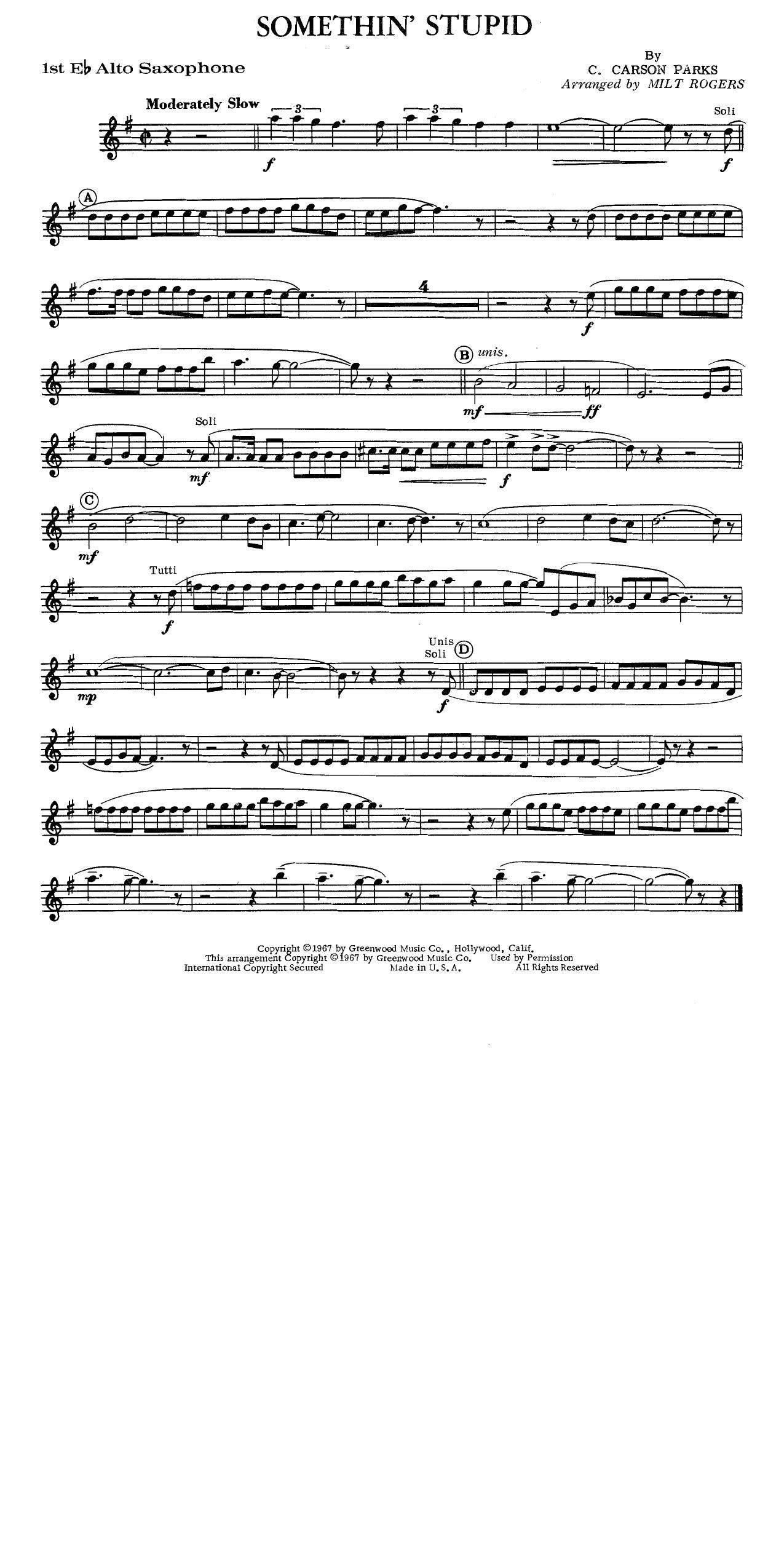
Somethin' Stupid (M.Rogers)
Composed by Carson Parks
Arranged by M.Rogers
- Ensemble: Big Band
- Style: Jazz Standard
- Pages: 22
- Instruments (17): 1st Eb Alto Saxophone, 2nd Bb Tenor Saxophone, 3rd Eb Alto Saxophone, 4th Bb Tenor Saxophone, 5th Eb Baritone Saxophone, 1st Bb Trumpet, 2nd Bb Trumpet, 3rd Bb Trumpet, 4th Bb Trumpet, 1st Trombone, 2nd Trombone, 3rd Trombone, 4th Trombone, Bass, Guitar, Drums, Piano
- Difficulty: medium
- Content: Individual Parts
- Format: PDF Download (Instant)
- Price: $24.99
Originally penned by Carson Parks and immortalized globally in 1967 by the father-daughter duo of Frank and Nancy Sinatra, "Somethin' Stupid" bridges the worlds of traditional pop craftsmanship and breezy, mid-century vocal jazz. While initially recognized as a chart-topping vocal duet, the tune's inherent melodic charm, sophisticated harmonic underpinnings, and infectious, conversational phrasing have long made it a fertile canvas for instrumental jazz interpretation. It represents a fascinating transitional era where commercial pop sensibilities began seamlessly merging with relaxed, swinging small-group and big-band aesthetics, enduring as a beloved staple of the Great American Songbook adjacent repertoire. Basking in a relaxed, mid-tempo swing feel, this chart exudes a playful, nonchalant elegance. The arrangement maintains a warm, inviting harmonic palette that evokes late-night lounge sophistication combined with the rich, brass-driven warmth of a classic 1960s studio orchestra. Rather than relying on aggressive, high-octane bombast, the emotional core here is rooted in wry charm, subtle dynamic shifts, and an effortless groove. The ensemble colors are lush and inviting, utilizing close-position voicings in the saxes and muted brass accents to create an intimate yet full-bodied big band texture that feels both nostalgic and refreshingly contemporary. Arranger M.Rogers approaches this classic material with a keen ear for textural contrast and dynamic interplay, steering clear of predictable head-chart formulas. The treatment features clever counter-melodies woven into the inner voices, sophisticated chord substitutions that elevate the underlying harmony, and a delightfully conversational soli section that mimics the call-and-response nature of the original lyric. M.Rogers skillfully balances tutti power with transparent, rhythm-section-driven interludes, ensuring the chart never feels over-scored. The writing showcases signature fluency in modern mainstream big band idioms, giving every section a vital narrative role rather than relegating the accompaniment to passive background pads. The melody is initially introduced with tasteful economy, shared fluidly between the brass and woodwind sections before opening up for featured solo space that invites expressive, melodic improvisation. Technical demands are moderate rather than virtuosic, placing a premium on pristine intonation, stylistic uniformity, swing subdivision accuracy, and subtle articulation control rather than sheer velocity or altissimo range. Advanced high school ensembles, collegiate jazz orchestras, and professional community big bands will find this arrangement an absolute joy to rehearse and perform. It serves as an ideal change-of-pace concert centerpiece, offering audiences a familiar, sophisticated melody while giving the band a chance to showcase deep-pocket groove, stylistic cohesion, and nuanced musicality. Success with this chart hinges on maintaining a relaxed, conversational medium-swing feel without letting the tempo drag or push. The rhythm section must establish an unhurried, buoyant pocket; the drummer should favor crisp, feathered bass drum accents and a clean ride cymbal pattern that breathes, keeping hi-hats sharp on beats two and four. Horn players should prioritize seamless legato phrasing on the bridged lines, utilizing gentle articulation and controlled vibrato to emulate vocal phrasing. Watch out for dynamic balance during the inner-voice counterlines; the saxophones and trombones must project their moving lines cleanly beneath the lead trumpet without covering the melody. Trumpets and trombones should utilize cup or basket mutes where indicated to achieve that authentic, intimate 1960s studio warmth. Rehearsals should focus heavily on the unison passages between sections to lock in articulation and stylistic uniformity across the entire band. Q: What instruments and parts are included in this big band arrangement? A: The complete 17-instrument instrumentation features a standard big band setup: 1st Eb Alto Saxophone, 2nd Bb Tenor Saxophone, 3rd Eb Alto Saxophone, 4th Bb Tenor Saxophone, 5th Eb Baritone Saxophone, 4 trumpets, 4 trombones, guitar, piano, bass, and drums, accompanied by a comprehensive 31-page conductor score. Q: What is the difficulty level of this arrangement? A: This piece is graded as medium difficulty, making it exceptionally well-suited for advanced high school ensembles, college jazz bands, and professional community big bands seeking a sophisticated yet accessible change-of-pace chart. Q: What is the musical style and historical context of "Somethin' Stupid"? A: Originally written by Carson Parks and made famous by Frank and Nancy Sinatra in 1967, this arrangement reframes the iconic pop-jazz standard into a relaxed, mid-tempo big band swing vehicle steeped in mid-century lounge elegance. Q: What makes M.Rogers' arrangement unique? A: M.Rogers elevates the familiar tune through clever inner-voice counter-melodies, sophisticated chord substitutions, and a conversational soli section that captures the playful vocal interplay of the original recording while maximizing big band textures. Q: What is the performance duration and recommended tempo for this chart? A: While performance time can vary slightly based on solo choruses, the chart is designed as a standard concert-length arrangement set at a comfortable, unhurried medium-swing tempo that prioritizes deep pocket groove and relaxed phrasing.
Questions and answers
- What is included in the Somethin' Stupid (M.Rogers) PDF?
- The verified current file contains a conductor score and individual parts across 22 pages.
- How many instruments or parts are listed for Somethin' Stupid (M.Rogers)?
- The verified instrumentation list contains 17 entries for this Big Band arrangement.
- Who is credited for Somethin' Stupid (M.Rogers)?
- Composer: Carson Parks. Arranger: M.Rogers.
- What difficulty is listed for Somethin' Stupid (M.Rogers)?
- The verified difficulty level is medium.
- What style is listed for Somethin' Stupid (M.Rogers)?
- The catalog lists the style as Jazz Standard.
- Can I preview Somethin' Stupid (M.Rogers) before buying?
- Yes. The product page provides a preview generated from the current PDF file.
- How is Somethin' Stupid (M.Rogers) delivered?
- After successful payment, the digital PDF is made available for download. The displayed price is $24.99.
Musicians Also Search For
Somethin' Stupid M.Rogers PDF • Somethin' Stupid M.Rogers sheet music • Somethin' Stupid arranged by M.Rogers • M.Rogers big band charts • M.Rogers jazz arrangements PDF • Somethin' Stupid Carson Parks sheet music • Somethin' Stupid Carson Parks big band arrangements • Carson Parks big band charts • Somethin' Stupid big band arrangements • Somethin' Stupid big band PDF download • Somethin' Stupid jazz sheet music • big band sheet music download • Somethin' Stupid conductor score PDF • Somethin' Stupid individual parts download • Somethin' Stupid sheet music PDF • Somethin' Stupid Jazz Standard charts • Jazz Standard big band arrangements • buy Somethin' Stupid sheet music • download Somethin' Stupid PDF • Somethin' Stupid jazz charts • best M.Rogers big band arrangements • Carson Parks arranged by M.Rogers • Somethin' Stupid printable sheet music • big band repertoire PDF