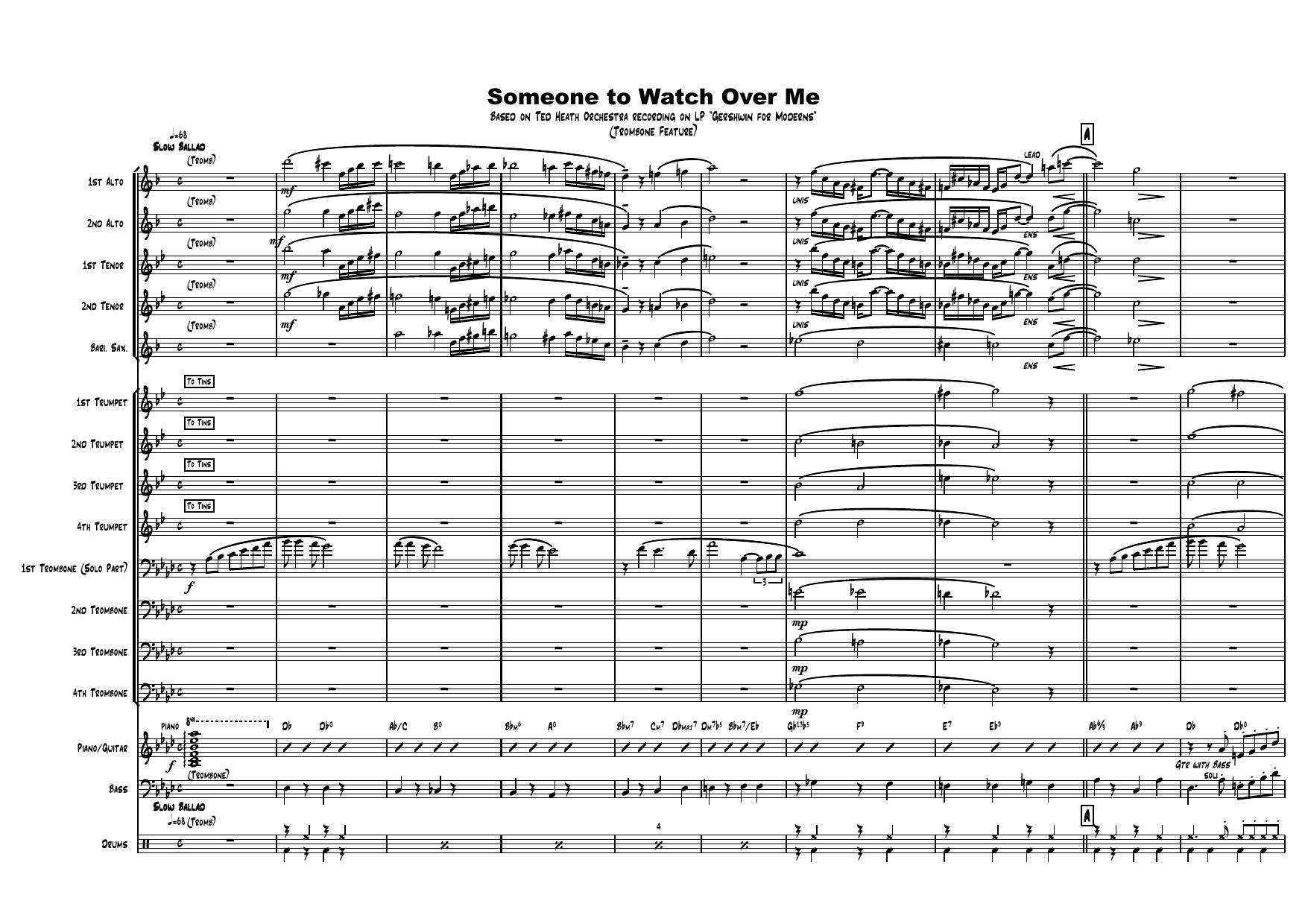
Someone To Watch Over Me (J.Farley)
Composed by George Gershwin
Arranged by John Farley
- Ensemble: Big Band
- Pages: 30
- Instruments (17): 1st Alto Saxophone, 2nd Alto Saxophone, 1st Tenor Saxophone, 2nd Tenor Saxophone, Baritone Saxophone, 1st Trumpet, 2nd Trumpet, 3rd Trumpet, 4th Trumpet, 1st Trombone (Solo Part), 2nd Trombone, 3rd Trombone, 4th Trombone, Piano, Guitar, Bass, Drums
- Difficulty: medium
- Content: Individual Parts
- Format: PDF Download (Instant)
- Price: $24.99
George Gershwin’s timeless 1926 masterpiece, "Someone to Watch Over Me," stands as one of the crown jewels of the Great American Songbook. Originally introduced by Gertrude Lawrence in the Broadway musical *Oh, Kay!*, the composition quickly transcended its theatrical origins to become a foundational vehicle for jazz interpretation. Countless luminaries—from Frank Sinatra and Ella Fitzgerald to modal jazz pioneers like Chet Baker and Keith Jarrett—have immortalized its poignant harmonic progression and yearning melody. As a quintessential jazz standard, the tune bridges early Tin Pan Alley craftsmanship with sophisticated post-war jazz harmony, offering an ideal canvas for expansive big band writing that prioritizes lush textures and emotional depth. Conceived as a sublime, expressive ballad, John Farley’s arrangement centers around a relaxed, rubato-leaning pulse that eventually settles into a luxurious, brushed 12/8 or slow 4/4 swing feel. The mood is deeply romantic, introspective, and cinematic, evoking the sultry atmosphere of a late-night New York jazz club. Farley exploits the full dynamic spectrum of the 16-piece big band, utilizing whisper-soft sustained pads in the brass contrasted against warm, rich lower-register saxophone solis. The emotional arc moves from solitary reflection to soaring, rich-textured collective climaxes, making it a powerful vehicle for storytelling rather than sheer athletic display. Farley’s distinctive approach to this chart relies on contemporary extended tertian harmonies, subtle chromatic mediant shifts, and lush, impressionistic woodwind voicings reminiscent of the Gil Evans school. Rather than relying on a traditional predictable shout chorus, Farley constructs an evolving narrative where the brass and reeds interweave contrapuntally. The arrangement features a prominent, soaring flugelhorn or tenor saxophone solo that floats above cascading, impressionistic background figures in the trombones. The sax section frequently utilizes double-tubed harmonic spreads, while the rhythm section is given ample freedom to employ rubato phrasing, modal vamp interludes, and subtle bossa-inflected harmonic substitutions beneath the primary melody. Designed primarily for advanced high school, collegiate, and professional ensembles, this 30-page publication demands a high degree of maturity, stylistic cohesion, and dynamic control. The primary technical challenge lies not in fast fingerwork, but in maintaining pitch center stability during exposed, ultra-soft chordal passages and executing seamless rubato transitions with the conductor. Lead trumpet players will encounter comfortable upper-register demands that emphasize a warm, lyrical tone over sheer altitude, while the rhythm section must possess a sophisticated harmonic ear to voice the chord changes effectively. It is immensely rewarding for groups seeking to showcase their expressive maturity, section blend, and emotional resonance. The primary technical challenge of John Farley’s arrangement is maintaining pristine intonation and a unified pulse during exposed, ultra-soft ensemble passages. Conductors should emphasize breath support and continuous airflow, especially during the rubato intro and transitional modulations. The tempo should remain a relaxed, breathing ballad pulse (around quarter note = 64-68 BPM). Avoid a rigid, metronomic feel; the rhythm section must breathe with the soloist and lead instruments, utilizing elastic phrasing while keeping the underlying pulse steady. Mute usage is specified for the brasses to achieve a dark, velvety texture: cup mutes and harmon mutes (stem half-in) are recommended during the statement of the secondary theme to create an intimate, vintage ambiance. Rehearsal should begin with sectional balance checks, ensuring the inner-voice trombone and sax harmonies are voiced cleanly against the melody. Pay close attention to the dynamic swells; the transition into the arrangement's emotional peak must build organically without forcing the tone. Q: What specific instruments and parts are included in this publication? A: This 30-page big band arrangement is scored for a standard 16-instrument ensemble, comprising Alto Saxophone 1, Alto Saxophone 2, Tenor Saxophone 1, Tenor Saxophone 2, Baritone Saxophone, 4 Trumpets (with flugelhorn doubles recommended), 4 Trombones, Piano, Guitar, Bass, Drums, and a comprehensive Conductor Score. Q: What is the difficulty level of this arrangement? A: This chart is calibrated for advanced high school, collegiate, and professional jazz orchestras. The primary challenges involve maintaining dynamic control at whisper-soft volumes, executing sophisticated extended harmonies, and demonstrating mature rubato phrasing rather than executing rapid technical passages. Q: What is the historical style and musical context of this piece? A: Based on George Gershwin's 1926 Broadway standard, this arrangement reimagines the classic tune through a modern jazz ballad lens. It draws inspiration from the lush, impressionistic arranging traditions of post-swing modernists while honoring the intimate storytelling roots of the Great American Songbook. Q: What makes John Farley’s arrangement unique compared to other big band versions? A: Farley departs from conventional formulaic shout-chorus writing by utilizing contrapuntal horn textures, modern chromatic mediant shifts, and impressionistic woodwind voicings. The arrangement functions more like a cinematic tone poem, prioritizing lush harmonic depth and an evolving emotional narrative around a featured soloist. Q: What is the approximate performance duration and tempo feel? A: The arrangement performs at approximately 4.5 to 5 minutes, depending on the length of the improvised solo sections. It is set at a slow, expressive ballad tempo (approximately quarter note = 64–68 BPM) with a relaxed swing feel and rubato sections.
Questions and answers
- What is included in the Someone To Watch Over Me (J.Farley) PDF?
- The verified current file contains a conductor score and individual parts across 30 pages.
- How many instruments or parts are listed for Someone To Watch Over Me (J.Farley)?
- The verified instrumentation list contains 17 entries for this Big Band arrangement.
- Who is credited for Someone To Watch Over Me (J.Farley)?
- Composer: George Gershwin. Arranger: John Farley.
- What difficulty is listed for Someone To Watch Over Me (J.Farley)?
- The verified difficulty level is medium.
- Can I preview Someone To Watch Over Me (J.Farley) before buying?
- Yes. The product page provides a preview generated from the current PDF file.
- How is Someone To Watch Over Me (J.Farley) delivered?
- After successful payment, the digital PDF is made available for download. The displayed price is $24.99.
Musicians Also Search For
Someone To Watch Over Me John Farley PDF • Someone To Watch Over Me John Farley sheet music • Someone To Watch Over Me arranged by John Farley • John Farley big band charts • John Farley jazz arrangements PDF • Someone To Watch Over Me George Gershwin sheet music • Someone To Watch Over Me George Gershwin big band arrangements • George Gershwin big band charts • Someone To Watch Over Me big band arrangements • Someone To Watch Over Me big band PDF download • Someone To Watch Over Me jazz sheet music • big band sheet music download • Someone To Watch Over Me conductor score PDF • Someone To Watch Over Me individual parts download • Someone To Watch Over Me sheet music PDF • buy Someone To Watch Over Me sheet music • download Someone To Watch Over Me PDF • Someone To Watch Over Me jazz charts • best John Farley big band arrangements • George Gershwin arranged by John Farley • Someone To Watch Over Me printable sheet music • big band repertoire PDF