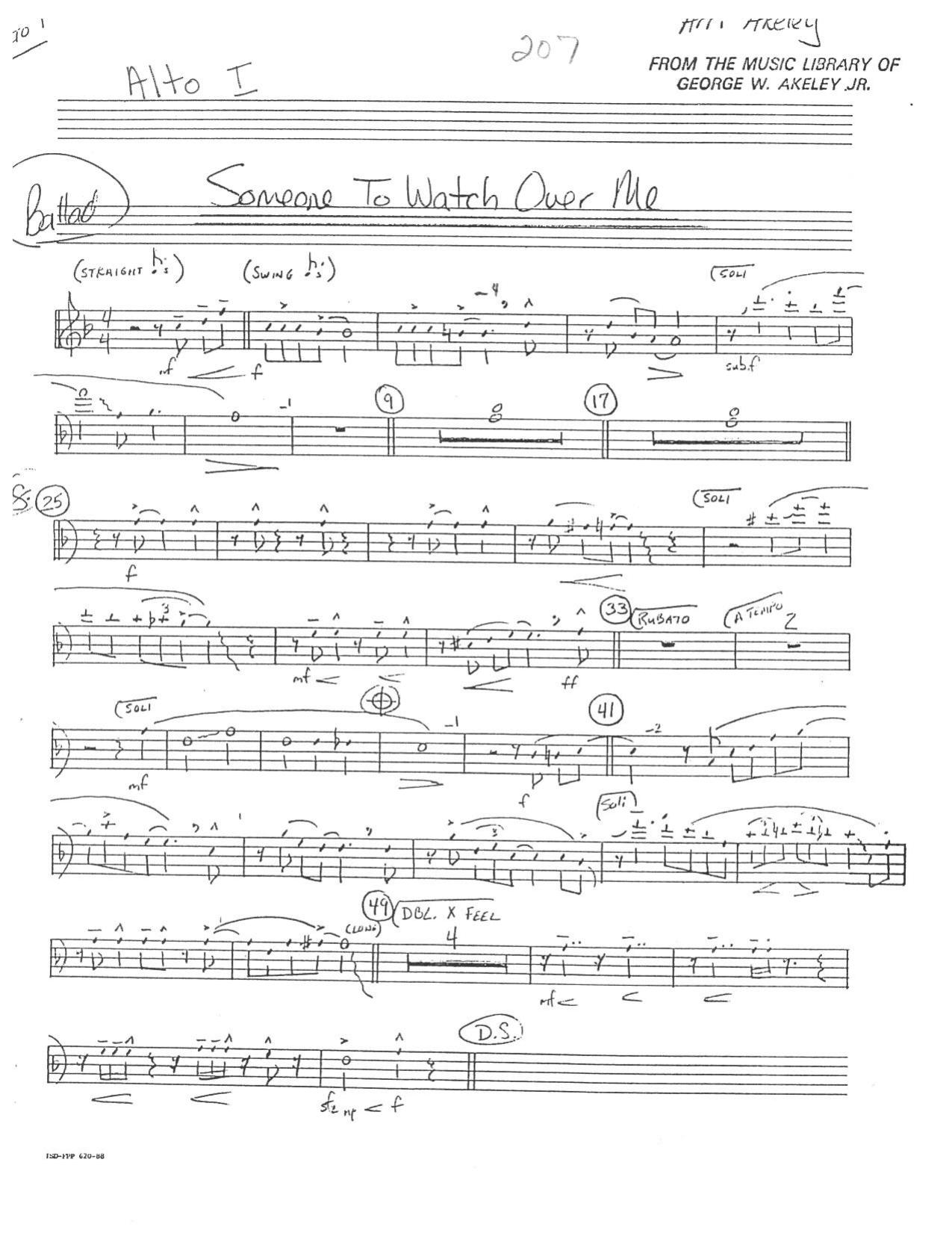
Someone To Watch Over Me (W.G.Akeley)
Composed by George Gershwin
Arranged by W.G.Akeley
- Ensemble: Big Band
- Style: Jazz Standard
- Pages: 36
- Instruments (17): Alto Saxophone 1, Alto Saxophone 2, Tenor Saxophone 1, Tenor Saxophone 2, Baritone Saxophone, Trumpet 1, Trumpet 2, Trumpet 3, Trumpet 4, Trombone 1, Trombone 2, Trombone 3, Trombone 4 (Bass), Acoustic Piano, Acoustic Bass, Drums, Guitar
- Difficulty: medium
- Content: Individual Parts
- Format: PDF Download (Instant)
- Price: $24.99
George Gershwin’s timeless 1926 masterpiece, "Someone To Watch Over Me," stands as one of the crown jewels of the Great American Songbook. Originally introduced by Gertrude Lawrence in the Broadway musical *Oh, Kay!*, the composition quickly transcended its theatrical origins to become a foundational vehicle for jazz improvisation. Through legendary interpretations by vocalists like Ella Fitzgerald and Frank Sinatra, as well as instrumental revisions by jazz titans such as Coleman Hawkins and Art Tatum, the song cemented its status as the quintessential emotional ballad. Its sophisticated harmonic progression and lingering, bittersweet melody invite endless reinterpretation, making it a timeless canvas for jazz arrangers seeking to explore depth, vulnerability, and dynamic contrast within a large ensemble framework. W.G.Akeley approaches this enduring standard through the lens of a lush, evocative ballad, anchoring the chart in a slow, expressive 12/8 or triplet-feel swing groove that allows the harmonic richness to breathe. The mood is deeply romantic, introspective, and at times cinematic, moving from quiet, tender vulnerability to sweeping, dynamic climaxes. Akeley utilizes dense, modern extended chord voicings in the brass and rich woodwind doublings to create a shimmering sonic texture. The arrangement carefully balances exposed solo passages with full-ensemble swells, evoking the golden age of classic big band balladry while incorporating sophisticated contemporary harmonic shifts that keep both performers and listeners thoroughly engaged. The arrangement opens with a delicate, atmospheric introduction led by the rhythm section and warm saxophone solis, establishing an intimate mood before introducing the primary melody. The lead alto saxophone and flugelhorn or muted trumpet sections carry the initial thematic statements, maintaining a singing, vocal-like quality throughout. A standout feature of Akeley’s chart is a soaring, harmonized sax soli that reinterprets the middle bridge with exquisite linear counterpoint, followed by a subtle modulation that lifts the emotional peak of the piece. While there are no blistering technical hurdles in terms of extreme speed, the primary challenges lie in breath control, intonation during sustained chord clusters, and maintaining a unified, languid macro-tempo across the ensemble. Advanced high school ensembles with strong section leaders, collegiate jazz orchestras, and professional community big bands will find this arrangement an ideal centerpiece for a concert program. It offers younger players an invaluable lesson in rubato phrasing, dynamic control, and ensemble listening, while giving advanced groups the sophisticated harmonic material necessary to craft a truly breathtaking performance. The chart rewards meticulous attention to balance and blend, ensuring that the poignant lyricism of Gershwin’s writing remains front and center from the first measure to the final, fading chord. The primary technical challenge in mastering W.G.Akeley’s setting of "Someone To Watch Over Me" lies in sustaining intensity and rich intonation at a slow, ballad tempo. Conductors should emphasize a relaxed, flowing triplet feel rather than a rigid, mechanical subdivision. The rhythm section must lay down an ultra-laid-back pulse, with the bassist providing a deep, warm half-note or two-feel foundation and the pianist utilizing sparse, tasteful voicings that avoid cluttering the mid-range. Brass players must focus heavily on air support during sustained, lushly voiced chords to prevent pitch sagging, utilizing gentle vibrato only where stylistically appropriate. Mutes (straight and cup) are recommended for specific trumpet and trombone passages to achieve the desired pastel color palette. Rehearsals should begin by having the saxophones and brass isolate their respective chordal balances a cappella before integrating the rhythm section, ensuring the intricate inner voicings speak clearly through every modulation. Q: What instruments and parts are included in this big band arrangement? A: The 17-instrument orchestration includes the standard big band lineup: Alto Saxophone 1, Alto Saxophone 2, Tenor Saxophone 1, Tenor Saxophone 2, Baritone Saxophone, four trumpets, four trombones, and a full rhythm section comprising piano, guitar, bass, and drums, spanning a 36-page score and parts set. Q: What is the difficulty level of this chart? A: This arrangement is rated as medium-advanced (Grade 4), primarily due to the demands placed on intonation, balance, endurance at slow tempos, and sophisticated harmonic reading rather than extreme technical velocity. Q: What is the historical and stylistic context of this piece? A: Written by George Gershwin in 1926, this arrangement styles the iconic Tin Pan Alley standard as a lush, traditional big band ballad rooted in the classic swing era harmonic tradition. Q: What makes W.G.Akeley's arrangement unique? A: Akeley distinguishes this chart through exceptionally rich, contemporary extended voicings, a sweeping harmonized saxophone soli that reinterprets the bridge, and a seamless structural modulation that elevates the emotional peak. Q: What is the performance duration and tempo of this arrangement? A: The arrangement performs at a slow, expressive ballad tempo (approximately quarter note = 64-72 BPM with a triplet feel) and has an estimated running time of roughly 4 to 5 minutes depending on solo expansiveness.
Questions and answers
- What is included in the Someone To Watch Over Me (W.G.Akeley) PDF?
- The verified current file contains individual parts across 36 pages.
- How many instruments or parts are listed for Someone To Watch Over Me (W.G.Akeley)?
- The verified instrumentation list contains 17 entries for this Big Band arrangement.
- Who is credited for Someone To Watch Over Me (W.G.Akeley)?
- Composer: George Gershwin. Arranger: W.G.Akeley.
- What difficulty is listed for Someone To Watch Over Me (W.G.Akeley)?
- The verified difficulty level is medium.
- What style is listed for Someone To Watch Over Me (W.G.Akeley)?
- The catalog lists the style as Jazz Standard.
- Can I preview Someone To Watch Over Me (W.G.Akeley) before buying?
- Yes. The product page provides a preview generated from the current PDF file.
- How is Someone To Watch Over Me (W.G.Akeley) delivered?
- After successful payment, the digital PDF is made available for download. The displayed price is $24.99.
Musicians Also Search For
Someone To Watch Over Me W.G.Akeley PDF • Someone To Watch Over Me W.G.Akeley sheet music • Someone To Watch Over Me arranged by W.G.Akeley • W.G.Akeley big band charts • W.G.Akeley jazz arrangements PDF • Someone To Watch Over Me George Gershwin sheet music • Someone To Watch Over Me George Gershwin big band arrangements • George Gershwin big band charts • Someone To Watch Over Me big band arrangements • Someone To Watch Over Me big band PDF download • Someone To Watch Over Me jazz sheet music • big band sheet music download • Someone To Watch Over Me individual parts download • Someone To Watch Over Me sheet music PDF • Someone To Watch Over Me Jazz Standard charts • Jazz Standard big band arrangements • buy Someone To Watch Over Me sheet music • download Someone To Watch Over Me PDF • Someone To Watch Over Me jazz charts • best W.G.Akeley big band arrangements • George Gershwin arranged by W.G.Akeley • Someone To Watch Over Me printable sheet music • big band repertoire PDF