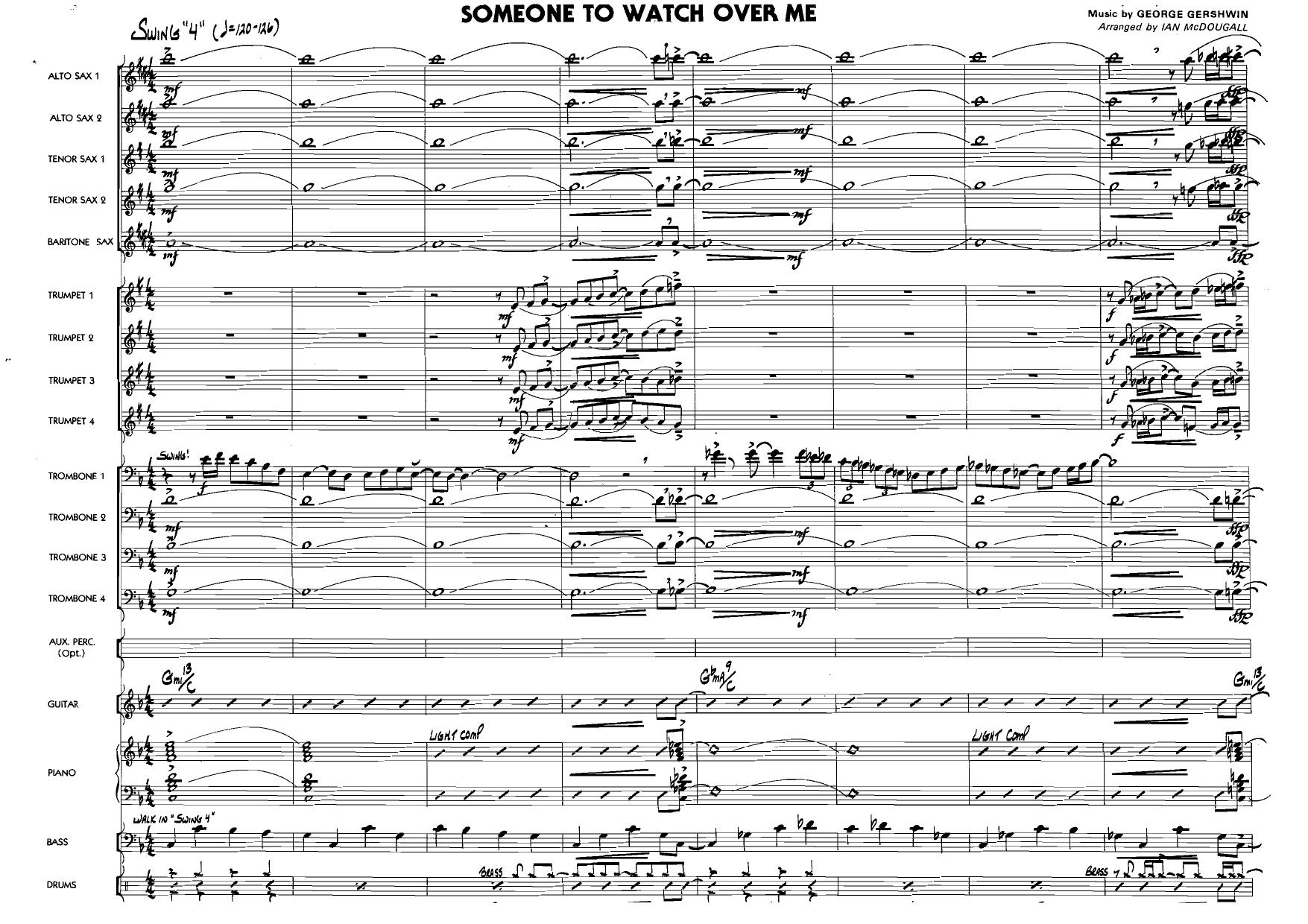
Someone To Watch Over Me (I.McDougall)
Composed by George Gershwin
Arranged by I.McDougall
- Ensemble: Big Band
- Style: Jazz Standard
- Pages: 46
- Instruments (18): Alto Sax 1, Alto Sax 2, Tenor Sax 1, Tenor Sax 2, Baritone Sax, Trumpet 1, Trumpet 2, Trumpet 3, Trumpet 4, Trombone 1 (Solo), Trombone 2, Trombone 3, Trombone 4, Aux Perc (Opt), Guitar, Piano, Bass, Drums
- Difficulty: advanced
- Content: Individual Parts
- Format: PDF Download (Instant)
- Price: $24.99
George Gershwin’s timeless 1926 ballad "Someone To Watch Over Me," originally penned for the Broadway musical *Oh, Kay!*, stands as one of the most enduring melodic achievements of the Great American Songbook. Over the decades, it transitioned from a sentimental theater tune into an essential jazz standard, interpreted by legendary vocalists and instrumentalists alike, including Ella Fitzgerald, Chet Baker, and Coleman Hawkins. Its harmonic sophistication—steeped in rich chromatic movement and poignant resolution—provides an ideal canvas for jazz composition, inviting deep emotional exploration and nuanced reharmonization. In this masterful big band setting, renowned arranger Ian McDougall transforms the classic ballad into a lush, expressive vehicle for the modern jazz ensemble. Conceived primarily as a slow, rubato-leaning ballad that settles into a deeply resonant, breath-controlled swing feel, the arrangement evokes a mood of introspection, warmth, and soaring romance. McDougall avoids the trap of heavy-handed sentimentality, instead employing sophisticated extended harmonies, gorgeous saxophone solis, and subtle dynamic shifts that build from fragile, exposed lines to a rich, full-ensemble warmth. The emotional arc moves fluidly from private reflection to grand, cinematic expansiveness. McDougall’s distinct compositional voice shines through in the sophisticated voicing of the reed and brass sections. The arrangement places significant emphasis on warm, low-register saxophone textures and gorgeous, shimmering trumpet and trombone pads that cushion the melody. The lead alto saxophone and flugelhorn (or lead trumpet) share primary melodic duties, requiring an exquisite sense of rubato timing and lyrical phrasing. A standout feature of the chart is a meticulously crafted chordal soli that showcases the section's blend and intonation, demanding precise control over subtle vibrato and dynamic shading. While there is no chaotic up-tempo shout chorus, the climax of the chart swells organically, utilizing full-ensemble block voicings that ring with lush ninth and thirteenth chords before resolving into a quiet, breathtaking final cadence. Advanced high school, collegiate, and professional big bands will find this arrangement an invaluable addition to their library. It serves as an exceptional showcase for a featured soloist—whether on tenor saxophone, trumpet, or trombone—while simultaneously challenging the ensemble's listening skills, balance, and stylistic maturity. Because it relies heavily on rubato pacing, dynamic restraint, and emotional depth rather than sheer velocity, it offers a refreshing, highly rewarding counterweight to standard up-tempo swinger charts in a concert program. Bringing Ian McDougall’s arrangement of "Someone To Watch Over Me" to life requires immense discipline in pacing, balance, and intonation. The primary technical challenge lies in the execution of the slow, rubato sections; the conductor must maintain absolute control over the ensemble’s breathing and subdivision to prevent dragging or rushing during unaccompanied or thinly scored passages. The tempo marking is a relaxed, ballad feel with a subtle, underlying pulse rather than a rigid swing drive. Rhythm section players must approach their roles with utmost economy—the piano should voice rich, sparse, Gershwin-esque chord extensions without crowding the texture, while the bass provides a deep, warm half-note or light walking foundation. Drummers should rely heavily on brushes, treating the cymbals as coloristic elements rather than timekeeping anchors. Special attention must be paid to blend within the saxophone and brass sections; flutter-tonguing or extreme mutes are absent, but players must execute precise dynamic swells (cresdecendi and decrescendi) on sustained whole notes. Rehearsal should begin with section-only work to isolate the dense harmonic voicings, ensuring that the inner voices of the chords are balanced evenly beneath the lead melody. Q: What instruments and parts are included in this arrangement? A: This chart is scored for a standard 18-instrument big band instrumentation, featuring 2 alto saxophones, 2 tenor saxophones, 1 baritone saxophone, 4 trumpets, 4 trombones, guitar, piano, bass, and drums, along with a comprehensive 92-page conductor score. Q: What is the difficulty level of this arrangement? A: It is graded as advanced, primarily due to the high demands placed on intonation, balance, dynamic control, and rubato phrasing rather than technical velocity or extreme range. Q: What is the historical and stylistic context of this chart? A: It reinterprets George Gershwin's 1926 Broadway standard through a sophisticated contemporary jazz big band lens, emphasizing lush harmonic textures, lyrical ballad playing, and subtle swing feels reminiscent of modern Canadian and American jazz orchestra traditions. Q: What makes Ian McDougall's arrangement unique compared to standard stock charts? A: McDougall's distinctive approach features intricate chordal solis, rich extended harmonies (ninths, elevenths, and thirteenths), and an organic architectural build that prioritizes warm, low-register section writing and emotional nuance over conventional big band bombast. Q: What is the typical performance duration and tempo of the piece? A: The arrangement is structured as a concert-length ballad lasting approximately 4 to 5 minutes, performed at a slow, expressive tempo that allows ample room for rubato interpretation and a featured instrumental solo.
Questions and answers
- What is included in the Someone To Watch Over Me (I.McDougall) PDF?
- The verified current file contains a conductor score and individual parts across 46 pages.
- How many instruments or parts are listed for Someone To Watch Over Me (I.McDougall)?
- The verified instrumentation list contains 18 entries for this Big Band arrangement.
- Who is credited for Someone To Watch Over Me (I.McDougall)?
- Composer: George Gershwin. Arranger: I.McDougall.
- What difficulty is listed for Someone To Watch Over Me (I.McDougall)?
- The verified difficulty level is advanced.
- What style is listed for Someone To Watch Over Me (I.McDougall)?
- The catalog lists the style as Jazz Standard.
- Can I preview Someone To Watch Over Me (I.McDougall) before buying?
- Yes. The product page provides a preview generated from the current PDF file.
- How is Someone To Watch Over Me (I.McDougall) delivered?
- After successful payment, the digital PDF is made available for download. The displayed price is $24.99.
Musicians Also Search For
Someone To Watch Over Me I.McDougall PDF • Someone To Watch Over Me I.McDougall sheet music • Someone To Watch Over Me arranged by I.McDougall • I.McDougall big band charts • I.McDougall jazz arrangements PDF • Someone To Watch Over Me George Gershwin sheet music • Someone To Watch Over Me George Gershwin big band arrangements • George Gershwin big band charts • Someone To Watch Over Me big band arrangements • Someone To Watch Over Me big band PDF download • Someone To Watch Over Me jazz sheet music • big band sheet music download • Someone To Watch Over Me conductor score PDF • Someone To Watch Over Me individual parts download • Someone To Watch Over Me sheet music PDF • Someone To Watch Over Me Jazz Standard charts • Jazz Standard big band arrangements • buy Someone To Watch Over Me sheet music • download Someone To Watch Over Me PDF • Someone To Watch Over Me jazz charts • best I.McDougall big band arrangements • George Gershwin arranged by I.McDougall • Someone To Watch Over Me printable sheet music • big band repertoire PDF