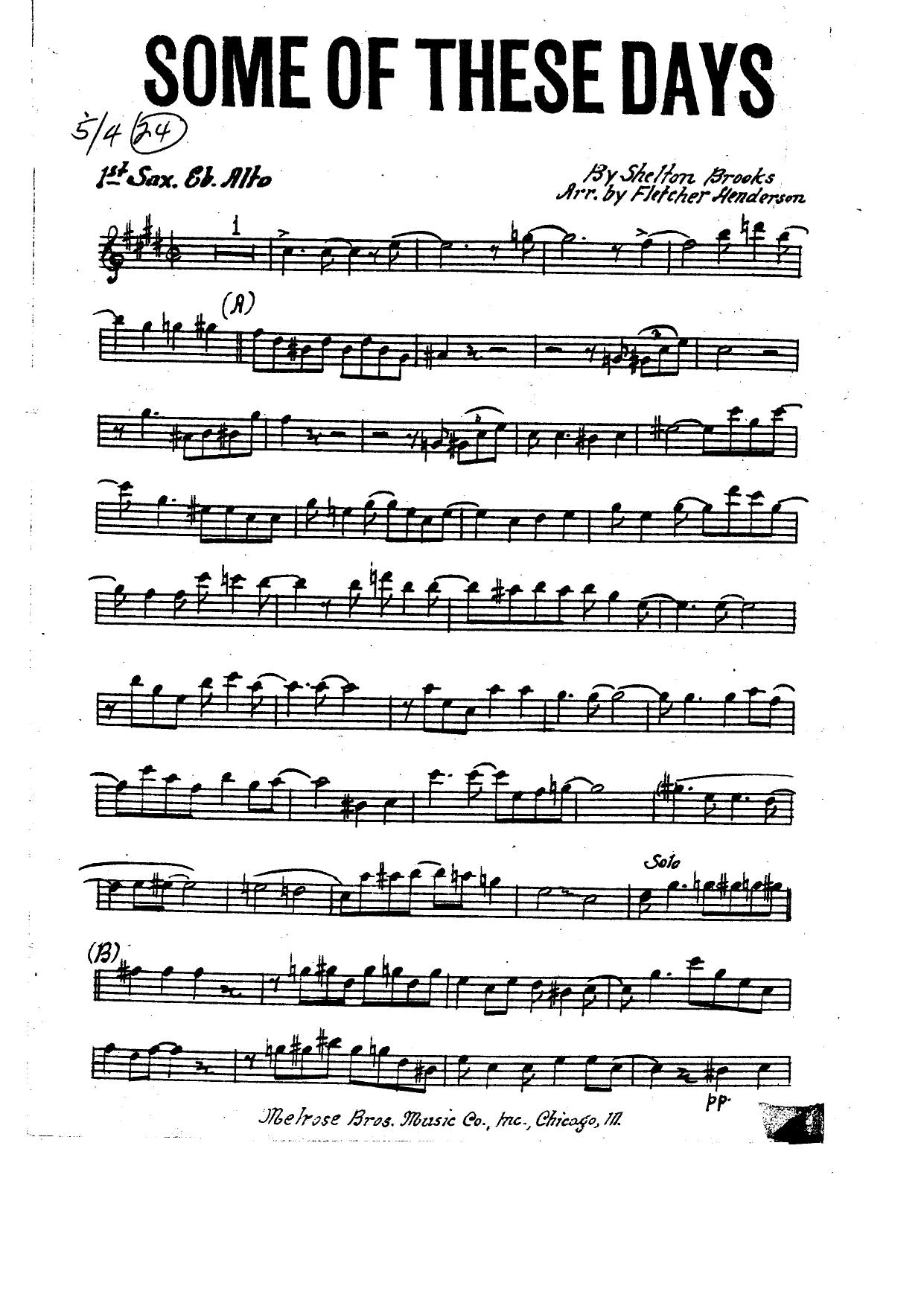
Some Of These Days (F.Henderson) sheet music preview

Some Of These Days (F.Henderson)

Composed by Shelton Brooks

Arranged by Fletcher Henderson

  • Ensemble: Big Band
  • Pages: 24
  • Instruments (15): 1st Sax. Eb Alto, 2nd Sax. Bb Tenor, 3rd Sax. Eb Alto, 4th Sax. Eb Baritone, 4th Sax. Eb Alto, 1st Bb Trumpet, 2nd Bb Trumpet, 3rd Bb Trumpet, 1st Trombone, 2nd Trombone, Piano, Violin (A), Guitar, Bass, Drums
  • Difficulty: medium
  • Content: Individual Parts
  • Format: PDF Download (Instant)
  • Price: $24.99

Shelton Brooks penned "Some Of These Days" in 1910, securing its place as an enduring Tin Pan Alley classic that found its ultimate jazz evolution in the hands of visionary architect Fletcher Henderson. Recorded during the vibrant crucible of the 1920s and 1930s swing era, Henderson’s interpretation transformed the standard vaudeville tune into a masterclass of pioneering big band arranging. As the man who essentially shaped the sound of the early Benny Goodman orchestra and led his own legendary Roseland Ballroom orchestra, Henderson infused the composition with the swinging drive, call-and-response textures, and sophisticated sectional writing that defined the transition from early New Orleans polyphony to large-ensemble swing. Driving forward with an infectious, buoyant medium-swing tempo in 4/4 time, this arrangement exudes an irrepressible vintage energy characterized by buoyant syncopation and a high-spirited, celebratory mood. The harmonic landscape balances early jazz simplicity with the richer, extended voicings that Henderson pioneered, evoking the smoky, high-energy atmosphere of Harlem's golden age of jazz clubs. Listeners and performers alike are immediately swept up in the jubilant momentum, where every phrase crackles with spontaneous-sounding vitality while maintaining absolute precision within the brass and reed sections. Henderson’s signature arranging style shines through brilliant sectional interplay, where the brass and saxophones trade rhythmic jabs before uniting in rich, harmonized block-chord solis. Rather than relying on static background accompaniment, Henderson treats every instrument as an active participant in a rolling counterpoint, utilizing staggered entrances, driving swing eighth notes, and a tightly wound shout chorus that builds maximum tension and release. The melodic responsibility shifts fluidly between the trumpet and saxophone sections, keeping the texture constantly evolving and engaging for both the players and the audience. Executing this chart successfully requires a mature sense of swing and stylistic authenticity, making it ideally suited for advanced high school, collegiate, community, and professional jazz ensembles looking to authentically explore the roots of big band history. While the 7-instrument flexible or compact instrumentation (featuring Alto Sax, Tenor Sax, Trumpet, Trombone, Piano, and rhythm section support) makes it remarkably versatile for smaller horn sections, it demands precise articulation, unified phrasing, and clean section balance. Performers will find immense satisfaction in navigating Henderson's clever transitional figures and the joyous, high-impact climaxes that reward meticulous rehearsal with an authentic, roof-raising vintage jazz sound. Navigating this Fletcher Henderson arrangement requires a deep commitment to 1920s and 30s swing articulation, prioritizing short, crisp staccatos and a bouncy, forward-leaning eighth-note feel rather than a modern, heavy-handed rock or contemporary jazz swing. The tempo should remain steady and danceable, avoiding any tendency to rush during the high-energy ensemble passages. Horn players must pay careful attention to dynamic contrasts, ensuring that background figures sit comfortably underneath whoever is carrying the primary melodic line. Special attention should be given to section blend; because this is a compact 7-instrument scoring, every individual voice functions almost like a soloist, leaving no room for a weak link in intonation or balance. Conductors should rehearse the syncopated figures slowly at first to lock in the placement of off-beat accents, gradually building up to the intended performance tempo. Encourage the rhythm section, particularly the piano and drums, to maintain a steady, unhurried comping style that anchors the buoyant horn lines without overplaying. Q: What instruments and parts are included in this arrangement? A: This chart is scored for a compact 7-instrument ensemble featuring Alto Saxophone, Tenor Saxophone, Trumpet, Trombone, Piano, and integrated rhythm section parts across a comprehensive 24-page score and parts set. Q: What is the difficulty level of this Fletcher Henderson arrangement? A: It is well-suited for intermediate to advanced ensembles, including skilled high school, collegiate, and professional groups, due to its requirement for precise section articulation, stylistic swing authenticity, and tight rhythmic coordination. Q: What is the historical style and background of this piece? A: Originally composed by Shelton Brooks in 1910, this piece is presented through Fletcher Henderson's iconic big band lens, capturing the pioneering swing-era aesthetic of the 1920s and 1930s jazz tradition. Q: What makes this specific arrangement unique? A: It showcases Henderson's masterclass approach to sectional interplay, utilizing brilliant call-and-response textures, clever counterpoint, and rich block-chord voicings that defined the evolution of early large-ensemble jazz. Q: What is the recommended performance tempo and duration? A: The arrangement is set in a buoyant medium-swing feel at a traditional dance tempo, typically resulting in a performance duration of approximately 3 to 4 minutes depending on the chosen repeats and solo extensions.

Questions and answers

What is included in the Some Of These Days (F.Henderson) PDF?
The verified current file contains individual parts across 24 pages.
How many instruments or parts are listed for Some Of These Days (F.Henderson)?
The verified instrumentation list contains 15 entries for this Big Band arrangement.
Who is credited for Some Of These Days (F.Henderson)?
Composer: Shelton Brooks. Arranger: Fletcher Henderson.
What difficulty is listed for Some Of These Days (F.Henderson)?
The verified difficulty level is medium.
Can I preview Some Of These Days (F.Henderson) before buying?
Yes. The product page provides a preview generated from the current PDF file.
How is Some Of These Days (F.Henderson) delivered?
After successful payment, the digital PDF is made available for download. The displayed price is $24.99.

Musicians Also Search For

Some Of These Days Fletcher Henderson PDFSome Of These Days Fletcher Henderson sheet musicSome Of These Days arranged by Fletcher HendersonFletcher Henderson big band chartsFletcher Henderson jazz arrangements PDFSome Of These Days Shelton Brooks sheet musicSome Of These Days Shelton Brooks big band arrangementsShelton Brooks big band chartsSome Of These Days big band arrangementsSome Of These Days big band PDF downloadSome Of These Days jazz sheet musicbig band sheet music downloadSome Of These Days individual parts downloadSome Of These Days sheet music PDFbuy Some Of These Days sheet musicdownload Some Of These Days PDFSome Of These Days jazz chartsbest Fletcher Henderson big band arrangementsShelton Brooks arranged by Fletcher HendersonSome Of These Days printable sheet musicbig band repertoire PDF

All arrangements by Fletcher Henderson All Shelton Brooks sheet music