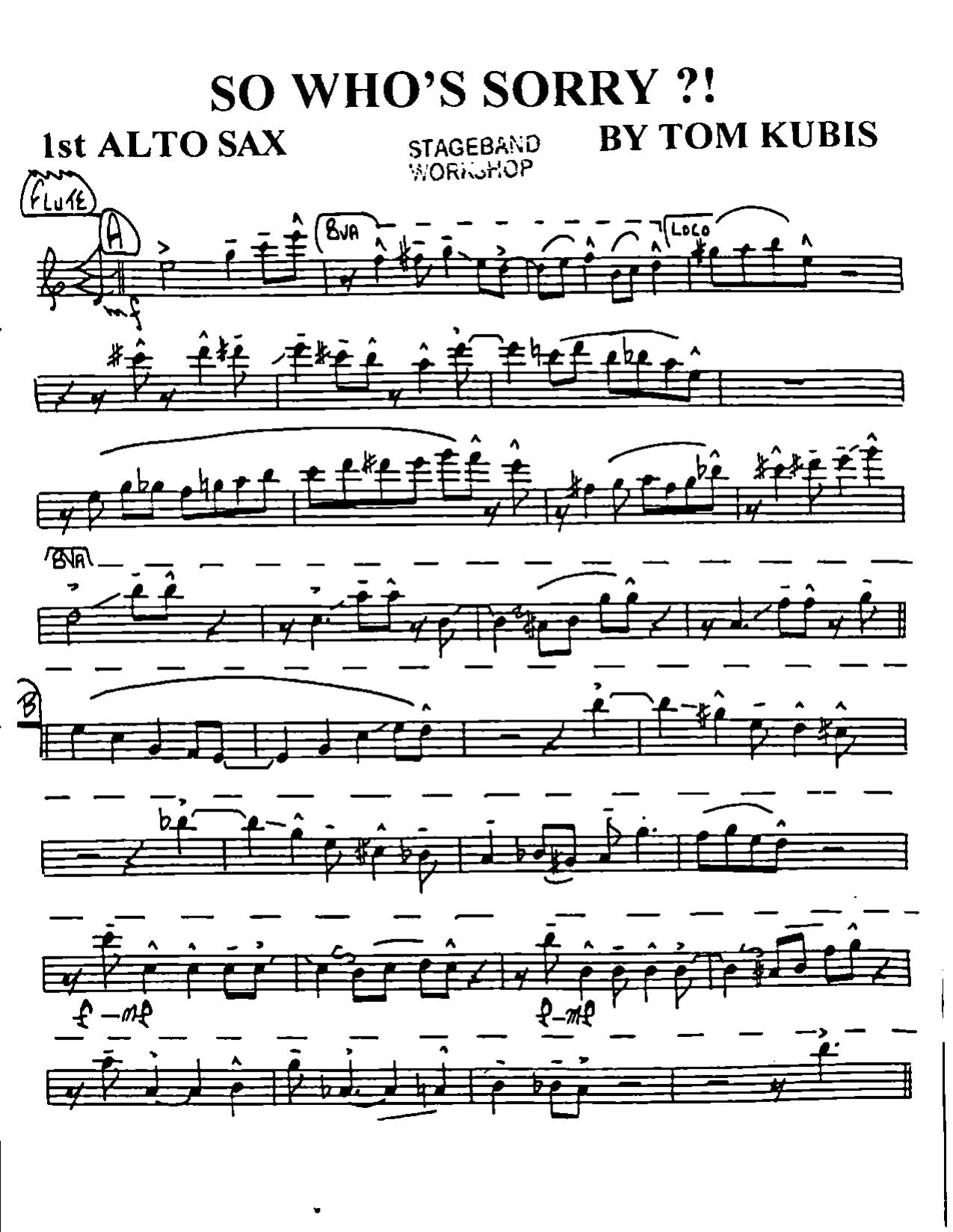
So Who's Sorry (T.Kubis)
Composed by Tom Kubis
Arranged by Tom Kubis
- Ensemble: Big Band
- Pages: 70
- Instruments (19): 1st Alto Sax, Alto II / Clarinet, Alto III, 2nd Alto Sax, 1st Tenor Sax, 2nd Tenor Sax, Baritone Sax, 1st Trumpet, 2nd Trumpet, 3rd Trumpet, 4th Trumpet, 1st Trombone, 2nd Trombone, 3rd Trombone, 4th Trombone, Piano, Bass, Drums, Guitar
- Difficulty: advanced
- Content: Individual Parts
- Format: PDF Download (Instant)
- Price: $24.99
Tom Kubis is widely celebrated as one of the most inventive and swinging writers in modern big band history, and *"So Who's Sorry"* stands as a prime example of his signature compositional voice. Rooted in the rich tradition of West Coast contemporary big band jazz, Kubis blends traditional swing propulsion with sophisticated, harmonically dense voicings that nod to arrangers like Sammy Nestico and Bob Florence, yet retain an unmistakable, irrepressible sense of humor and high-energy drive. Written in an era where modern big band writers sought to push standard harmonic boundaries while keeping audiences thoroughly entertained, this chart captures the vibrant spirit of contemporary mainstream jazz through clever thematic development and sparkling ensemble interplay. From downbeat, the arrangement establishes an infectious, driving medium-up swing groove characterized by crisp articulation, buoyant syncopation, and a playful swagger. The harmonic language is rich with extended and altered dominants, yet the voice-leading remains transparent, allowing the intricate inner lines to sing through the texture. Kubis frames the primary melodic material with bright, punchy brass hits and fluid saxophone counterlines that evoke the classic Los Angeles studio recording sessions. The emotional arc moves effortlessly from cheeky, driving segments to lush, harmonically suspended ensemble passages, maintaining a high level of engagement for both performers and listeners from the first measure to the final explosive chord. The roadmap of the chart features brilliant sectional writing, highlighted by a tightly knit sax soli that demands precision, unified breath support, and a light, agile articulation style. The brass section is utilized both as a powerhouse rhythmic engine and a lyrical counterpart, deploying stylistic devices such as crisp staccatos, dramatic falls, and soaring lead trumpet lines that anchor the upper register. A dynamic shout chorus near the conclusion acts as the structural climax, building relentless momentum through cyclical harmonic sequences before resolving into a high-octane tag ending. Solo opportunities are provided over standard, accessible changes, allowing featured improvisers to stretch out and converse directly with the surrounding ensemble background figures. Advanced high school, collegiate, and professional big bands will find this chart to be an exceptionally rewarding addition to their repertoire. While the chart is written for a flexible or reduced 7-instrument configuration (Alto Sax, Tenor Sax, Trumpet, Trombone, Piano, and rhythm section support), it packs the sonic weight and textural variety of a full 17-piece jazz orchestra across its 70 pages of comprehensive scoring. Ensemble directors will appreciate how the chart naturally trains musicians in stylistic consistency, swing subdivision, and dynamic contrast, making it an ideal centerpiece for festival competition sets or sophisticated concert programs. Successfully executing *"So Who's Sorry"* requires absolute rhythmic precision and a deep commitment to a buoyant, forward-moving swing feel. The tempo should be kept right in the sweet spot of a comfortable medium-up swing—fast enough to generate genuine excitement, but relaxed enough to let eighth notes breathe without rushing. Conductors must ensure that the rhythm section locks in tightly; the drummer should maintain a feather-light ride cymbal pattern with crisp hi-hat chicks on beats two and four, avoiding heavy backbeats that could bog down the chart's inherent bounce. In terms of technical challenges, the horn sections must master the dynamic contrast between hushed, harmonically complex background figures and roaring, unforced ensemble peaks. Pay close attention to short articulations—quarter notes and eighth notes should be clipped cleanly without losing their core tone. Brass players should execute stylistic markings such as doits and falls with intentional pitch control rather than arbitrary sliding. During rehearsal, isolate the intricate sax soli and practice it under tempo with a metronome clicking only on beats two and four before bringing it up to performance speed. Balance is key: ensure the rhythm section piano voicings do not clash with the closely spaced upper-structure extensions scored in the horns. Q: What specific instruments and parts are included in this 70-page publication? A: This arrangement is scored for a 7-instrument ensemble configuration consisting of Alto Saxophone, Tenor Saxophone, Trumpet, Trombone, Piano, Bass, and Drums, optimized to deliver a full big band sound with reduced personnel. Q: What is the difficulty level of this Tom Kubis arrangement? A: This chart is graded as advanced, making it ideal for skilled high school jazz ensembles, collegiate groups, and professional freelance big bands looking for sophisticated West Coast swing writing. Q: What musical style and historical era does this piece represent? A: It represents contemporary mainstream West Coast big band jazz, embodying the swinging, harmonically advanced, and high-energy arranging style pioneered by Tom Kubis in the late 20th and early 21st centuries. Q: What makes this particular arrangement unique compared to standard big band charts? A: Kubis packs the sonic density and clever voice-leading of a full 17-piece jazz orchestra into a compact 7-instrument setup, featuring signature witty harmonic turns, dynamic shout choruses, and intricate sectional solis. Q: What is the recommended performance tempo and duration for this piece? A: The arrangement is set in a driving medium-up swing feel with a performance duration of approximately 4 to 5 minutes, depending on the length of the improvised solo choruses.
Questions and answers
- What is included in the So Who's Sorry (T.Kubis) PDF?
- The verified current file contains individual parts across 70 pages.
- How many instruments or parts are listed for So Who's Sorry (T.Kubis)?
- The verified instrumentation list contains 19 entries for this Big Band arrangement.
- Who is credited for So Who's Sorry (T.Kubis)?
- Composer: Tom Kubis. Arranger: Tom Kubis.
- What difficulty is listed for So Who's Sorry (T.Kubis)?
- The verified difficulty level is advanced.
- Can I preview So Who's Sorry (T.Kubis) before buying?
- Yes. The product page provides a preview generated from the current PDF file.
- How is So Who's Sorry (T.Kubis) delivered?
- After successful payment, the digital PDF is made available for download. The displayed price is $24.99.
Musicians Also Search For
So Who's Sorry Tom Kubis PDF • So Who's Sorry Tom Kubis sheet music • So Who's Sorry arranged by Tom Kubis • Tom Kubis big band charts • Tom Kubis jazz arrangements PDF • So Who's Sorry Tom Kubis big band arrangements • So Who's Sorry big band arrangements • So Who's Sorry big band PDF download • So Who's Sorry jazz sheet music • big band sheet music download • So Who's Sorry individual parts download • So Who's Sorry sheet music PDF • buy So Who's Sorry sheet music • download So Who's Sorry PDF • So Who's Sorry jazz charts • best Tom Kubis big band arrangements • So Who's Sorry printable sheet music • big band repertoire PDF