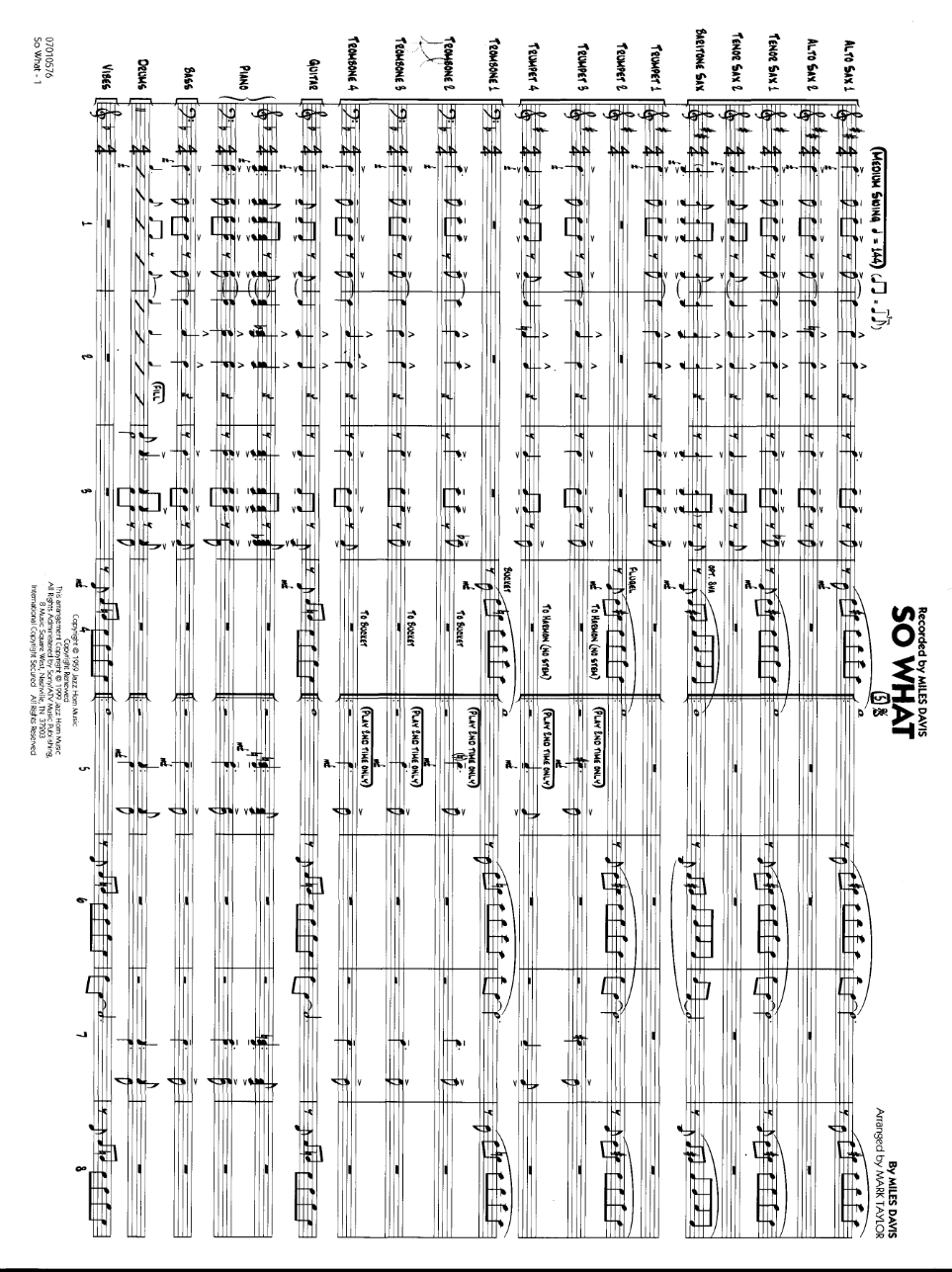
So What (M.Taylor)
Composed by Miles Davis
Arranged by Mark Taylor
- Ensemble: Big Band
- Pages: 44
- Instruments (20): Alto Sax 1, Alto Sax 2, Tenor Sax 1, Tenor Sax 2, Baritone Sax, Trumpet 1, Trumpet 2, Trumpet 3, Trumpet 4, Trombone 1, Trombone 2, Trombone 3, Trombone 4, Guitar, Piano, Bass, Drums, Vibes, Solo Sheet - Saxes, Solo Sheet - Brass
- Difficulty: medium
- Content: Individual Parts
- Format: PDF Download (Instant)
- Price: $24.99
Modal jazz underwent a monumental shift when Miles Davis recorded the definitive version on his 1959 landmark album *Kind of Blue*. Built upon a minimalist two-chord structure in D minor and Eb minor, the composition revolutionized improvisational concepts by encouraging soloists to navigate harmonic landscapes using scale choices rather than rapid chord changes. As one of the most revered jazz standards in the twentieth-century canon, the tune remains a masterclass in space, tension, and release, originally popularized by Davis alongside jazz titans like John Coltrane, Cannonball Adderley, and Bill Evans. Mark Taylor’s masterwork big band adaptation breathes fresh vitality into this iconic modal framework while respecting the stark elegance of the original recording. Maintaining the unmistakable medium-groove swing feel, the chart opens with the signature upright bass ostinato before expanding the iconic theme across the full brass and reed sections. The mood is effortlessly cool yet crackling with underlying intensity, evoking the smoky sophistication of late-fifties modern jazz clubs. Taylor employs rich, open-voiced horn harmonies that capture the vast, spacious feeling of modal writing, punctuated by sophisticated ensemble interplay that keeps the momentum driving forward. Throughout the arrangement, the melody is passed seamlessly between the saxophones and muted brass, creating dynamic contrast and textural variety. Featured solo spaces allow competent improvisers to stretch out over the timeless D Dorian and Eb Dorian vamp, supported by crisp background figures from the ensemble. The technical demands center less on executing lightning-fast bebop changes and more on stylistic precision, rhythmic exactness, and maintaining a relaxed, pocket-driven swing feel at a moderate tempo. The ensemble writing rewards precision in phrasing and dynamic control, particularly during subtle transitional interludes and sophisticated shout choruses that build organically without losing the cool-jazz aesthetic. Advanced high school, collegiate, and professional big bands will find this arrangement an exceptional vehicle for developing modal improvisational vocabulary and section cohesion. Because the harmonic hurdles are streamlined, directors can focus heavily on stylistic nuance, articulation, and ensemble blend. It serves as an ideal centerpiece for educational concerts, festival repertoires, and professional club dates, offering audiences an unforgettable journey through one of the most influential compositions in jazz history. Achieving an authentic performance of this arrangement requires a disciplined approach to the medium swing feel, prioritizing a relaxed yet driving groove over heavy articulation. The rhythm section is the anchor; the bass and drums must lock into an unyielding, conversational pocket, avoiding any tendency to rush the tempo. Horn players should focus on clean, precise phrasing with controlled vibrato, ensuring that the open modal harmonies ring clearly without muddying the texture. Muted brass sections should balance their brilliance with warmth to match the classic West Coast / cool jazz aesthetic. During open solo sections, the rhythm section must dynamically react to the soloist while maintaining the underlying modal vamp, allowing ample breathing room for spatial exploration. Rehearsals should initially isolate the rhythm section groove before layering in the saxes and brass, paying meticulous attention to dynamic balance during the signature ensemble solis. Q: What instruments and parts are included in this big band publication? A: The complete 44-page arrangement is scored for an 18-piece standard big band instrumentation, featuring Alto Saxophone 1, Alto Saxophone 2, Tenor Saxophone 1, Tenor Saxophone 2, Baritone Saxophone, four trumpets, four trombones, guitar, piano, bass, drums, and a comprehensive conductor score. Q: What is the difficulty level of Mark Taylor's arrangement? A: This chart is graded as medium-advanced, making it well-suited for advanced high school ensembles, college jazz bands, and professional community groups looking to refine their modal jazz interpretation and section blend. Q: How does this arrangement fit into the historical context of jazz? A: It reimagines Miles Davis’s legendary 1959 modal composition from *Kind of Blue*, translating the groundbreaking, scale-based improvisational vehicle into a rich, full-ensemble big band format. Q: What makes this specific arrangement by Mark Taylor unique? A: Taylor expertly balances the minimalist, spacious ethos of the original recording with lush, contemporary big band voicings and clever background figures that give every section a chance to shine. Q: What is the performance tempo and expected duration of the piece? A: The arrangement is set at a comfortable medium swing tempo (approximately 132 beats per minute) and typically runs around 4 to 6 minutes depending on the length of the open solo rotations.
Questions and answers
- What is included in the So What (M.Taylor) PDF?
- The verified current file contains a conductor score and individual parts across 44 pages.
- How many instruments or parts are listed for So What (M.Taylor)?
- The verified instrumentation list contains 20 entries for this Big Band arrangement.
- Who is credited for So What (M.Taylor)?
- Composer: Miles Davis. Arranger: Mark Taylor.
- What difficulty is listed for So What (M.Taylor)?
- The verified difficulty level is medium.
- Can I preview So What (M.Taylor) before buying?
- Yes. The product page provides a preview generated from the current PDF file.
- How is So What (M.Taylor) delivered?
- After successful payment, the digital PDF is made available for download. The displayed price is $24.99.
Musicians Also Search For
So What Mark Taylor PDF • So What Mark Taylor sheet music • So What arranged by Mark Taylor • Mark Taylor big band charts • Mark Taylor jazz arrangements PDF • So What Miles Davis sheet music • So What Miles Davis big band arrangements • Miles Davis big band charts • So What big band arrangements • So What big band PDF download • So What jazz sheet music • big band sheet music download • So What conductor score PDF • So What individual parts download • So What sheet music PDF • buy So What sheet music • download So What PDF • So What jazz charts • best Mark Taylor big band arrangements • Miles Davis arranged by Mark Taylor • So What printable sheet music • big band repertoire PDF