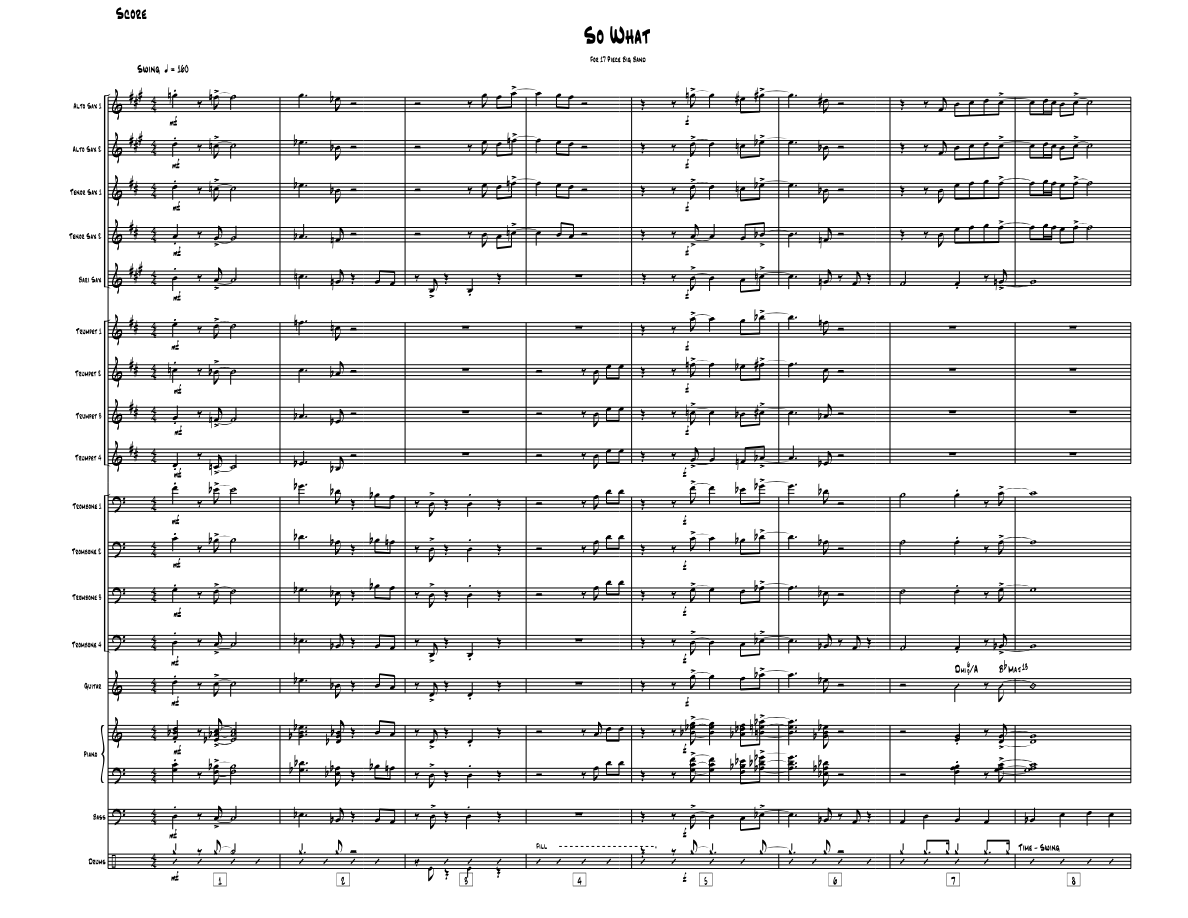
So What (J.Martin)
Composed by Miles Davis
Arranged by Jim Martin
- Ensemble: Big Band
- Pages: 97
- Instruments (17): Alto Sax 1, Alto Sax 2, Tenor Sax 1, Tenor Sax 2, Bari Sax, Trumpet 1, Trumpet 2, Trumpet 3, Trumpet 4, Trombone 1, Trombone 2, Trombone 3, Trombone 4, Guitar, Piano, Bass, Drums
- Difficulty: advanced
- Content: Individual Parts
- Format: PDF Download (Instant)
- Price: $24.99
Originally recorded on Miles Davis’s landmark 1959 Columbia Records masterpiece *Kind of Blue*, "So What" stands as the definitive anthem of modal jazz. Eschewing the complex, rapidly shifting chord changes of bebop, Davis and his sextet—featuring John Coltrane, Cannonball Adderley, Bill Evans, Paul Chambers, and Jimmy Cobb—built an entire composition around two adjacent Dorian modes in D minor and Eb minor. This revolutionary framework forced improvisers to rely on melodic invention, space, and linear phrasing rather than vertical harmonic navigation. As the quintessential gateway into modal improvisation, the tune remains a cornerstone of the jazz canon, challenging ensembles to maintain deep, hypnotic momentum without the safety net of frequent chord substitutions. Jim Martin’s expansive big band adaptation translates the intimate, lingering tension of the original sextet recording into a rich, texturally diverse canvas. Set at a cool, measured medium-swing tempo, the chart captures the sophisticated, urbane atmosphere of late-1950s modern jazz while expanding the sonic palette through lush harmonic voicings and dynamic contrast. The mood oscillates between smoky, understated introspection during the thematic statements and commanding, brass-heavy intensity during the ensemble build-ups. The iconic bass motif—famously answered by crisp, staccato horn stabs—retains its central structural role, anchoring the arrangement while allowing the harmonic undercurrents to shift effortlessly between the home key and its half-step modal neighbor. Reimagining a tune famous for its minimalist economy requires a delicate balance of space and power, and Martin achieves this by distributing thematic material thoughtfully across the entire 17-piece ensemble. The famous call-and-response head is initially stated by the bass and low reeds before being echoed by shimmering saxophone solis and muted brass counterlines. Solo space is thoughtfully integrated, providing a flexible framework for your strongest horn players to stretch out over the modal vamps. Technically, the chart demands exceptional internal time-feel, immaculate section blending, and dynamic control rather than blazing finger-buster technique. The saxophones require agile phrasing for flowing modal lines, while the brass must master subtle color changes using cup and straight mutes to emulate the cool-school aesthetic. Advanced high school ensembles with strong section leaders, as well as collegiate and professional big bands, will find this arrangement an ideal vehicle for developing modal sophistication and stylistic maturity. Because the harmony does not move rapidly, directors can use this chart to teach advanced concepts of phrasing, swing subdivision, and linear melodic development. The 97-page publication includes a comprehensive conductor score alongside all 17 individual instrumental parts, ensuring that every player has the detailed context needed to execute Martin’s sophisticated interpretation with precision and authentic jazz articulation. The primary technical challenge in executing Jim Martin’s chart lies in sustaining an effortless, driving medium-swing feel without rushing or dragging. The rhythm section must lock into a relaxed, unhurried groove where the quarter note is heavy and the eighth notes maintain a subtle, late-swing placement. Conductors should emphasize that modal tunes require supreme dynamic sensitivity; the tension in "So What" comes from restraint, not volume. Saxophone sections must focus on seamless legato phrasing during linear modal passages, ensuring that articulations match precisely across all four chairs. Brass players should utilize clean, unforced attacks, employing standard straight and cup mutes where indicated to achieve the requisite smoky, atmospheric timbre of the cool jazz era. Rehearsal time should be heavily invested in the interplay between the rhythm section and the horn backgrounds, ensuring that the iconic call-and-response figures snap together with absolute rhythmic precision and zero lag. Q: What instruments and parts are included in this arrangement? A: This 17-instrument big band arrangement includes full parts for Alto Saxophone 1, Alto Saxophone 2, Tenor Saxophone 1, Tenor Saxophone 2, Baritone Saxophone, four trumpets, four trombones, guitar, piano, bass, drums, and a comprehensive conductor score across 97 pages. Q: What is the difficulty level of this Jim Martin arrangement? A: It is targeted at advanced high school, collegiate, and professional big bands that possess solid ensemble reading skills, good intonation, and a strong grasp of medium-swing and modal styles. Q: What is the historical context and musical style of "So What"? A: Originally composed by Miles Davis for his 1959 modal jazz masterpiece *Kind of Blue*, this piece revolutionized jazz by trading complex bebop chord changes for expansive Dorian mode vamps. Q: What makes this specific arrangement by Jim Martin unique? A: Martin brilliantly scales down the intimate tension of the original small-group recording into a rich 17-piece big band canvas, utilizing sophisticated modal voicings, dynamic textural shifts, and clever counterlines. Q: What is the recommended performance tempo and duration? A: The arrangement is set at a cool, relaxed medium-swing tempo (approximately 116–124 BPM), with a standard performance duration of roughly 5 to 6 minutes depending on soloist rotations.
Questions and answers
- What is included in the So What (J.Martin) PDF?
- The verified current file contains a conductor score and individual parts across 97 pages.
- How many instruments or parts are listed for So What (J.Martin)?
- The verified instrumentation list contains 17 entries for this Big Band arrangement.
- Who is credited for So What (J.Martin)?
- Composer: Miles Davis. Arranger: Jim Martin.
- What difficulty is listed for So What (J.Martin)?
- The verified difficulty level is advanced.
- Can I preview So What (J.Martin) before buying?
- Yes. The product page provides a preview generated from the current PDF file.
- How is So What (J.Martin) delivered?
- After successful payment, the digital PDF is made available for download. The displayed price is $24.99.
Musicians Also Search For
So What Jim Martin PDF • So What Jim Martin sheet music • So What arranged by Jim Martin • Jim Martin big band charts • Jim Martin jazz arrangements PDF • So What Miles Davis sheet music • So What Miles Davis big band arrangements • Miles Davis big band charts • So What big band arrangements • So What big band PDF download • So What jazz sheet music • big band sheet music download • So What conductor score PDF • So What individual parts download • So What sheet music PDF • buy So What sheet music • download So What PDF • So What jazz charts • best Jim Martin big band arrangements • Miles Davis arranged by Jim Martin • So What printable sheet music • big band repertoire PDF