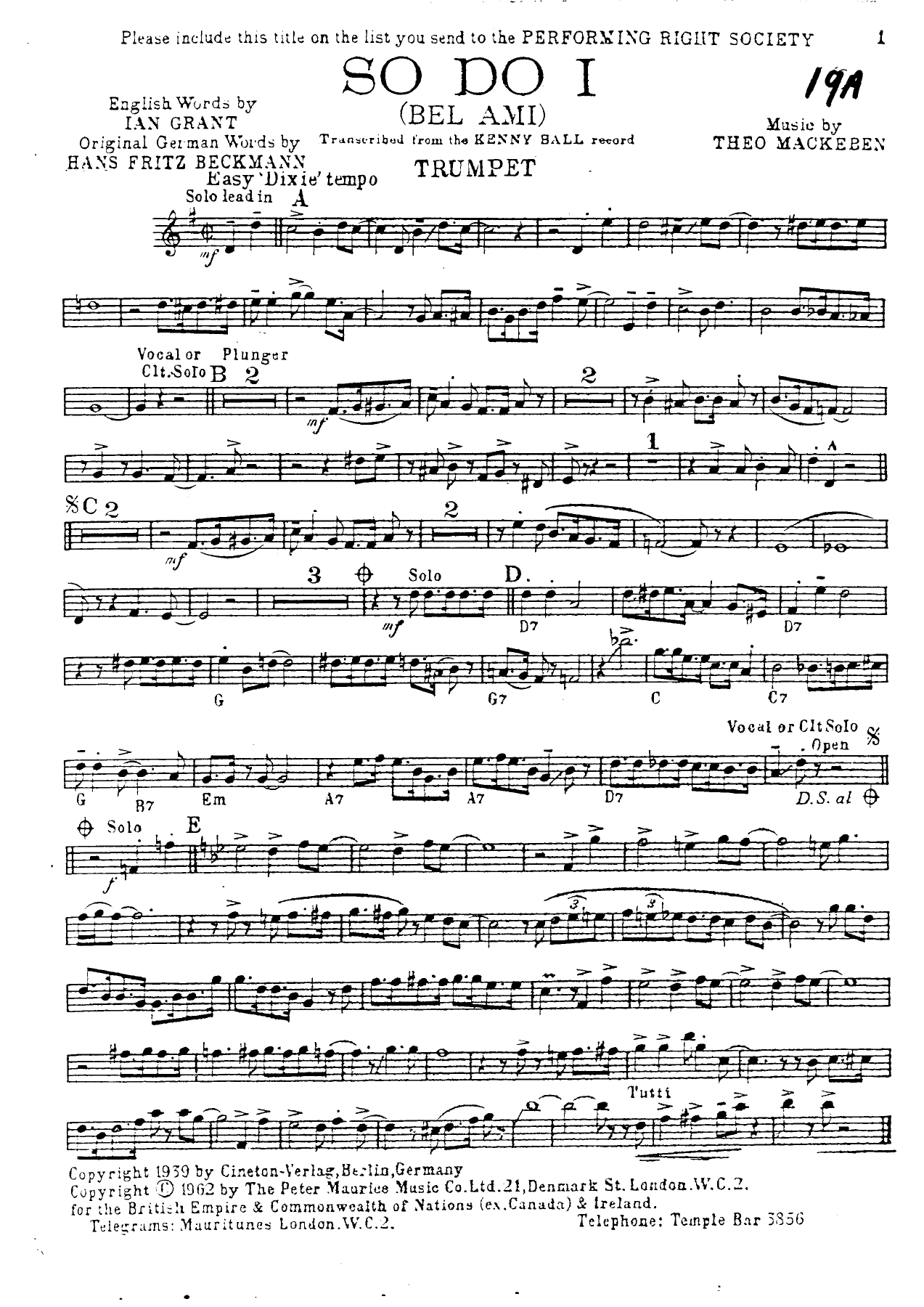
So Do I (K.Ball) sheet music preview

So Do I (K.Ball)

Composed by Kenny Ball

Arranged by Kenny Ball

  • Ensemble: Dixieland Band
  • Style: Jazz Standard
  • Pages: 11
  • Difficulty: easy
  • Content: Sheet Music
  • Format: PDF Download (Instant)
  • Price: $18.99

"So Do I" emerged in 1962 as a vibrant original composition from the trumpet and bandleader Kenny Ball, becoming a signature tune for Kenny Ball and His Jazzmen during the burgeoning UK Trad Jazz revival. This period saw a resurgence of interest in Dixieland jazz, a style rooted in early 20th-century New Orleans, characterized by its lively, collective improvisation and a brassy, celebratory sound. Dixieland, or Traditional Jazz, gained widespread popularity in the 1940s and experienced a significant revival in the UK in the early 1960s, with Kenny Ball's band at the forefront, alongside contemporaries like Acker Bilk and Chris Barber. The piece embodies the joyful, accessible spirit that made Dixieland a beloved genre, drawing influences from ragtime, blues, and military marching band music. Musically, "So Do I" is a quintessential medium-swing Dixieland standard, typically performed in a bright, optimistic major key that evokes a feeling of cheerful exuberance. The energy is consistently high, driven by a buoyant two-beat feel in the rhythm section, providing a solid, danceable foundation. The piece's character is defined by its polyphonic texture, where the "front line" instruments—trumpet, clarinet, and trombone—engage in simultaneous melodic embellishment and counterpoint, creating a rich, interwoven soundscape. This collective improvisation, a hallmark of the Dixieland style, contributes to the arrangement's infectious, feel-good mood. The harmonies are generally functional and straightforward, utilizing unembellished triads and seventh chords, which are characteristic of the genre and contribute to its immediate appeal. Kenny Ball's arrangement of "So Do I" showcases his distinctive approach to Dixieland, emphasizing clarity in the melodic lines while preserving the genre's improvisational spirit. As the bandleader and lead trumpeter, Ball often featured his own skillful trumpet playing, which would typically carry the main melodic statement or a recognizable paraphrase. The arrangement likely features a traditional Dixieland structure, beginning with an ensemble chorus of collective improvisation, followed by alternating solo sections for the front-line instruments, and culminating in a powerful shout chorus where the entire band unites for a spirited, harmonized finale. Ball's arrangements are known for their judicious choice of material and ability to maintain the genre's high profile, making them rewarding to perform due to their inherent musicality and audience engagement. Performance of this arrangement is a rewarding experience, particularly for the interplay within the front line. The trumpet typically states the melody, with the clarinet weaving intricate, arpeggiated countermelodies above it, and the trombone providing "tailgate" harmonies, glissandi, and robust counter-lines. Featured solos are integral, offering opportunities for individual expression within the collective framework. Technical challenges include maintaining rhythmic precision in the driving two-beat feel, executing clean collective improvisation, and ensuring balance within the polyphonic texture. The arrangement is well-suited for high school, college, and community jazz ensembles looking to explore authentic Dixieland repertoire. Its accessible harmonies and clear melodic structure make it an excellent teaching tool for understanding collective improvisation and the roles of each instrument in a traditional jazz setting, while still offering enough challenge for more advanced players to refine their stylistic nuances. This arrangement of "So Do I" thrives on a medium-swing tempo with a buoyant two-beat feel, emphasizing beats one and three in the bass and tuba. Conductors should encourage a light, driving rhythmic pulse rather than a heavy, four-square approach. Key technical challenges include maintaining rhythmic precision during collective improvisation sections, particularly for the front line (trumpet, clarinet, trombone), where individual melodic lines must interlock without clashing. Rehearsal should focus on developing a clear understanding of each instrument's role: the trumpet leading the melody, the clarinet providing agile counter-melodies, and the trombone offering harmonic support and rhythmic punctuation with glissandi. Encourage players to listen actively and respond to each other. Special techniques like plunger mutes for brass, and subtle falls and doits for the trombone and clarinet, will enhance the authentic Dixieland sound. Practice the shout chorus for maximum impact, ensuring strong dynamics and unified articulation. Q: What instruments/parts are included in this arrangement? A: This arrangement for Dixieland Band typically includes parts for trumpet, clarinet, trombone, banjo (or guitar), piano, tuba (or string bass), and drums. Q: What is the difficulty level of this arrangement? A: This arrangement is suitable for intermediate to advanced high school, college, and community jazz ensembles. It offers accessible harmonies for learning while providing opportunities for developing collective improvisation and stylistic authenticity. Q: What is the musical style and historical context of "So Do I (K.Ball)"? A: "So Do I" is a Dixieland jazz standard, composed by Kenny Ball and popularized by his band during the UK Trad Jazz revival of the early 1960s. It embodies the lively, polyphonic, and celebratory sound of early 20th-century New Orleans jazz. Q: What makes this specific arrangement unique? A: Kenny Ball's arrangement of "So Do I" highlights his signature blend of clear melodic presentation with the dynamic, collective improvisation characteristic of Dixieland, ensuring a vibrant and engaging performance for both musicians and audiences. Q: What is the typical performance duration or tempo for "So Do I"? A: "So Do I" is a medium-swing piece, typically performed at a bright, danceable tempo, resulting in a performance duration usually between two and four minutes, depending on the number and length of improvised solos.

Musicians Also Search For

So Do I Kenny Ball PDFSo Do I Kenny Ball sheet musicSo Do I arranged by Kenny BallKenny Ball dixieland band chartsKenny Ball jazz arrangements PDFSo Do I Kenny Ball dixieland band arrangementSo Do I dixieland band arrangementSo Do I dixieland band PDF downloadSo Do I jazz ensemble sheet musicdixieland band sheet music instant downloadSo Do I sheet music with partsSo Do I Jazz Standard chartJazz Standard dixieland band arrangementsbuy So Do I sheet music onlinedownload So Do I PDFSo Do I jazz chartbest Kenny Ball dixieland band arrangementsSo Do I printable sheet musicdixieland band repertoire PDF

All arrangements by Kenny Ball All Kenny Ball sheet music