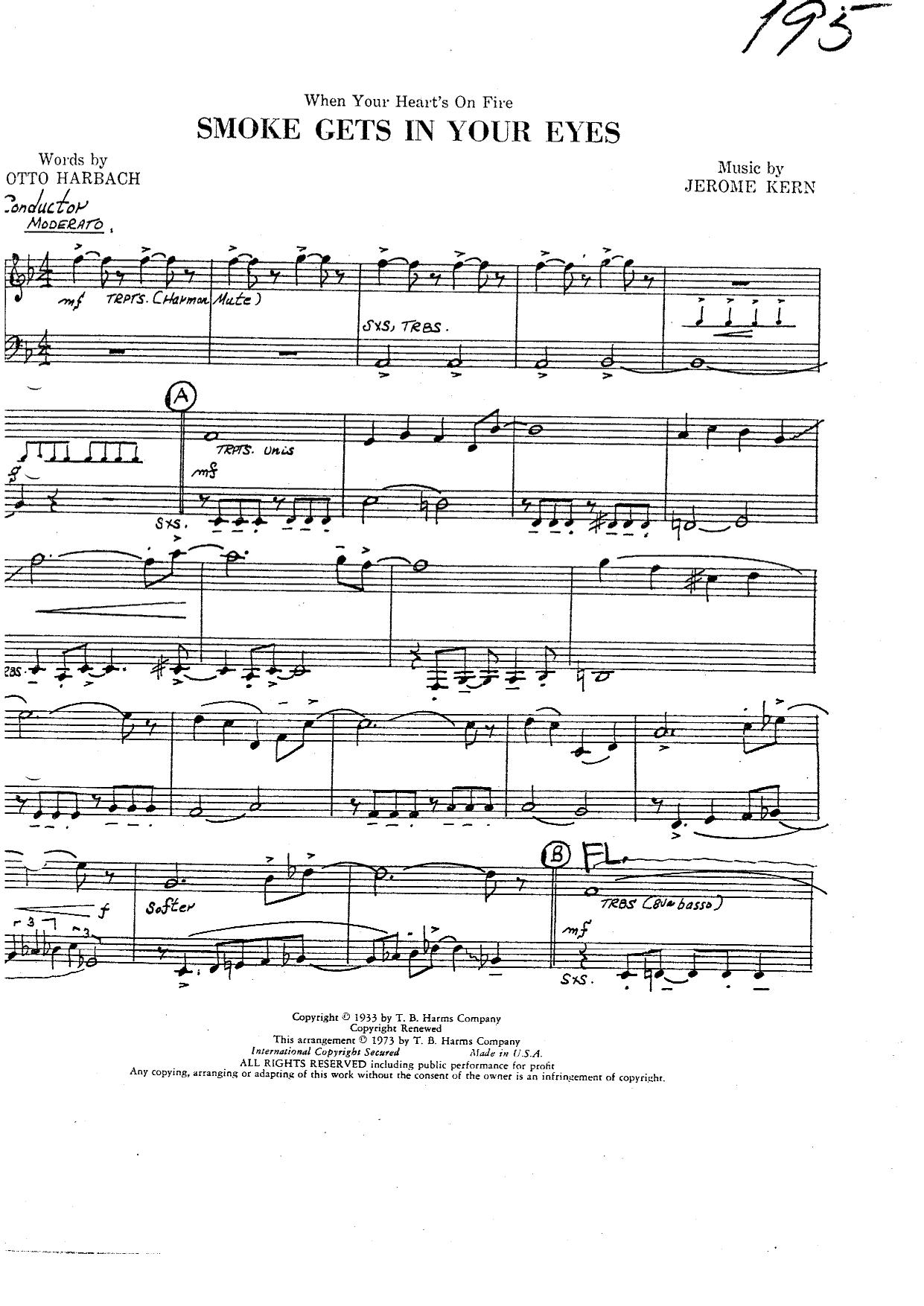
Smoke Gets In Your Eyes sheet music preview

Smoke Gets In Your Eyes

Composed by Jerome Kern

Arranged by Unknown

  • Ensemble: Big Band
  • Style: Jazz Standard
  • Pages: 44
  • Instruments (20): Conductor, Alto Saxophone I, Alto Saxophone II, Tenor Saxophone I, Tenor Saxophone II, Baritone Saxophone, Trumpet I, Trumpet II, Trumpet III, Trumpet IV, Trombone I, Trombone II, Trombone III, Trombone IV, Piano, Guitar, Bass, Tuba, Drums, Flute
  • Difficulty: medium
  • Content: Individual Parts
  • Format: PDF Download (Instant)
  • Price: $24.99

Jerome Kern and Otto Harbach’s timeless masterpiece "Smoke Gets In Your Eyes"—originally introduced in the 1933 Broadway musical *Roberta* and later immortalized by The Platters, Art Tatum, and countless jazz luminaries—stands as one of the quintessential jewels of the Great American Songbook. This classic standard bridges the gap between early 20th-century theatrical songwriting and sophisticated post-swing jazz harmonic language, offering ensembles a rich canvas for expressive rubato playing, lush chord clusters, and profound emotional storytelling. Unfolding primarily as a lush, evocative ballad with subtle metric shifts and floating tempo feels, this big band interpretation evokes a deeply nostalgic, cinematic atmosphere. The mood swings masterfully between hauntingly introspective stillness and sweeping, romantic cinematic grandeur. The arrangement opens with an atmospheric, rubato chordal introduction in the brass and reeds before settling into a warm, expressive 4/4 ballad tempo. Rich, extended voicings—utilizing major sevenths, ninths, and altered dominants—permeate the saxophone section, creating a dense, velvet-textured harmonic bed that honors the sophisticated DNA of the original Kern composition while pushing into modern jazz territory. The arrangement brilliantly balances tutti ensemble writing with delicate textural contrasts. The melody is initially stated by a featured solo instrument—ideally tenor saxophone or flugelhorn—supported by softly shimmering muted brass and sustained reed pads. As the chart progresses, the arrangement expands dynamically, featuring a soaring saxophone soli that showcases seamless section blend and intonation control. While there is no high-octane shout chorus, the climax of the chart delivers a breathtaking, full-ensemble swell characterized by cascading upper-structure triads and a gorgeous modulating transition that lifts the harmonic center before resolving back to the home key for a tender, whispered coda. Advanced high school, collegiate, and professional big bands will find this arrangement an exceptional vehicle for developing mature ballad-playing skills, dynamic control, and ensemble listening. Because success relies heavily on breath support, intonation across extreme registers, and subtle rubato phrasing rather than sheer velocity, it serves as an invaluable masterclass in musicality and taste. It is an ideal centerpiece for formal concert settings, festival performances, or sophisticated jazz club sets where emotional depth and refined execution take precedence. Mastering this arrangement requires meticulous attention to breath support, intonation, and stylistic unity across all sections. Conductors should emphasize that a ballad does not mean a lack of momentum; the underlying subdivision must remain alive and fluid, especially during rubato transitions. The primary technical challenge lies in the execution of the dense, extended-tertian harmonies; saxophone and brass sections must spend dedicated rehearsal time balancing internal chord tones so that the upper extensions—such as 9ths, #11s, and 13ths—shimmer without distorting the fundamental pitch center. Subtle coloristic effects are utilized sparingly but effectively, including gentle cup and straight mutes in the trumpet and trombone sections to create a warm, veiled timbre during the head statements. Rehearsals should begin with slow, chorale-style tone matching of the chord voicings independently of the rhythm section, ensuring that the players listen across sections to lock in the tuning of major sevenths and minor ninths. Pay close attention to the dynamic arc; avoid overblowing in the middle registers, allowing the natural resonance of the big band instrumentation to fill the acoustic space organically. Q: What instruments and parts are included in this big band arrangement? A: The arrangement is scored for a standard 18-instrument big band instrumentation, featuring Alto Saxophone 1, Alto Saxophone 2, Tenor Saxophone 1, Tenor Saxophone 2, and Baritone Saxophone, alongside a full complement of brass and rhythm parts, plus a comprehensive conductor score across its 44 pages. Q: What is the difficulty level of this chart? A: This arrangement is graded as advanced-intermediate to advanced, making it best suited for collegiate, high-level high school, and professional jazz ensembles due to its demands on intonation, dynamic control, and mature ballad phrasing. Q: What is the musical style and historical context of this piece? A: Rooted in the Great American Songbook tradition, this chart treats Jerome Kern's 1933 theater standard as a sophisticated jazz ballad, incorporating rich post-swing harmonies and expressive, cinematic arrangements. Q: What makes this specific arrangement unique? A: It stands out through its lush, extended-harmony voicings, a gorgeous saxophone soli, and a subtle modulating transition that builds intense emotional resonance without relying on a traditional high-volume shout chorus. Q: What is the performance duration and tempo feel of the arrangement? A: The piece is performed at a slow, expressive ballad tempo with a flowing feel, typically lasting around 4 to 5 minutes depending on the length of the improvised solo sections and the conductor's handling of rubato passages.

Questions and answers

What is included in the Smoke Gets In Your Eyes PDF?
The verified current file contains a conductor score and individual parts across 44 pages.
How many instruments or parts are listed for Smoke Gets In Your Eyes?
The verified instrumentation list contains 20 entries for this Big Band arrangement.
Who is credited for Smoke Gets In Your Eyes?
Composer: Jerome Kern. Arranger: Unknown.
What difficulty is listed for Smoke Gets In Your Eyes?
The verified difficulty level is medium.
What style is listed for Smoke Gets In Your Eyes?
The catalog lists the style as Jazz Standard.
Can I preview Smoke Gets In Your Eyes before buying?
Yes. The product page provides a preview generated from the current PDF file.
How is Smoke Gets In Your Eyes delivered?
After successful payment, the digital PDF is made available for download. The displayed price is $24.99.

Musicians Also Search For

Smoke Gets In Your Eyes Unknown PDFSmoke Gets In Your Eyes Unknown sheet musicSmoke Gets In Your Eyes arranged by UnknownUnknown big band chartsUnknown jazz arrangements PDFSmoke Gets In Your Eyes Jerome Kern sheet musicSmoke Gets In Your Eyes Jerome Kern big band arrangementsJerome Kern big band chartsSmoke Gets In Your Eyes big band arrangementsSmoke Gets In Your Eyes big band PDF downloadSmoke Gets In Your Eyes jazz sheet musicbig band sheet music downloadSmoke Gets In Your Eyes conductor score PDFSmoke Gets In Your Eyes individual parts downloadSmoke Gets In Your Eyes sheet music PDFSmoke Gets In Your Eyes Jazz Standard chartsJazz Standard big band arrangementsbuy Smoke Gets In Your Eyes sheet musicdownload Smoke Gets In Your Eyes PDFSmoke Gets In Your Eyes jazz chartsbest Unknown big band arrangementsJerome Kern arranged by UnknownSmoke Gets In Your Eyes printable sheet musicbig band repertoire PDF

All arrangements by Unknown All Jerome Kern sheet music