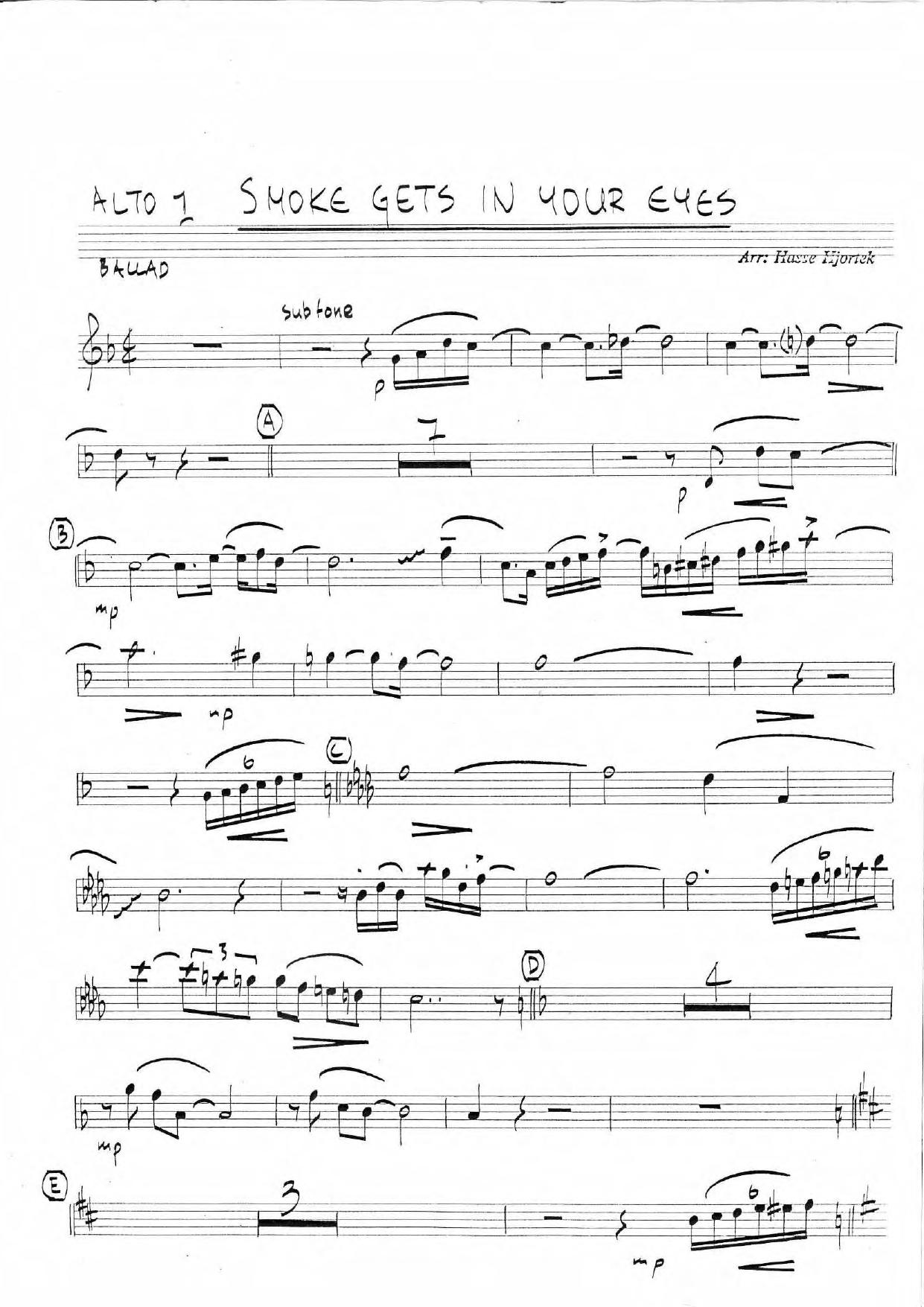
Smoke Gets In Your Eyes (H.Hjortek)
Composed by Jerome Kern
Arranged by H.Hjortek
- Ensemble: Big Band
- Style: Jazz Standard
- Pages: 31
- Instruments (16): Alto Saxophone 1, Alto Saxophone 2, Tenor Saxophone 1, Tenor Saxophone 2, Baritone Saxophone, Trumpet 1, Trumpet 2, Trumpet 3, Trumpet 4, Trombone 1, Trombone 2, Trombone 3, Trombone 4, Bass, Drums, Piano
- Difficulty: medium
- Content: Individual Parts
- Format: PDF Download (Instant)
- Price: $24.99
Jerome Kern and Otto Harbach penned "Smoke Gets In Your Eyes" for the 1933 Broadway musical *Roberta*, cementing its place almost immediately in the Great American Songbook. While initially conceived as a sentimental stage tune, the composition achieved true immortality when jazz icons like Art Tatum, Thelonious Monk, and crucially, Clifford Brown with strings reimagined its sophisticated harmonic framework. The song represents the pinnacle of 1930s theater composition, defined by a sweeping, ascending A-section and a deceptively complex bridge that moves through unexpected tonal centers. Its enduring appeal lies in the bittersweet melancholy of its melody, which invites both tender introspection and deep, blues-infused harmonic exploration. H.Hjortek’s big band treatment frames this timeless standard as a lush, expressive ballad characterized by rich, contemporary extended harmonies and a deeply emotive rubato-to-swing pacing. The arrangement opens with a atmospheric, impressionistic introduction featuring shimmering woodwind textures and warm, muted brass voicings that establish an intimate, cinematic mood. As the chart unfolds, it transitions into a gorgeous, unhurried tempo feel anchored by a subtle brush-work groove in the drums. The emotional arc moves from quiet, fragile vulnerability in the opening choruses to a soaring, harmonically dense climax that showcases the full dynamic spectrum of a modern 16-piece jazz orchestra. H.Hjortek approaches the score with a masterclass in modern big band orchestration, utilizing lush saxophone soli sections and intricate chord voicings reminiscent of the Gil Evans or Bob Mintzer schools. The melody is initially carried by a featured alto saxophone or trumpet soloist before expanding into rich, multi-layered ensemble textures where the brass and reeds converse in delicate counterpoint. The arrangement avoids predictable paths by introducing sophisticated reharmonizations across the bridge, shifting tonal weight to create a profound sense of yearning. A restrained yet powerful shout chorus builds organically without losing the inherent intimacy of the ballad style, resolving into a peaceful, floating coda that leaves a lasting impression on the listener. Advanced high school ensembles, collegiate jazz orchestras, and professional community big bands will find this chart an exceptional vehicle for developing ensemble blend, intonation, and lyrical phrasing. While the individual technical demands on range and speed are moderate, the true challenge lies in the mature musicality required to sustain tension and emotional resonance over a slow-moving harmonic landscape. It serves as an ideal festival centerpiece or concert closer, offering soloists ample room for expressive interpretation while providing the horn section with some of the most lush, satisfying scoring found in contemporary big band literature. Conductors should approach H.Hjortek’s arrangement of "Smoke Gets In Your Eyes" with an emphasis on seamless blending and elastic phrasing, maintaining a ballad tempo around 64-72 BPM where the subdivision remains alive and internal. The primary technical challenge lies in the dense, extended-tertial harmonies; trumpet and trombone sections must practice their chord balance meticulously to ensure that inner-voice alterations do not overpower the primary melodic line. Pay close attention to dynamic markings, as the emotional impact relies heavily on extreme contrast—moving effortlessly from a breathy *pianissimo* to a rich, resonant *forte* during the developmental peak. Drummers should utilize light brush work on the snare, emphasizing a gentle two-and-four pulse that breathes with the soloists rather than locking into a rigid metronomic grid. Rehearsals should initially isolate the chordal voicings without rhythm section accompaniment to lock in intonation before applying the subtle rubato shifts written into the conductor’s score. Q: What instruments and parts are included in this 16-instrument big band scoring? A: The arrangement is scored for a standard 16-piece jazz orchestra featuring Alto Saxophone 1, Alto Saxophone 2, Tenor Saxophone 1, Tenor Saxophone 2, Baritone Saxophone, 4 Trumpets, 4 Trombones, Piano, Guitar, Bass, and Drums, spread across a comprehensive 31-page score and parts set. Q: What is the difficulty level of this specific arrangement? A: This chart is graded as advanced-intermediate, making it ideal for advanced high school, collegiate, and professional big bands that possess strong control over slow-tempo intonation and lyrical ensemble phrasing. Q: What musical style and historical context does this chart inhabit? A: It is a sophisticated jazz standard ballad style rooted in the 1930s Great American Songbook tradition, updated with modern harmonic colors and contemporary big band orchestration techniques reminiscent of the Gil Evans tradition. Q: What makes H.Hjortek's arrangement unique compared to standard big band versions? A: This arrangement stands out through its lush, impressionistic reharmonizations across the bridge, intricate woodwind-heavy voicings, and an organic architectural build that avoids clichés in favor of deep emotional storytelling. Q: What is the approximate performance duration and tempo feel of the piece? A: The performance duration is approximately 4.5 to 5 minutes, performed primarily at a slow, expressive ballad tempo around 64 to 72 BPM with flexible rubato phrasing.
Questions and answers
- What is included in the Smoke Gets In Your Eyes (H.Hjortek) PDF?
- The verified current file contains individual parts across 31 pages.
- How many instruments or parts are listed for Smoke Gets In Your Eyes (H.Hjortek)?
- The verified instrumentation list contains 16 entries for this Big Band arrangement.
- Who is credited for Smoke Gets In Your Eyes (H.Hjortek)?
- Composer: Jerome Kern. Arranger: H.Hjortek.
- What difficulty is listed for Smoke Gets In Your Eyes (H.Hjortek)?
- The verified difficulty level is medium.
- What style is listed for Smoke Gets In Your Eyes (H.Hjortek)?
- The catalog lists the style as Jazz Standard.
- Can I preview Smoke Gets In Your Eyes (H.Hjortek) before buying?
- Yes. The product page provides a preview generated from the current PDF file.
- How is Smoke Gets In Your Eyes (H.Hjortek) delivered?
- After successful payment, the digital PDF is made available for download. The displayed price is $24.99.
Musicians Also Search For
Smoke Gets In Your Eyes H.Hjortek PDF • Smoke Gets In Your Eyes H.Hjortek sheet music • Smoke Gets In Your Eyes arranged by H.Hjortek • H.Hjortek big band charts • H.Hjortek jazz arrangements PDF • Smoke Gets In Your Eyes Jerome Kern sheet music • Smoke Gets In Your Eyes Jerome Kern big band arrangements • Jerome Kern big band charts • Smoke Gets In Your Eyes big band arrangements • Smoke Gets In Your Eyes big band PDF download • Smoke Gets In Your Eyes jazz sheet music • big band sheet music download • Smoke Gets In Your Eyes individual parts download • Smoke Gets In Your Eyes sheet music PDF • Smoke Gets In Your Eyes Jazz Standard charts • Jazz Standard big band arrangements • buy Smoke Gets In Your Eyes sheet music • download Smoke Gets In Your Eyes PDF • Smoke Gets In Your Eyes jazz charts • best H.Hjortek big band arrangements • Jerome Kern arranged by H.Hjortek • Smoke Gets In Your Eyes printable sheet music • big band repertoire PDF