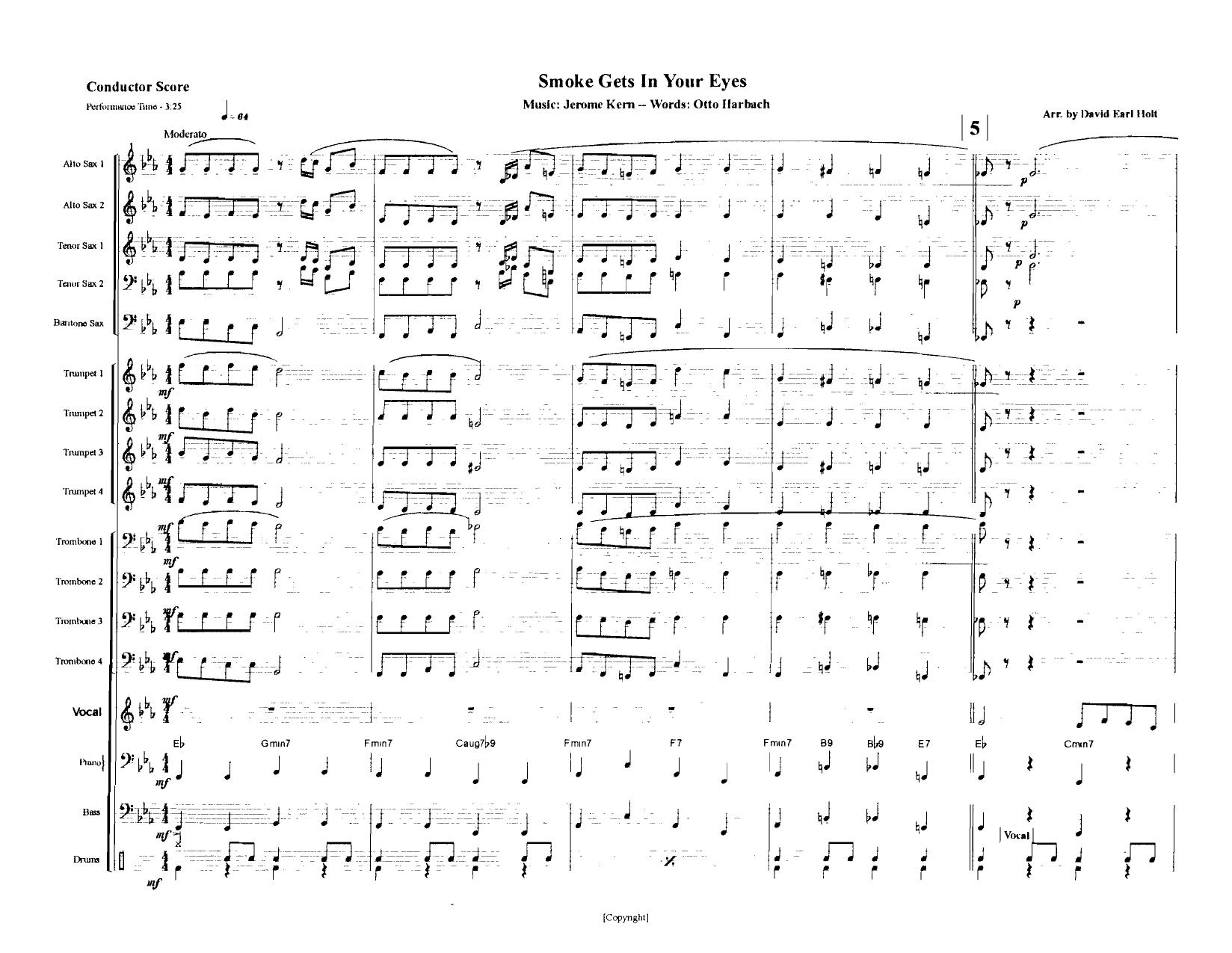
Smoke Gets In Your Eyes (D.E.Holt)
Composed by Jerome Kern
Arranged by D.E.Holt
- Ensemble: Big Band
- Style: Jazz Standard
- Pages: 50
- Instruments (18): Alto Sax 1, Alto Sax 2, Tenor Sax 1, Tenor Sax 2, Baritone Sax, Trumpet 1, Trumpet 2, Trumpet 3, Trumpet 4, Trombone 1, Trombone 2, Trombone 3, Trombone 4, Vocal, Piano, Bass, Drums, Violin
- Difficulty: advanced
- Content: Individual Parts
- Format: PDF Download (Instant)
- Price: $24.99
Jerome Kern’s timeless masterpiece "Smoke Gets In Your Eyes," introduced in the 1933 Broadway musical *Roberta* and subsequently immortalized by artists ranging from The Platters to Art Tatum, stands as one of the most enduring vehicles in the Great American Songbook. Its sophisticated harmonic progression and sweeping melodic contour have made it a favorite canvas for jazz interpreters across generations. This specific big band treatment translates the intimate pathos of the original composition into a lush, dynamic orchestral canvas, capturing the quintessential elegance of the swing-era ballad tradition while infusing it with modern harmonic color. Conceived as an expressive, emotive concert ballad, this arrangement unfolds at a unhurried, rubato-leaning tempo that prioritizes lyrical phrasing and deep emotional resonance. The mood shifts seamlessly from introspective, smoky quietude to rich, cinematic swells of full-ensemble harmony. D.E.Holt approaches the material with a sophisticated ear for counterpoint and texture, utilizing extended chord voicings—such as major-seven chords with sharp elevens and altered dominants—to modernize Kern's classic changes without losing their nostalgic core. The arrangement avoids static block-chord writing, favoring fluid, interdependent voice-leading among the anachronistic sections. The narrative arc of the chart belongs primarily to the saxophone section, which carries the initial exposition of the theme with warm, harmonized subtones, though the flugelhorns and trombones quickly join to build a dense, velvety sonic texture. Featured solo space allows a lead instrumentalist—ideally a tenor saxophone or trumpet—to stretch out over lush, sustaining background pads that provide a harmonic safety net while maintaining high tension. Technical challenges center on breath control, intonation in extreme registers, and maintaining a unified stylistic approach to the rubato phrasing. The payoff is a deeply satisfying, sophisticated centerpiece for any concert program, offering moments of exquisite dynamic contrast and rich tonal interplay. Advanced high school ensembles with mature lead players, collegiate jazz orchestras, and professional community big bands will find this chart exceptionally rewarding. It demands a high degree of listening maturity, as balance and blend are critical to bringing out Holt's intricate inner-voice movements. Rather than relying on fast tempos or flashy technical display, this arrangement challenges the ensemble to master the subtle art of the ballad: maintaining intense emotional concentration, pristine intonation, and seamless ensemble breathing from the first downbeat to the final, fading chord. Success with this arrangement hinges on the ensemble's ability to approach the ballad tempo with an internal pulse that prevents the music from dragging. The conductor should encourage a flexible, vocal approach to phrasing, treating the eighth-note subdivisions with a relaxed, late-swing feel where appropriate. Intonation is the primary technical hurdle, particularly during dense, stacked-tertian chord clusters in the brass; balancing the lower register of the trombones against the upper extensions of the saxophones requires careful listening across sections. Mutes are optional but can be employed effectively in the muted trumpet and cup-muted trombone sections to create a vintage, moody atmosphere during the second chorus. Rehearsal should begin with section-only work on long tones and balance, ensuring that the inner voices emerge clearly beneath the primary melody. Emphasize dynamic extremes—the softest passages must whisper, while the climactic ensemble swells should bloom without forcing the sound into distortion. Q: What instruments and parts are included in this big band arrangement? A: The full 19-instrument big band instrumentation comprises two alto saxophones, two tenor saxophones, baritone saxophone, standard brass sections, and a rhythm section, backed by a comprehensive 62-page conductor score. Q: What is the difficulty level of this arrangement? A: This chart is graded as advanced-intermediate to advanced, making it ideal for high school top bands, collegiate ensembles, and professional community big bands seeking a sophisticated ballad feature. Q: What is the musical style and historical context of this piece? A: It is a jazz standard arrangement of Jerome Kern’s 1933 classic, styled as a lush, expansive concert ballad that draws on both traditional swing-era voicings and contemporary harmonic textures. Q: What makes D.E.Holt's arrangement unique? A: Holt utilizes fluid counterpoint, rich extended harmonies, and intricate inner-voice movement rather than simple block chords, elevating a familiar melody into a cinematic orchestral experience. Q: What is the performance duration and tempo feel of the piece? A: The arrangement is structured as a slow, expressive concert ballad in 4/4 time, with a suggested performance duration of approximately four to five minutes depending on the length of the improvised solo.
Questions and answers
- What is included in the Smoke Gets In Your Eyes (D.E.Holt) PDF?
- The verified current file contains a conductor score and individual parts across 50 pages.
- How many instruments or parts are listed for Smoke Gets In Your Eyes (D.E.Holt)?
- The verified instrumentation list contains 18 entries for this Big Band arrangement.
- Who is credited for Smoke Gets In Your Eyes (D.E.Holt)?
- Composer: Jerome Kern. Arranger: D.E.Holt.
- What difficulty is listed for Smoke Gets In Your Eyes (D.E.Holt)?
- The verified difficulty level is advanced.
- What style is listed for Smoke Gets In Your Eyes (D.E.Holt)?
- The catalog lists the style as Jazz Standard.
- Can I preview Smoke Gets In Your Eyes (D.E.Holt) before buying?
- Yes. The product page provides a preview generated from the current PDF file.
- How is Smoke Gets In Your Eyes (D.E.Holt) delivered?
- After successful payment, the digital PDF is made available for download. The displayed price is $24.99.
Musicians Also Search For
Smoke Gets In Your Eyes D.E.Holt PDF • Smoke Gets In Your Eyes D.E.Holt sheet music • Smoke Gets In Your Eyes arranged by D.E.Holt • D.E.Holt big band charts • D.E.Holt jazz arrangements PDF • Smoke Gets In Your Eyes Jerome Kern sheet music • Smoke Gets In Your Eyes Jerome Kern big band arrangements • Jerome Kern big band charts • Smoke Gets In Your Eyes big band arrangements • Smoke Gets In Your Eyes big band PDF download • Smoke Gets In Your Eyes jazz sheet music • big band sheet music download • Smoke Gets In Your Eyes conductor score PDF • Smoke Gets In Your Eyes individual parts download • Smoke Gets In Your Eyes sheet music PDF • Smoke Gets In Your Eyes Jazz Standard charts • Jazz Standard big band arrangements • buy Smoke Gets In Your Eyes sheet music • download Smoke Gets In Your Eyes PDF • Smoke Gets In Your Eyes jazz charts • best D.E.Holt big band arrangements • Jerome Kern arranged by D.E.Holt • Smoke Gets In Your Eyes printable sheet music • big band repertoire PDF