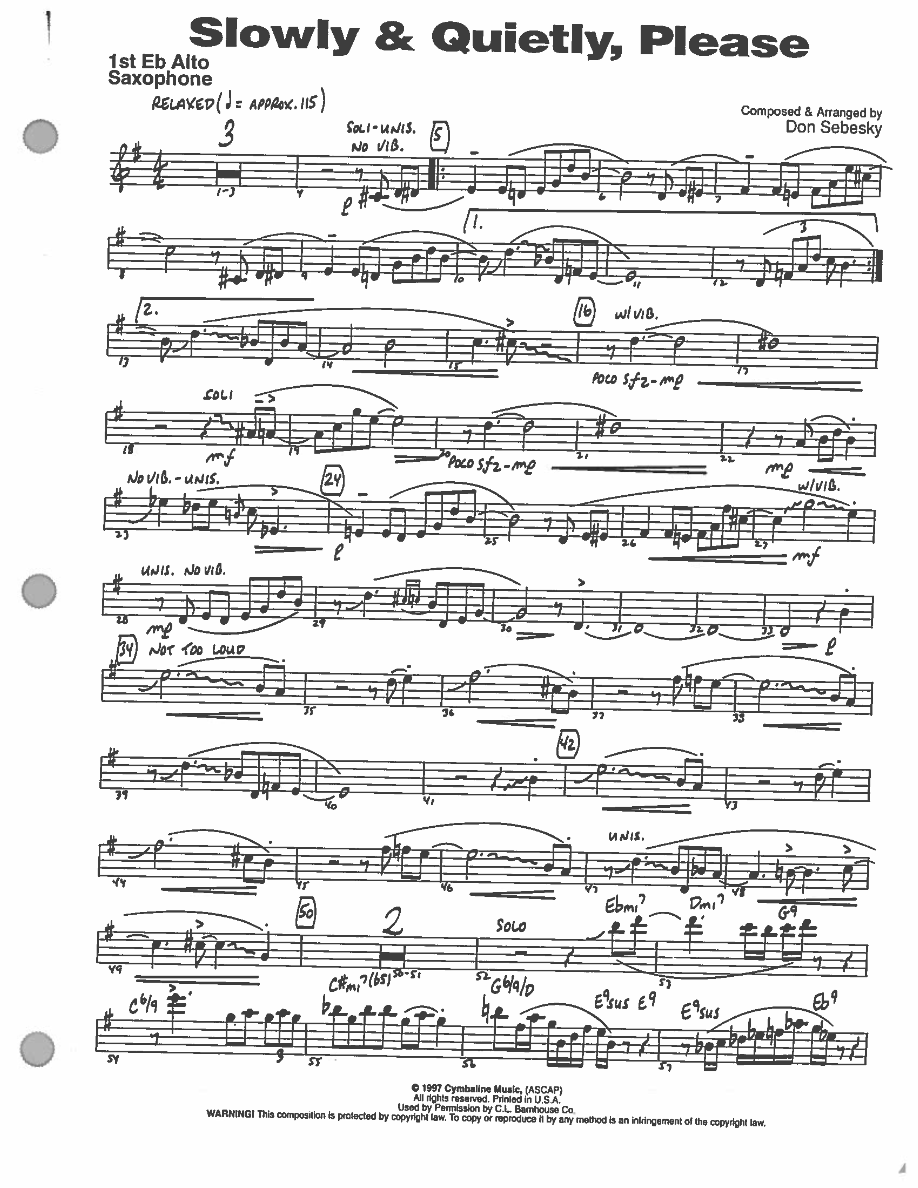
Slowly & Quietly, Please (D.Sebesky) sheet music preview

Slowly & Quietly, Please (D.Sebesky)

Composed by Don Sebesky

Arranged by Don Sebesky

  • Ensemble: Big Band
  • Pages: 36
  • Instruments (17): 1st Eb Alto Saxophone, 2nd Eb Alto Saxophone, 1st Bb Tenor Saxophone, 2nd Bb Tenor Saxophone, Eb Baritone Saxophone, 1st Bb Trumpet, 2nd Bb Trumpet, 3rd Bb Trumpet, 4th Bb Trumpet, 1st Trombone, 2nd Trombone, 3rd Trombone, 4th Trombone, Guitar, Bass, Drums, Piano
  • Difficulty: medium
  • Content: Individual Parts
  • Format: PDF Download (Instant)
  • Price: $24.99

Composed and structured by master arranger Don Sebesky, "Slowly & Quietly, Please" represents the sophisticated, lush aesthetic that defined modern post-bop and studio jazz writing during the mid-20th century. Sebesky, renowned for his iconic work with Maynard Ferguson, Wes Montgomery, and the CTI Records stable, crafted a rich legacy of transforming jazz ensemble writing through cinematic scope and harmonic depth. This particular chart stands out as an exquisite entry in his catalog, capturing the introspective and elegant side of big band performance. It reflects an era when jazz composition embraced subtle coloration, rich textures, and expressive nuance, bridging traditional swing sensibilities with contemporary harmonic sophistication. Musically, the piece is conceived as a pensive, slow jazz ballad driven by a relaxed, flowing tempo and a deeply evocative mood. The composition unfolds in a lush key center that allows for sweeping chord progressions, suspended voicings, and gorgeous chromatic inner-voice movements. Rather than relying on heavy, driving shout choruses, the emotional weight of the work is carried by its profound tranquility, sophisticated melancholia, and gradual building of dynamic tension. The mood shifts effortlessly from whispered, intimate ensemble statements to soaring, passionate climaxes, creating a compelling emotional arc that commands both listener and player attention from the first measure to the final chord. Sebesky’s distinctive arranging approach is immediately apparent in the meticulous voicing of the 17-instrument ensemble. Utilizing dense, extended chord structures—such as major-ninths, eleventh, and altered dominants—he treats the big band like a chamber orchestra. The saxophones, featuring dual altos and tenors alongside a anchored baritone, are frequently utilized in tight, harmonized block-parallel or counterpoint soli sections that weave seamlessly around the brass. The brass writing avoids excessive volume in favor of warm, muted colors and glowing chordal pads, displaying Sebesky’s signature penchant for subtle coloristic shifts and masterful orchestration that prevents the texture from ever feeling static or heavy. Throughout the arrangement, the melodic material is shared fluidly across sections, though the primary voice often highlights a lyrical saxophone or trumpet soloist supported by shimmering background pads from the reeds and brass. The chart features dedicated solo space allowing featured performers to stretch out conceptually within a supportive, harmonically rich framework. Technical challenges lie primarily in intonation, balance, and sustained breath control, as the slow tempo exposes any imperfections in ensemble blend. Navigating the sophisticated harmonic shifts smoothly while maintaining a continuous, elastic sense of time provides a deeply rewarding musical experience for advanced ensembles. Advanced high school, collegiate, and professional jazz ensembles will find this chart exceptionally well-suited to their repertoire. Because success on this piece depends heavily on mature listening skills, dynamic control, and refined stylistic execution, it serves as an ideal vehicle for teaching advanced ballad playing and ensemble blending. Directors looking to program a sophisticated, emotionally resonant work that showcases lyrical depth over sheer volume will discover that this arrangement leaves a lasting impression on any audience. Achieving the proper execution of "Slowly & Quietly, Please" requires meticulous attention to balance, intonation, and a fluid, unhurried sense of time. The conductor must establish a stable yet flexible tempo feel where the subdivision remains internal and felt rather than overtly stated by the rhythm section. Avoid rushing the pickup notes or dragging the downbeats; the ballad tempo demands absolute horizontal linear momentum. Technically, the primary challenge rests in maintaining pristine intonation across extended chord voicings at soft dynamics. Players must constantly listen across sections to match vibrato width and timbre. Mute usage should be handled carefully where indicated, ensuring that brass sections blend rather than pierce the ensemble texture. Rehearsal should begin by stripping away the rhythm section and having the horns practice chorales of the primary harmonic blocks to lock in internal tuning. Pay close attention to dynamic markings; the transition from whispered pianissimos to full-ensemble swells must be controlled smoothly without forcing tone quality. Soloists should approach their features with a deep sense of thematic development, echoing the pensive, melodic character established by Sebesky’s written background figures. Q: What instruments and parts are included in this arrangement? A: This 36-page big band arrangement is scored for a full 17-instrument ensemble, including Alto Saxophone 1, Alto Saxophone 2, Tenor Saxophone 1, Tenor Saxophone 2, Baritone Saxophone, plus standard trumpet, trombone, and rhythm section parts. Q: What is the difficulty level of this chart? A: This piece is graded as advanced intermediate to advanced (Grade 3 to 4), making it ideal for accomplished high school, collegiate, and professional jazz ensembles. Q: What is the musical style and historical context of the piece? A: Written by master arranger Don Sebesky, it is a sophisticated jazz swing ballad that captures the lush, cinematic harmonic vocabulary of the mid-20th-century modern studio jazz era. Q: What makes this Don Sebesky arrangement unique? A: It showcases Sebesky's signature orchestral approach to big band writing, utilizing rich extended harmonies, chamber-like voicings, and subtle dynamic color shifts rather than traditional high-energy shout choruses. Q: What is the performance tempo or duration guidance? A: The chart is structured as a slow, pensive ballad that requires a relaxed, elastic tempo feel and strong internal subdivision to maintain momentum across its expressive duration.

Questions and answers

What is included in the Slowly & Quietly, Please (D.Sebesky) PDF?
The verified current file contains individual parts across 36 pages.
How many instruments or parts are listed for Slowly & Quietly, Please (D.Sebesky)?
The verified instrumentation list contains 17 entries for this Big Band arrangement.
Who is credited for Slowly & Quietly, Please (D.Sebesky)?
Composer: Don Sebesky. Arranger: Don Sebesky.
What difficulty is listed for Slowly & Quietly, Please (D.Sebesky)?
The verified difficulty level is medium.
Can I preview Slowly & Quietly, Please (D.Sebesky) before buying?
Yes. The product page provides a preview generated from the current PDF file.
How is Slowly & Quietly, Please (D.Sebesky) delivered?
After successful payment, the digital PDF is made available for download. The displayed price is $24.99.

Musicians Also Search For

Slowly & Quietly, Please Don Sebesky PDFSlowly & Quietly, Please Don Sebesky sheet musicSlowly & Quietly, Please arranged by Don SebeskyDon Sebesky big band chartsDon Sebesky jazz arrangements PDFSlowly & Quietly, Please Don Sebesky big band arrangementsSlowly & Quietly, Please big band arrangementsSlowly & Quietly, Please big band PDF downloadSlowly & Quietly, Please jazz sheet musicbig band sheet music downloadSlowly & Quietly, Please individual parts downloadSlowly & Quietly, Please sheet music PDFbuy Slowly & Quietly, Please sheet musicdownload Slowly & Quietly, Please PDFSlowly & Quietly, Please jazz chartsbest Don Sebesky big band arrangementsSlowly & Quietly, Please printable sheet musicbig band repertoire PDF

All arrangements by Don Sebesky All Don Sebesky sheet music