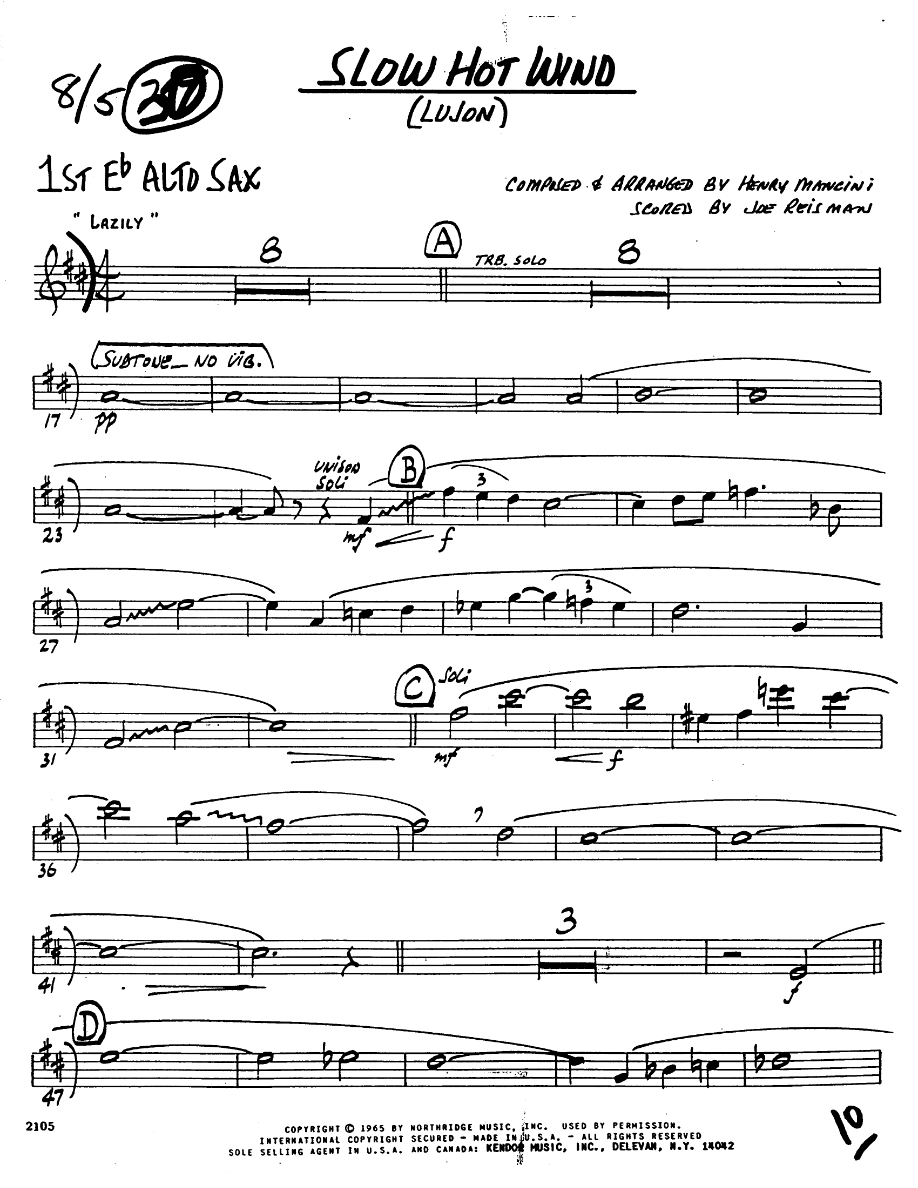
Slow Hot Wind (H.Mancini) sheet music preview

Slow Hot Wind (H.Mancini)

Composed by Henry Mancini

Arranged by H.Mancini

  • Ensemble: Big Band
  • Style: Jazz Standard
  • Pages: 30
  • Instruments (17): 1st Eb Alto Sax, 2nd Eb Alto Sax, 1st Bb Tenor Sax, 2nd Bb Tenor Sax, Eb Bari Sax / Opt. Bb Bass Clar., 1st Bb Trumpet, 2nd Bb Trumpet, 3rd Bb Trumpet, 4th Bb Trumpet, 1st Trombone, 2nd Trombone, 3rd Trombone, 4th Trombone (Bass) / Tuba, Electric Bass, Electric Guitars, Drums, Electric Piano
  • Difficulty: medium
  • Content: Individual Parts
  • Format: PDF Download (Instant)
  • Price: $24.99

Henry Mancini’s "Slow Hot Wind," originally conceived as the instrumental "Lujon" for his 1961 album *Mr. Lucky Goes Latin*, stands as a pinnacle of mid-century mood music. While the original recording utilized the exotic sounds of the lujon (a metal percussion instrument), the piece evolved into a sophisticated jazz standard after Norman Gimbel added his evocative lyrics. It represents the height of the "Cool Jazz" meets "Exotica" era, characterized by a blend of cinematic orchestration and jazz-inflected harmonies. The composition gained further immortality through definitive vocal versions by artists like Sarah Vaughan and Johnny Mathis, cementing its place in the Great American Songbook as a masterclass in atmospheric tension. The musical character of this arrangement is defined by a sultry, slow-burn bossa nova feel, typically set in a haunting minor key. It evokes the oppressive, heavy atmosphere of a tropical heatwave, utilizing a medium-slow tempo that demands rhythmic discipline and a deep pocket. The mood is inherently cinematic—sophisticated, slightly mysterious, and intensely melodic. Rather than the aggressive punch of a traditional swing chart, the energy here is internal and simmering, relying on sustained textures and a lush, transparent harmonic language that allows the melody to float effortlessly above the rhythm section’s steady pulse. In this specific treatment by Mancini himself, the orchestration reflects his signature "West Coast" cool aesthetic. The arrangement utilizes the full 17-piece big band to create a tapestry of sound, often featuring the saxophones in lush, close-position voicings while the brass provide punctuated, muted responses. Mancini’s approach avoids the clichés of the era, instead opting for sophisticated cluster harmonies and subtle modulations that heighten the emotional stakes. The inclusion of an optional Bb Bass Clarinet part for the baritone saxophone adds a dark, woody texture to the bottom of the woodwind section, a hallmark of Mancini’s penchant for unique instrumental colors. Performance demands center on breath control and phrasing, as the melody is passed between sections to maintain a continuous, flowing line. While the lead trumpet range is generally accessible, the challenge lies in the ensemble’s ability to maintain a consistent "lay-back" feel without dragging. This arrangement is ideally suited for advanced high school, collegiate, or professional ensembles that possess the maturity to handle delicate dynamics and complex tonal balances. It serves as a perfect contrast piece in a concert program, offering a moment of sophisticated repose that showcases the band's ability to play with nuance and restraint. Achieving the correct "Slow Hot Wind" feel requires the rhythm section to maintain a strict, unwavering bossa nova groove while the horns play with a relaxed, almost behind-the-beat phrasing. The conductor should emphasize the "long-short" nature of the rhythmic figures in the saxophones to ensure the lines do not sound stiff or academic. Pay close attention to the balance between the muted trumpets and the open trombones; the brass must never overpower the woodwind textures. Rehearse the transition into the mid-chart swells to ensure the volume increases through intensity of tone rather than mere force. Intonation in the cluster voicings is paramount, particularly in the lower woodwinds and trombones. Aim for a shimmering, transparent sound that captures the "heat haze" suggested by the title. Q: What is the exact instrumentation included in this Mancini arrangement? A: This is a standard 17-piece big band arrangement consisting of 5 Saxophones (with an optional Bb Bass Clarinet part for the Baritone Sax), 4 Trumpets, 4 Trombones, and a 4-piece rhythm section (Piano, Bass, Drums, and Guitar). The 30-page score provides full conductor views and individual parts for all players. Q: What is the difficulty level of this specific jazz chart? A: This arrangement is classified as Grade 4 (Intermediate-Advanced), making it appropriate for proficient high school bands, college ensembles, and professional groups. The difficulty stems not from extreme ranges or technical speed, but from the requirement for mature phrasing, ensemble balance, and dynamic control. Q: In what musical style and historical context was "Slow Hot Wind" written? A: The piece is a quintessential Bossa Nova jazz standard from the early 1960s, originally titled "Lujon." It represents the "Space Age Pop" and "Exotica" movements, where jazz harmonies were blended with Latin rhythms and cinematic orchestration to create a sophisticated, atmospheric sound. Q: What makes this Henry Mancini arrangement unique compared to other versions? A: This version is distinctive because it is Mancini’s own orchestration, featuring his signature use of woodwind colors and specific brass muting techniques. The arrangement emphasizes texture and mood over traditional solo sections, utilizing a 30-page score to detail intricate ensemble voicings that are rarely found in stock arrangements. Q: What is the recommended tempo and approximate performance duration? A: The piece should be performed at a medium-slow tempo, approximately 80-90 BPM, with a sultry bossa nova feel. A typical performance of this arrangement lasts between 3:30 and 4:00 minutes, depending on the conductor's interpretation of the rubato sections.

Questions and answers

What is included in the Slow Hot Wind (H.Mancini) PDF?
The verified current file contains individual parts across 30 pages.
How many instruments or parts are listed for Slow Hot Wind (H.Mancini)?
The verified instrumentation list contains 17 entries for this Big Band arrangement.
Who is credited for Slow Hot Wind (H.Mancini)?
Composer: Henry Mancini. Arranger: H.Mancini.
What difficulty is listed for Slow Hot Wind (H.Mancini)?
The verified difficulty level is medium.
What style is listed for Slow Hot Wind (H.Mancini)?
The catalog lists the style as Jazz Standard.
Can I preview Slow Hot Wind (H.Mancini) before buying?
Yes. The product page provides a preview generated from the current PDF file.
How is Slow Hot Wind (H.Mancini) delivered?
After successful payment, the digital PDF is made available for download. The displayed price is $24.99.

Musicians Also Search For

Slow Hot Wind H.Mancini PDFSlow Hot Wind H.Mancini sheet musicSlow Hot Wind arranged by H.ManciniH.Mancini big band chartsH.Mancini jazz arrangements PDFSlow Hot Wind Henry Mancini sheet musicSlow Hot Wind Henry Mancini big band arrangementsHenry Mancini big band chartsSlow Hot Wind big band arrangementsSlow Hot Wind big band PDF downloadSlow Hot Wind jazz sheet musicbig band sheet music downloadSlow Hot Wind individual parts downloadSlow Hot Wind sheet music PDFSlow Hot Wind Jazz Standard chartsJazz Standard big band arrangementsbuy Slow Hot Wind sheet musicdownload Slow Hot Wind PDFSlow Hot Wind jazz chartsbest H.Mancini big band arrangementsHenry Mancini arranged by H.ManciniSlow Hot Wind printable sheet musicbig band repertoire PDF

All arrangements by H.Mancini All Henry Mancini sheet music