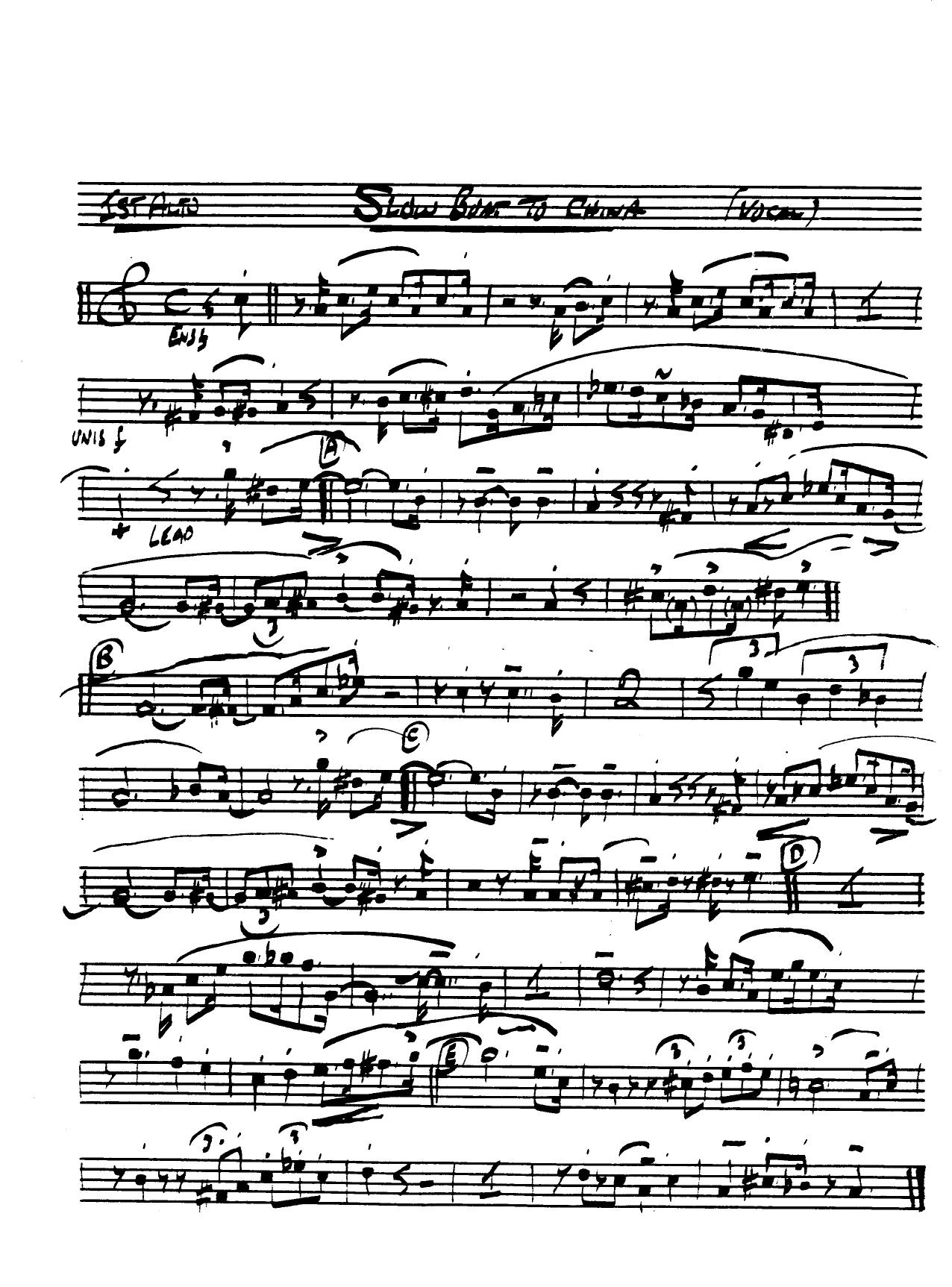
Slow Boat To China (J.Farley)
Composed by Frank Loesser
Arranged by John Farley
- Ensemble: Big Band
- Pages: 23
- Instruments (18): 1st Alto Saxophone, 2nd Alto Saxophone, 1st Tenor Saxophone, 2nd Tenor Saxophone, Baritone Saxophone, 1st Trumpet, 2nd Trumpet, 3rd Trumpet, 4th Trumpet, 1st Trombone, 2nd Trombone, 3rd Trombone, 4th Trombone, Piano, Guitar, Bass, Drums, Vocal
- Difficulty: medium
- Content: Individual Parts
- Format: PDF Download (Instant)
- Price: $24.99
Frank Loesser penned the timeless popular song "On a Slow Boat to China" in 1947, quickly watching it transform from a Tin Pan Alley hit into an enduring staple of the American Songbook and a favorite vehicle for jazz improvisers. Rooted in the post-war swing and early bebop transition era, the melody was famously championed by jazz icons such as Ben Webster, Sonny Stitt, and Dexter Gordon, who utilized its infectious, cyclical 32-bar AABA form to explore both lush harmonic balladry and driving, mid-tempo swing interpretations. Its harmonic progression offers a brilliant playground for jazz horn players, making it a natural fit for sophisticated big band arranging that honors the breezy, romantic optimism of the original composition while infusing it with modern tonal color. John Farley’s masterful big band treatment approaches the standard with a vibrant, mid-tempo swing feel that emphasizes buoyant rhythm section interplay and sophisticated horn voicings. The arrangement opens with a clever, conversational intro that hints at the journey ahead before settling into a infectious, pocket-deep groove anchored by the bass and drums. Farley utilizes rich, extended chordal voicings in the brass that bridge the gap between traditional swing-era warmth and modern post-bop harmonic tension. Throughout the chart, the melody is intelligently distributed across different sections, featuring a lush saxophone soli that highlights tight intonation and lyrical phrasing, contrasted by punchy brass background figures that propel the chart forward without ever crowding the lead voice. The dramatic narrative of the chart culminates in a high-energy shout chorus that builds steadily in dynamic intensity and rhythmic complexity, showcasing Farley's gift for structural pacing. Featured solo space is provided over standard changes, allowing advanced improvisers to stretch out while the ensemble lays down a supportive, dynamic carpet of sound. Technical challenges lie primarily in maintaining a relaxed, driving swing eighth-note feel at a moderate tempo—where rushing or dragging is most exposed—as well as executing clean articulations and dynamic balance during the dense ensemble solis. The rhythmic figures demand crisp execution, particularly in the saxes during fast-moving diatonic passages and chromatic slides. Advanced high school, collegiate, and professional jazz ensembles will find this chart exceptionally rewarding to rehearse and perform. It strikes an ideal balance between audience accessibility and musical depth, providing enough challenge to elevate a section's collective listening and blend skills while offering an undeniable crowd-pleasing aesthetic. Whether programmed as a sophisticated change-of-pace tune in a standard concert set or utilized as an educational vehicle for teaching ensemble swing mechanics, Farley’s arrangement breathes fresh, sophisticated life into a mid-century classic. Conductors should approach John Farley’s "Slow Boat To China" with a primary focus on time feel and section balance. The tempo should sit comfortably in a medium swing pocket; avoid pushing the metronome, as the groove relies entirely on relaxed, forward-moving eighth notes where the upbeats are naturally emphasized. Key technical challenges include executing the tight, interwoven sax solis with uniform articulation, ensuring that the dynamic ceiling of the brass during the shout chorus never overpowers the lead alto and rhythm section. Watch out for intonation in the extended tertian and quartal chord voicings, particularly in the lower brass where minor seconds and altered tones require careful tuning. No extended techniques such as plunger mutes or extreme altissimo are strictly mandated, but players should utilize tasteful falls, doits, and ghost notes where indicated to authentic stylistic ends. Rehearsal strategy should begin with rhythm section isolation—locking in the hi-hat on two and four and establishing a steady, unhurried bass line—before layering in the horns section by section to build optimal ensemble cohesion. Q: What instrumentation and parts are included in this publication? A: The arrangement is scored for a standard 18-piece big band instrumentation, comprising 5 saxophones (1st Alto, 2nd Alto, 1st Tenor, 2nd Tenor, Baritone), 4 trumpets, 4 trombones, and a full 5-piece rhythm section (piano, guitar, bass, drums), complete with full conductor score and individual parts across 23 total pages. Q: What is the difficulty level of this arrangement? A: This chart is graded as advanced, making it best suited for college, advanced high school, community, and professional jazz orchestras that possess strong section reading skills and experienced soloists. Q: What is the historical and stylistic style of this piece? A: It is a swinging jazz arrangement based on Frank Loesser’s 1947 popular standard, framed within a classic medium-swing big band aesthetic that bridges traditional swing-era warmth with contemporary harmonic voicings. Q: What makes John Farley’s arrangement unique compared to other versions? A: Farley’s chart stands out due to its clever use of modern extended harmonies, a meticulously crafted saxophone soli, and a dynamically escalating shout chorus that reinterprets a familiar Tin Pan Alley melody with fresh architectural depth. Q: What is the performance duration and recommended tempo for this arrangement? A: The arrangement runs approximately 4 to 5 minutes in length when performed at the recommended medium swing tempo of around 120-126 beats per minute.
Questions and answers
- What is included in the Slow Boat To China (J.Farley) PDF?
- The verified current file contains individual parts across 23 pages.
- How many instruments or parts are listed for Slow Boat To China (J.Farley)?
- The verified instrumentation list contains 18 entries for this Big Band arrangement.
- Who is credited for Slow Boat To China (J.Farley)?
- Composer: Frank Loesser. Arranger: John Farley.
- What difficulty is listed for Slow Boat To China (J.Farley)?
- The verified difficulty level is medium.
- Can I preview Slow Boat To China (J.Farley) before buying?
- Yes. The product page provides a preview generated from the current PDF file.
- How is Slow Boat To China (J.Farley) delivered?
- After successful payment, the digital PDF is made available for download. The displayed price is $24.99.
Musicians Also Search For
Slow Boat To China John Farley PDF • Slow Boat To China John Farley sheet music • Slow Boat To China arranged by John Farley • John Farley big band charts • John Farley jazz arrangements PDF • Slow Boat To China Frank Loesser sheet music • Slow Boat To China Frank Loesser big band arrangements • Frank Loesser big band charts • Slow Boat To China big band arrangements • Slow Boat To China big band PDF download • Slow Boat To China jazz sheet music • big band sheet music download • Slow Boat To China individual parts download • Slow Boat To China sheet music PDF • buy Slow Boat To China sheet music • download Slow Boat To China PDF • Slow Boat To China jazz charts • best John Farley big band arrangements • Frank Loesser arranged by John Farley • Slow Boat To China printable sheet music • big band repertoire PDF