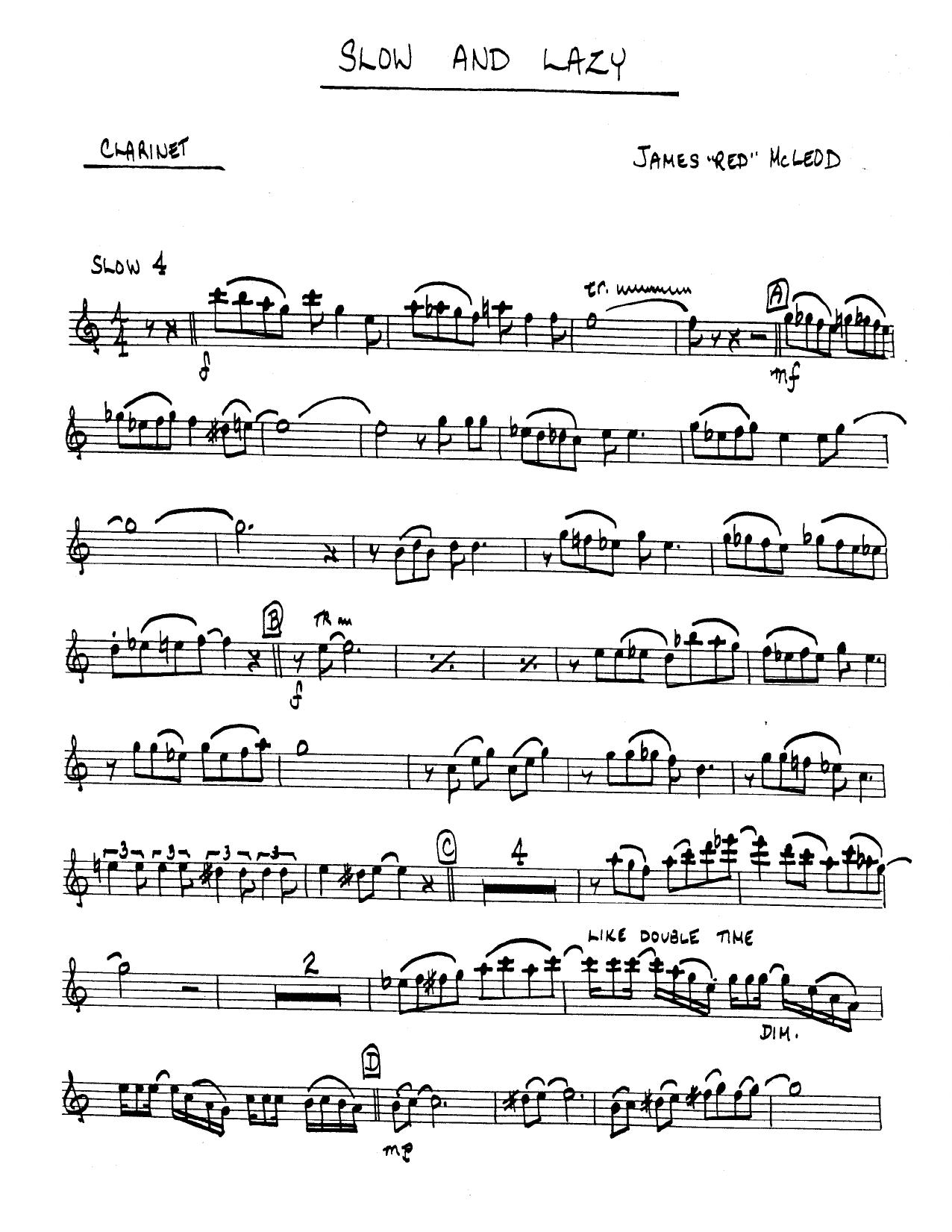
Slow And Lazy - James Red McLeod (J.R.McLeod)
Composed by James Red McLeod
- Ensemble: Dixieland Band
- Style: Dixieland
- Pages: 18
- Instruments (10): Clarinet, Cornet, Tenor Sax, Trombone, Piano, String Bass, Tuba, Drums, Banjo, Guitar
- Difficulty: easy
- Content: Individual Parts
- Format: PDF Download (Instant)
- Price: $18.99
"Slow And Lazy," a quintessential Dixieland standard penned by James Red McLeod, transports listeners directly to the vibrant, early jazz scene of New Orleans. While the exact composition date is somewhat fluid, the piece firmly embodies the spirit of the 1910s and 1920s, a formative era when jazz was coalescing from ragtime, blues, and brass band traditions. McLeod, a figure deeply entrenched in this foundational period, crafted a tune that perfectly captures the relaxed yet rhythmically infectious essence of early jazz. It's a piece that evokes images of riverboat cruises and speakeasy revelry, becoming a staple for bands aiming to showcase the genre's authentic charm and improvisational freedom. Its enduring appeal lies in its deceptively simple melodic lines and its inherent invitation for collective improvisation, a hallmark of the Dixieland sound. This particular arrangement of "Slow And Lazy" presents the piece in a classic Dixieland ensemble format, featuring the core seven instruments that define the style: Clarinet, Trumpet, Trombone, Piano, Bass, Drums, and Banjo (or Guitar). The musical character is, as the title suggests, a relaxed, medium-slow tempo, often interpreted with a gentle, two-beat feel that underpins the intricate counterpoint of the front line. The key typically resides in a comfortable concert F or Bb, allowing for bright, open sonorities. The mood is inherently joyful and laid-back, evoking a sense of nostalgic warmth and communal music-making. The arrangement maintains a clear melodic focus, with the trumpet often stating the initial theme, followed by the characteristic Dixieland "collective improvisation" section where the clarinet weaves a florid counter-melody above the trombone's tailgate smears and the trumpet's lead. While the arranger for this specific edition remains unknown, their approach clearly prioritizes authenticity and playability within the Dixieland tradition. The arrangement provides a solid framework, outlining the head arrangements and suggesting voicings that allow the individual instruments to shine without sacrificing the cohesive ensemble sound. Expect clear melodic lines for the front three horns, often in unison or harmonized in parallel thirds or sixths for impact. The rhythm section parts are thoughtfully notated to provide a steady, swinging foundation, with particular attention to the characteristic "oom-pah" bass line and banjo strumming patterns. There are ample opportunities for featured solos, typically over the chord changes of the main theme, allowing each horn player to demonstrate their improvisational prowess within the style. The arrangement culminates in a joyous, full-ensemble shout chorus, bringing the piece to a spirited close. Performing "Slow And Lazy" is a rewarding experience for a variety of ensembles, particularly community bands, college jazz combos, or dedicated Dixieland groups seeking to expand their authentic repertoire. The technical challenges are moderate; while individual parts are not excessively demanding, the true artistry lies in the collective interplay and the ability to improvise convincingly within the Dixieland idiom. The clarinet part requires agility and a sweet tone, the trumpet needs a strong lead voice, and the trombone benefits from expressive glissandi. The rhythm section must maintain a consistent, buoyant feel. The arrangement's clarity makes it accessible for high school bands with strong individual players, offering an excellent introduction to the nuances of early jazz ensemble playing and the joy of collective improvisation. Approaching "Slow And Lazy" requires a deep understanding of its stylistic nuances. The primary technical challenge lies not in individual virtuosity, but in achieving a cohesive, relaxed ensemble sound that allows for simultaneous melodic lines. Encourage the front line (Clarinet, Trumpet, Trombone) to listen intently to each other, maintaining distinct melodic roles during collective improvisation sections. The tempo should be a comfortable medium-slow, around quarter note = 90-100 BPM, with a gentle, unhurried two-beat feel in the rhythm section, avoiding any stiffness. Emphasize the characteristic Dixieland articulation: short, punchy notes for the trumpet, flowing legato for the clarinet, and expressive smears and glissandi for the trombone. Mutes, particularly a straight mute for the trumpet or trombone, can add textural variety to solos or specific ensemble passages. Rehearsal time should focus on balancing the front line during collective sections, ensuring no single instrument overpowers the others, and developing a unified rhythmic pulse from the rhythm section. Q: What instruments are included in this arrangement of "Slow And Lazy"? A: This arrangement is scored for a classic Dixieland septet, including Clarinet, Trumpet, Trombone, Piano, Bass, Drums, and Banjo (or Guitar). All individual parts are provided. Q: What is the difficulty level of this arrangement? A: This arrangement is rated as intermediate. While individual parts are not overly complex, the true challenge and reward lie in the collective improvisation and stylistic authenticity required for a convincing Dixieland performance. Q: What musical style and historical period does "Slow And Lazy" represent? A: "Slow And Lazy" is a quintessential Dixieland jazz piece, embodying the relaxed, collective improvisation style popular in New Orleans during the early 20th century, particularly the 1910s and 1920s. Q: What makes this specific arrangement unique or particularly effective? A: This arrangement provides a clear, authentic framework for "Slow And Lazy," offering well-defined head arrangements and ample space for solos and collective improvisation, making it an excellent resource for bands seeking a genuine Dixieland sound. Q: What is the typical performance duration and tempo for this piece? A: Given its medium-slow tempo (around quarter note = 90-100 BPM) and traditional Dixieland structure with multiple solo choruses, a typical performance of "Slow And Lazy" usually ranges from 3 to 4 minutes.
Questions and answers
- What is included in the Slow And Lazy - James Red McLeod (J.R.McLeod) PDF?
- The verified current file contains individual parts across 18 pages.
- How many instruments or parts are listed for Slow And Lazy - James Red McLeod (J.R.McLeod)?
- The verified instrumentation list contains 10 entries for this Dixieland Band arrangement.
- Who is credited for Slow And Lazy - James Red McLeod (J.R.McLeod)?
- Composer: James Red McLeod.
- What difficulty is listed for Slow And Lazy - James Red McLeod (J.R.McLeod)?
- The verified difficulty level is easy.
- What style is listed for Slow And Lazy - James Red McLeod (J.R.McLeod)?
- The catalog lists the style as Dixieland.
- Can I preview Slow And Lazy - James Red McLeod (J.R.McLeod) before buying?
- Yes. The product page provides a preview generated from the current PDF file.
- How is Slow And Lazy - James Red McLeod (J.R.McLeod) delivered?
- After successful payment, the digital PDF is made available for download. The displayed price is $18.99.
Musicians Also Search For
Slow And Lazy - James Red McLeod James Red McLeod sheet music • Slow And Lazy - James Red McLeod James Red McLeod dixieland band arrangements • James Red McLeod dixieland band charts • Slow And Lazy - James Red McLeod dixieland band arrangements • Slow And Lazy - James Red McLeod dixieland band PDF download • Slow And Lazy - James Red McLeod jazz sheet music • dixieland band sheet music download • Slow And Lazy - James Red McLeod individual parts download • Slow And Lazy - James Red McLeod sheet music PDF • Slow And Lazy - James Red McLeod Dixieland charts • Dixieland dixieland band arrangements • buy Slow And Lazy - James Red McLeod sheet music • download Slow And Lazy - James Red McLeod PDF • Slow And Lazy - James Red McLeod jazz charts • Slow And Lazy - James Red McLeod printable sheet music • dixieland band repertoire PDF