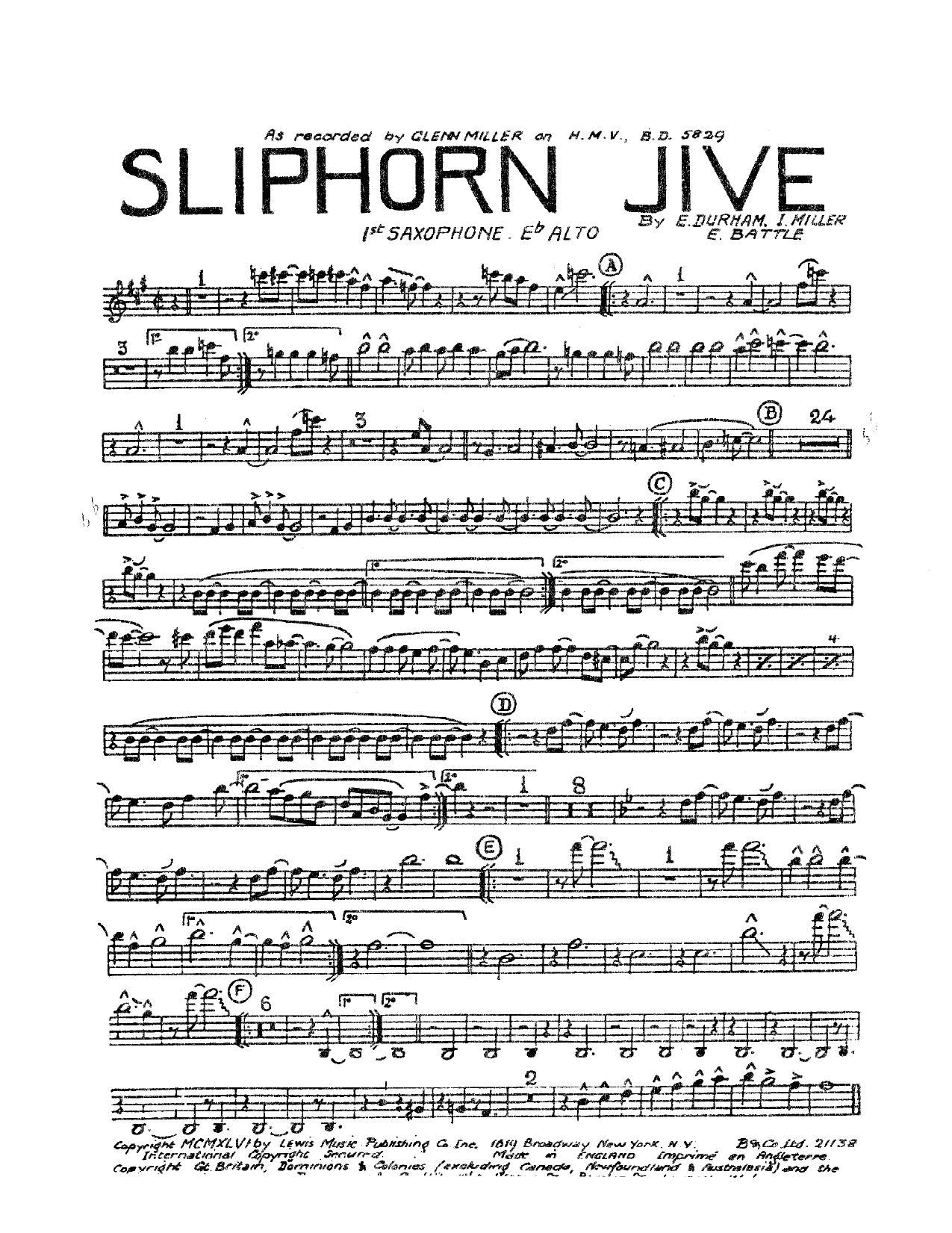
Sliphorn Jive (E.Durham) sheet music preview

Sliphorn Jive (E.Durham)

Composed by Eddie Durham

Arranged by Glen Miller

  • Ensemble: Big Band
  • Pages: 20
  • Instruments (16): 1st Eb Alto Saxophone, 2nd Eb Alto Saxophone, 3rd Bb Tenor Saxophone, 4th Bb Tenor Saxophone, 5th Eb Baritone Saxophone, 1st Bb Trumpet, 2nd Bb Trumpet, 3rd Bb Trumpet, Trombone Solo, 1st Trombone, 2nd Trombone, 3rd Trombone, Piano, Bass, Drums, Guitar
  • Difficulty: easy
  • Content: Individual Parts
  • Format: PDF Download (Instant)
  • Price: $24.99

Eddie Durham’s masterful composition "Sliphorn Jive," immortalized during the height of the swing era, stands as a quintessential showcase of early big band ingenuity and trombone-driven jazz writing. Composed by one of the genre’s most innovative arrangers and guitarists—famous for his work with Count Basie and Glenn Miller—the piece encapsulates the vibrant, rhythmically infectious energy of 1930s Harlem and Kansas City dance halls. "Sliphorn Jive" highlights the trombone section (the "sliphorns") as the driving narrative force, blending blues-inflected riffs with sophisticated section writing that bridges early hot jazz and the polished, highly orchestrated swing style that defined the Glenn Miller legacy. Characterized by a bouncing, medium-tempo swing feel in 4/4 time, the arrangement radiates an irrepressible, foot-tapping energy. The mood is playfully sophisticated yet earthy, anchored by driving walking basslines and crisp backbeats that evoke the smoky, high-spirited atmosphere of vintage ballrooms. The harmonic language relies heavily on blues-based minor structures, lush block-chord voicings for the reeds, and punchy, dynamic brass interjections that create a rich sonic tapestry. Listeners will immediately recognize the trademark call-and-response dynamics between the brass and saxophones, driving the groove forward with relentless momentum. Glenn Miller’s approach to this arrangement emphasizes clarity, precision, and impeccably balanced section writing. Rather than relying on sprawling, chaotic counterpoint, Miller crafts tight, interlocking voicings where the alto and tenor saxophones weave seamlessly around the trombone leads, creating a homogenized, velvety tone color. The arrangement features classic swing-era devices, including plunger-mute effects, snappy chromatic approaches, and a textbook shout chorus that builds tension through rhythmic unison figures before releasing into a triumphant final cadence. The scoring is optimized for an 8-instrument ensemble, proving that immense textural depth and harmonic richness can be achieved without a full eighteen-piece big band. Carrying the melodic weight is the trombone section, supported closely by the trumpet, while the alto and tenor saxophones provide intricate harmonic counter-melodies and rhythmic punctuation. Featured solo spaces allow individual players to stretch out over classic blues changes, demanding a strong command of swing articulation, dynamic control, and stylistic phrasing. Technical challenges include maintaining an even, relaxed eighth-note feel at a brisk medium tempo, executing precise section cut-offs, and balancing the inner voices so that the counter-melodies do not obscure the primary trombone lead. The reward lies in the sheer infectiousness of the groove and the historical satisfaction of recreating authentic 1930s big band textures. Advanced high school ensembles, collegiate jazz bands, and professional repertory groups will find this 20-page arrangement ideally suited to their capabilities. Smaller community big bands looking for a historically significant, tightly crafted chart that punches well above its weight class will particularly benefit from the intelligent 8-instrument voicing. It offers an invaluable educational vehicle for teaching authentic swing articulation, stylistic phrasing, and the foundational history of jazz orchestration. Achieving an authentic performance of "Sliphorn Jive" requires meticulous attention to the stylistic nuances of the 1930s swing era. Directors should lock the tempo at a comfortable, driving medium-swing groove—avoiding the temptation to rush, as the rhythmic pocket relies on a relaxed, behind-the-beat eighth-note subdivision. Articulation is paramount: notes must be tongued lightly with a classic "doo-dah" syllable structure, ensuring that unaccented notes are adequately shortened and accented notes receive a warm, vocal push. The primary technical hurdle involves the trombone section's execution of the signature "sliphorn" slides and plunger effects. Players should utilize proper mute technique and coordinate closely on slide positions to maintain intonation during glissandos. In rehearsal, isolate the rhythm section first to establish a rock-solid walking bassline and crisp hi-hat chop on beats two and four. Once the groove is secure, layer the horn sections section-by-section, paying strict attention to dynamic balance so that inner-voice harmonies support rather than overpower the lead melody. Q: What instruments and parts are included in this arrangement? A: This arrangement is scored for an 8-instrument ensemble, including parts for Alto Saxophone, Tenor Saxophone, Trumpet, Trombone, Piano, and rhythm section support across its 20 pages. Q: What is the difficulty level of this chart? A: It is well-suited for advanced high school, collegiate, and professional or community jazz ensembles capable of handling medium-tempo swing styles and sectional blend. Q: What is the historical context and musical style of "Sliphorn Jive"? A: Originally composed by Eddie Durham and styled through Glenn Miller’s arranging lens, the piece is a quintessential 1930s swing-era jazz chart emphasizing trombone-led blues motifs. Q: What makes this specific arrangement unique? A: It distills the rich, dense harmonic voicings and call-and-response dynamics of a full 1930s big band into an efficient 8-instrument format without sacrificing sonic power or authenticity. Q: What is the performance duration and recommended tempo? A: The arrangement is designed for a standard swing performance duration of approximately 3 to 4 minutes, anchored by a steady, driving medium-swing tempo.

Questions and answers

What is included in the Sliphorn Jive (E.Durham) PDF?
The verified current file contains individual parts across 20 pages.
How many instruments or parts are listed for Sliphorn Jive (E.Durham)?
The verified instrumentation list contains 16 entries for this Big Band arrangement.
Who is credited for Sliphorn Jive (E.Durham)?
Composer: Eddie Durham. Arranger: Glen Miller.
What difficulty is listed for Sliphorn Jive (E.Durham)?
The verified difficulty level is easy.
Can I preview Sliphorn Jive (E.Durham) before buying?
Yes. The product page provides a preview generated from the current PDF file.
How is Sliphorn Jive (E.Durham) delivered?
After successful payment, the digital PDF is made available for download. The displayed price is $24.99.

Musicians Also Search For

Sliphorn Jive Glen Miller PDFSliphorn Jive Glen Miller sheet musicSliphorn Jive arranged by Glen MillerGlen Miller big band chartsGlen Miller jazz arrangements PDFSliphorn Jive Eddie Durham sheet musicSliphorn Jive Eddie Durham big band arrangementsEddie Durham big band chartsSliphorn Jive big band arrangementsSliphorn Jive big band PDF downloadSliphorn Jive jazz sheet musicbig band sheet music downloadSliphorn Jive individual parts downloadSliphorn Jive sheet music PDFbuy Sliphorn Jive sheet musicdownload Sliphorn Jive PDFSliphorn Jive jazz chartsbest Glen Miller big band arrangementsEddie Durham arranged by Glen MillerSliphorn Jive printable sheet musicbig band repertoire PDF

All arrangements by Glen Miller All Eddie Durham sheet music