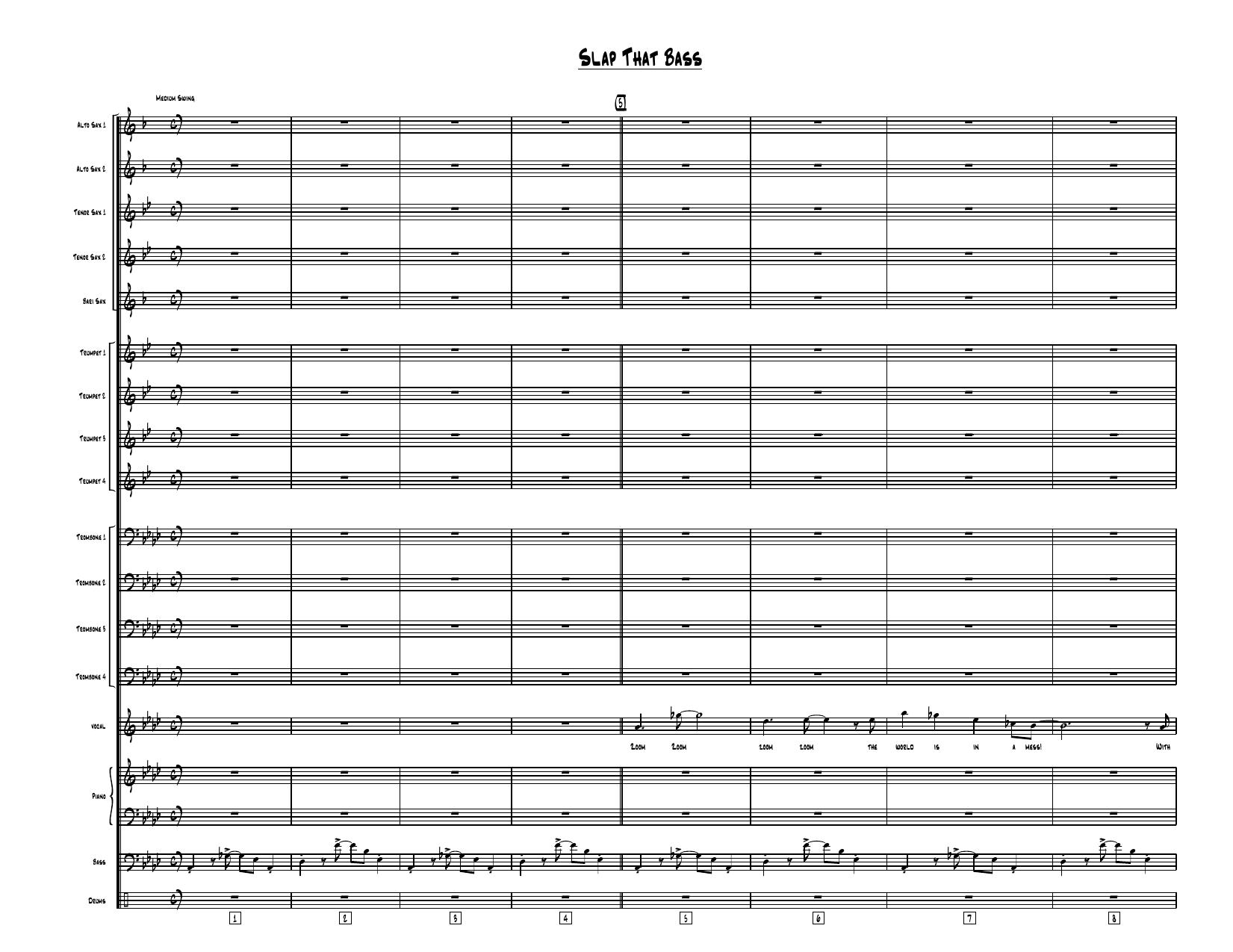
Slap That Bass (N.Riddle) sheet music preview

Slap That Bass (N.Riddle)

Composed by George Gershwin

Arranged by Frank Sinatra & Nelson Riddle

  • Ensemble: Big Band
  • Pages: 48
  • Instruments (17): Alto Sax 1, Alto Sax 2, Tenor Sax 1, Tenor Sax 2, Bari Sax, Trumpet 1, Trumpet 2, Trumpet 3, Trumpet 4, Trombone 1, Trombone 2, Trombone 3, Trombone 4, Female Vocal, Piano, Bass, Drums
  • Difficulty: medium
  • Content: Individual Parts
  • Format: PDF Download (Instant)
  • Price: $24.99

George Gershwin’s iconic 1937 theater tune "Slap That Bass," originally introduced in the Fred Astaire film *Shall We Dance*, achieved its definitive mid-century swinging incarnation through the legendary collaborative partnership of vocalist Frank Sinatra and master arranger Nelson Riddle. Representing the pinnacle of the 1950s Capitol Records golden era, Riddle’s charts transformed Broadway show tunes and Tin Pan Alley standards into sophisticated, high-energy orchestrations that defined sophisticated vocal jazz. This specific arrangement captures the effervescent, rhythmically driven spirit of that collaboration, translating Riddle's lush, harmonically inventive orchestral palette into a punchy, driving big band format tailored for an 8-instrument ensemble. Brimming with an irrepressible, swinging momentum, this chart operates at a brisk, buoyant medium-up tempo in 4/4 swing time. The mood is relentlessly optimistic, sophisticated, and playful, driven by syncopated rhythmic figures and a vibrant harmonic language rich in extended jazz chords, sharp chromatic passing tones, and clever counter-melodies. The arrangement evokes the glittering sophistication of a mid-century Vegas showroom floor or a high-end studio recording session, balancing punchy brass stabs with fluid, interlocking woodwind lines that keep the rhythmic engine firing continuously beneath the surface. Nelson Riddle’s signature arranging thumbprint is immediately recognizable in the chart's ingenious use of dynamic contrast, walking basslines transferred to horns, and sparkling counter-lines that weave around the central melody. Rather than relying on standard, predictable block voicings, Riddle utilizes inventive instrumental pairings—such as pairing the alto and tenor saxophones in tight, linear unison against muted brass responses—to create a remarkably full, transparent texture despite the compact 8-instrument configuration. The arrangement features crisp call-and-response figures between the rhythm section and the horns, building anticipation toward a tightly wound, exhilarating shout chorus that showcases advanced harmonic shifts without ever losing its danceable groove. The melodic load is shared deftly among the alto saxophone, tenor saxophone, trumpet, and trombone, creating a democratized texture where every player assumes a vital role in the overarching harmonic structure. Technical demands center around precision articulation, light and agile tongue work for fast-moving bebop-inflected lines, and a deep, innate understanding of traditional swing phrasing. Advanced high school, collegiate, and professional ensembles will find this chart deeply rewarding; it forces players to listen across sections and lock in tight rhythmic unisons. The standout moment arrives midway through the chart with a clever modulatory bridge that propels the ensemble into a high-energy climax, testing the band's collective ability to maintain immaculate intonation and crisp swing subdivision at a brisk tempo. Mastering this Nelson Riddle chart requires meticulous attention to articulation and stylistic uniformity across the 8-player ensemble. The tempo should remain bright and forward-moving, anchored by a steady, buoyant swing eighth-note feel where the upbeat is consistently emphasized without rushing. The primary technical challenge lies in the rapid, syncopated unison lines shared between the saxophones and brass; players must practice these passages slowly with a metronome to ensure that every short note is clipped with identical length and every accented note blooms naturally. Horn players should utilize precise breath support to execute the dynamic swells indicated in the score, avoiding harsh attacks on the upper register. Rhythm section members are the heartbeat of this arrangement: the pianist should deploy sparse, rhythmic comping reminiscent of Bill Miller's work with Sinatra, avoiding muddy low-register voicings to keep the ensemble texture transparent. Rehearsals should initially isolate the tricky rhythmic modulations in the bridge before attempting the chart at performance speed, ensuring that the transition into the shout chorus feels effortless and musically inevitable. Q: What specific instrumentation and parts are included in this arrangement? A: This arrangement is scored for an 8-instrument ensemble featuring Alto Saxophone, Tenor Saxophone, Trumpet, Trombone, Piano, and a rhythm section-compatible format spanning 48 comprehensive pages of score and parts. Q: What is the designated difficulty level for this chart? A: This piece is geared toward advanced high school, collegiate, and professional small big bands or jazz ensembles due to its demanding swing feel, rapid unisons, and sophisticated harmonic structures. Q: What is the historical background of this specific version? A: This arrangement channels the iconic aesthetic of Nelson Riddle's mid-century arrangements written for Frank Sinatra, translating the sophisticated vocal jazz style of the 1950s Capitol Records era into an instrumental format based on George Gershwin's 1937 classic. Q: What makes this Nelson Riddle arrangement unique for an 8-instrument band? A: It maximizes a compact 8-player instrumentation by utilizing inventive counter-melodies, transparent harmonic voicings, and tight horn-versus-rhythm call-and-response patterns that mimic the weight and color of a full 17-piece big band. Q: What is the performance duration and tempo feel of the piece? A: The arrangement runs approximately 3 to 4 minutes and is performed at a brisk, buoyant medium-up tempo featuring a driving 4/4 swing feel.

Questions and answers

What is included in the Slap That Bass (N.Riddle) PDF?
The verified current file contains a conductor score and individual parts across 48 pages.
How many instruments or parts are listed for Slap That Bass (N.Riddle)?
The verified instrumentation list contains 17 entries for this Big Band arrangement.
Who is credited for Slap That Bass (N.Riddle)?
Composer: George Gershwin. Arranger: Frank Sinatra & Nelson Riddle.
What difficulty is listed for Slap That Bass (N.Riddle)?
The verified difficulty level is medium.
Can I preview Slap That Bass (N.Riddle) before buying?
Yes. The product page provides a preview generated from the current PDF file.
How is Slap That Bass (N.Riddle) delivered?
After successful payment, the digital PDF is made available for download. The displayed price is $24.99.

Musicians Also Search For

Slap That Bass Frank Sinatra & Nelson Riddle PDFSlap That Bass Frank Sinatra & Nelson Riddle sheet musicSlap That Bass arranged by Frank Sinatra & Nelson RiddleFrank Sinatra & Nelson Riddle big band chartsFrank Sinatra & Nelson Riddle jazz arrangements PDFSlap That Bass George Gershwin sheet musicSlap That Bass George Gershwin big band arrangementsGeorge Gershwin big band chartsSlap That Bass big band arrangementsSlap That Bass big band PDF downloadSlap That Bass jazz sheet musicbig band sheet music downloadSlap That Bass conductor score PDFSlap That Bass individual parts downloadSlap That Bass sheet music PDFbuy Slap That Bass sheet musicdownload Slap That Bass PDFSlap That Bass jazz chartsbest Frank Sinatra & Nelson Riddle big band arrangementsGeorge Gershwin arranged by Frank Sinatra & Nelson RiddleSlap That Bass printable sheet musicbig band repertoire PDF

All arrangements by Frank Sinatra & Nelson Riddle All George Gershwin sheet music