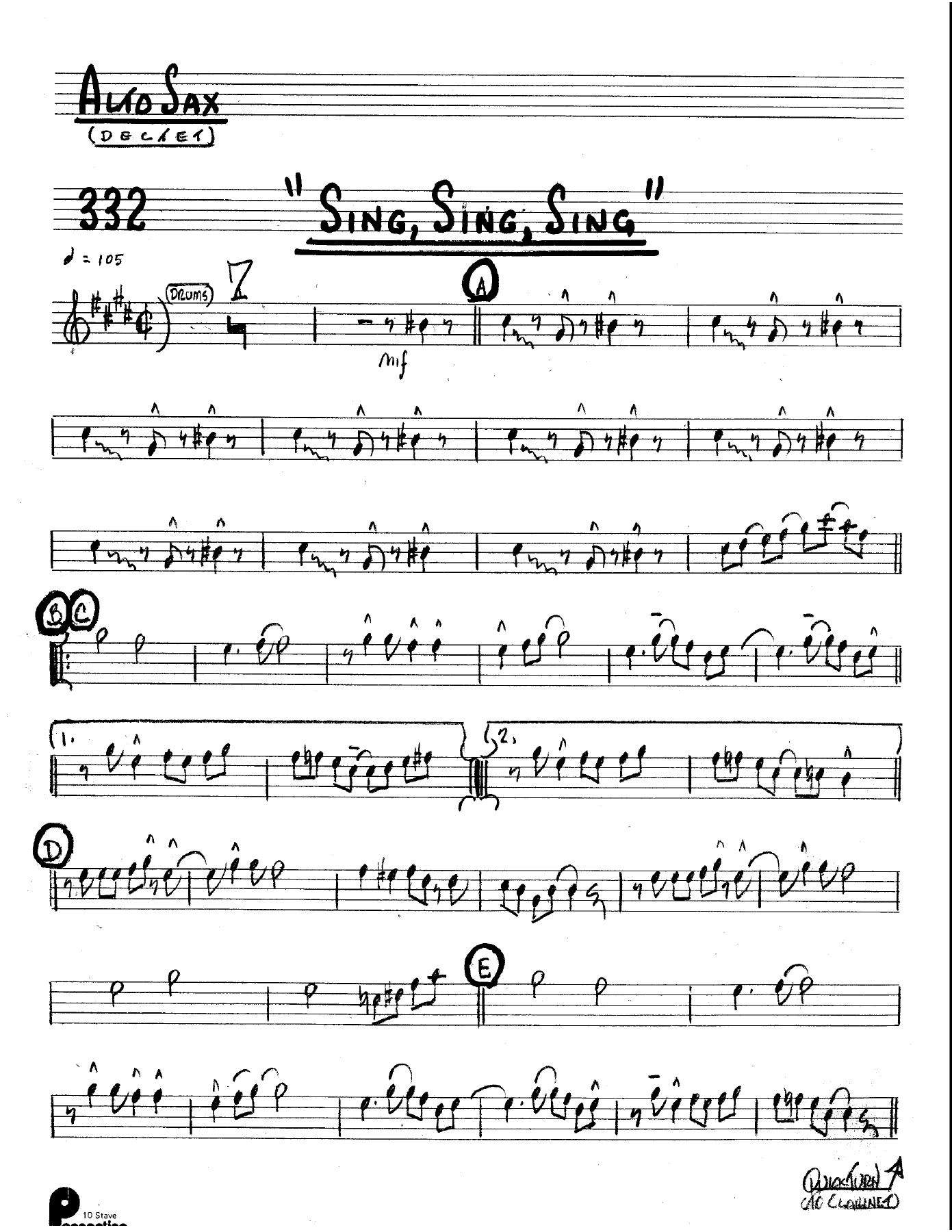
Sing, Sing, Sing (Kenton Dectet #332)
Composed by Louis Prima
Arranged by Stan Kenton Dected 176
- Ensemble: Small Ensemble
- Style: Jazz Standard
- Pages: 59
- Instruments (9): Alto Saxophone, Tenor Saxophone, Baritone Saxophone, Trumpet 1, Trumpet 2, Trombone, Piano, Bass, Drums
- Difficulty: easy
- Content: Individual Parts
- Format: PDF Download (Instant)
- Price: $12.99
Louis Prima's "Sing, Sing, Sing" stands as an indelible icon of the Swing Era, a composition that transcended its initial 1936 recording to become synonymous with the unbridled energy and rhythmic sophistication of big band jazz. Originally recorded by Prima with his New Orleans Gang, it was Benny Goodman's electrifying 1937 rendition, featuring Gene Krupa's legendary drum solo, that propelled the piece into the annals of jazz history, cementing its status as a quintessential jazz standard. The piece itself is a masterclass in rhythmic propulsion, built around a driving tom-tom beat and a memorable, syncopated melody. It embodies the exuberance and improvisational spirit of the late 1930s, a period when jazz was at the forefront of popular music, captivating audiences with its infectious swing feel and virtuosic displays. Its enduring appeal lies in its ability to evoke the joyous, dance-hall atmosphere of the era, making it a perennial favorite for both performers and listeners. This particular arrangement, "Sing, Sing, Sing (Kenton Dectet #332)," offers a unique and sophisticated reinterpretation of Prima's classic through the lens of Stan Kenton's distinctive Dectet sound. While the original is often associated with large big band forces, this Kenton Dectet arrangement masterfully distills the essence of the piece into a compact yet powerful small ensemble setting. The musical character remains an up-tempo, driving swing feel in 4/4 time, typically performed around 180-200 BPM, maintaining the original's high-energy mood. The arrangement is primarily in the key of E-flat major, though it explores harmonic nuances characteristic of Kenton's more progressive leanings. It evokes a feeling of exhilarating momentum and sophisticated swagger, a blend of raw swing power and polished ensemble precision. Stan Kenton Dectet 176's approach to "Sing, Sing, Sing" is marked by his signature voicings, which provide a rich, dense sound despite the smaller instrumentation. Expect intricate counterpoint and sophisticated harmonic extensions that elevate the original's melodic simplicity. The arrangement features a compelling interplay between the brass and reed sections, often employing tight, unison figures and harmonized soli passages that showcase the ensemble's precision. The iconic melody is initially carried by the trumpet, later transitioning to the saxophone section for a contrasting texture. While the original is famous for its extended drum solo, this Dectet arrangement integrates opportunities for featured instrumental solos, typically for trumpet and tenor saxophone, allowing individual voices to shine within the structured framework. Technical challenges include maintaining rhythmic tightness at a fast tempo, executing precise ensemble attacks and releases, and navigating the harmonic complexities of Kenton's voicings. The reward lies in performing a historically significant piece with a fresh, intellectually stimulating interpretation that allows a smaller ensemble to achieve a powerful, big-band-like impact. This arrangement is ideally suited for advanced high school, college, community, and professional jazz ensembles. Its demands for technical proficiency, tight ensemble playing, and a mature understanding of jazz phrasing make it an excellent choice for groups looking to challenge themselves with a sophisticated yet undeniably swinging chart. The compact nature of the Dectet allows for greater flexibility in performance venues while still delivering a full and impactful sound. It provides an invaluable opportunity to explore the evolution of jazz arranging, bridging the gap between traditional swing and the more modern harmonic concepts that Kenton championed. Conductors should emphasize rhythmic precision and a relentless, driving swing feel from the outset. The piece's high tempo (approx. 180-200 BPM) necessitates meticulous attention to articulation and ensemble attacks, particularly in the brass section. Pay close attention to the dynamic contrasts, using them to build excitement towards the shout chorus. The Kenton Dectet voicings require careful balance within sections to ensure clarity of harmony; encourage players to listen across the ensemble rather than just within their own section. Soloists should be encouraged to embrace the energetic spirit of the piece while navigating the underlying harmonic structure. Rehearsal time should be dedicated to locking in the drum groove and bass line, as they form the bedrock of this arrangement's infectious propulsion. Ensure all falls and scoops are executed uniformly and with stylistic integrity. Q: What instruments are included in the "Sing, Sing, Sing (Kenton Dectet #332)" arrangement? A: This Dectet arrangement typically includes parts for Trumpet, Trombone, Alto Saxophone, Tenor Saxophone, Baritone Saxophone, Piano, Bass, and Drums, providing a full and balanced sound for a small ensemble. Q: What is the difficulty level of this arrangement? A: This arrangement is considered advanced, suitable for experienced high school, college, community, and professional jazz ensembles due to its demanding tempo, intricate voicings, and requirements for precise ensemble playing. Q: What musical style and historical context does this arrangement represent? A: This arrangement is a jazz standard rooted in the Swing Era (1930s), reinterpreted with the sophisticated harmonic and textural approach characteristic of Stan Kenton's Dectet sound, blending classic swing with more progressive jazz elements. Q: What makes this specific arrangement unique compared to other versions of "Sing, Sing, Sing"? A: Its uniqueness lies in Stan Kenton Dectet 176's signature voicings and sophisticated harmonic treatment, adapting a classic big band staple for a smaller, more intimate ensemble without sacrificing its powerful swing and energy. Q: What is the typical performance duration and tempo for "Sing, Sing, Sing (Kenton Dectet #332)"? A: The typical performance duration is approximately 3-5 minutes, depending on solos, and it should be performed at an up-tempo, driving swing feel, generally between 180-200 beats per minute.
Questions and answers
- What is included in the Sing, Sing, Sing (Kenton Dectet #332) PDF?
- The verified current file contains individual parts across 59 pages.
- How many instruments or parts are listed for Sing, Sing, Sing (Kenton Dectet #332)?
- The verified instrumentation list contains 9 entries for this Small Ensemble arrangement.
- Who is credited for Sing, Sing, Sing (Kenton Dectet #332)?
- Composer: Louis Prima. Arranger: Stan Kenton Dected 176.
- What difficulty is listed for Sing, Sing, Sing (Kenton Dectet #332)?
- The verified difficulty level is easy.
- What style is listed for Sing, Sing, Sing (Kenton Dectet #332)?
- The catalog lists the style as Jazz Standard.
- Can I preview Sing, Sing, Sing (Kenton Dectet #332) before buying?
- Yes. The product page provides a preview generated from the current PDF file.
- How is Sing, Sing, Sing (Kenton Dectet #332) delivered?
- After successful payment, the digital PDF is made available for download. The displayed price is $12.99.
Musicians Also Search For
Sing, Sing, Sing Stan Kenton Dected 176 PDF • Sing, Sing, Sing Stan Kenton Dected 176 sheet music • Sing, Sing, Sing arranged by Stan Kenton Dected 176 • Stan Kenton Dected 176 small ensemble charts • Stan Kenton Dected 176 jazz arrangements PDF • Sing, Sing, Sing Louis Prima sheet music • Sing, Sing, Sing Louis Prima small ensemble arrangements • Louis Prima small ensemble charts • Sing, Sing, Sing small ensemble arrangements • Sing, Sing, Sing small ensemble PDF download • Sing, Sing, Sing jazz sheet music • small ensemble sheet music download • Sing, Sing, Sing individual parts download • Sing, Sing, Sing sheet music PDF • Sing, Sing, Sing Jazz Standard charts • Jazz Standard small ensemble arrangements • buy Sing, Sing, Sing sheet music • download Sing, Sing, Sing PDF • Sing, Sing, Sing jazz charts • best Stan Kenton Dected 176 small ensemble arrangements • Louis Prima arranged by Stan Kenton Dected 176 • Sing, Sing, Sing printable sheet music • small ensemble repertoire PDF