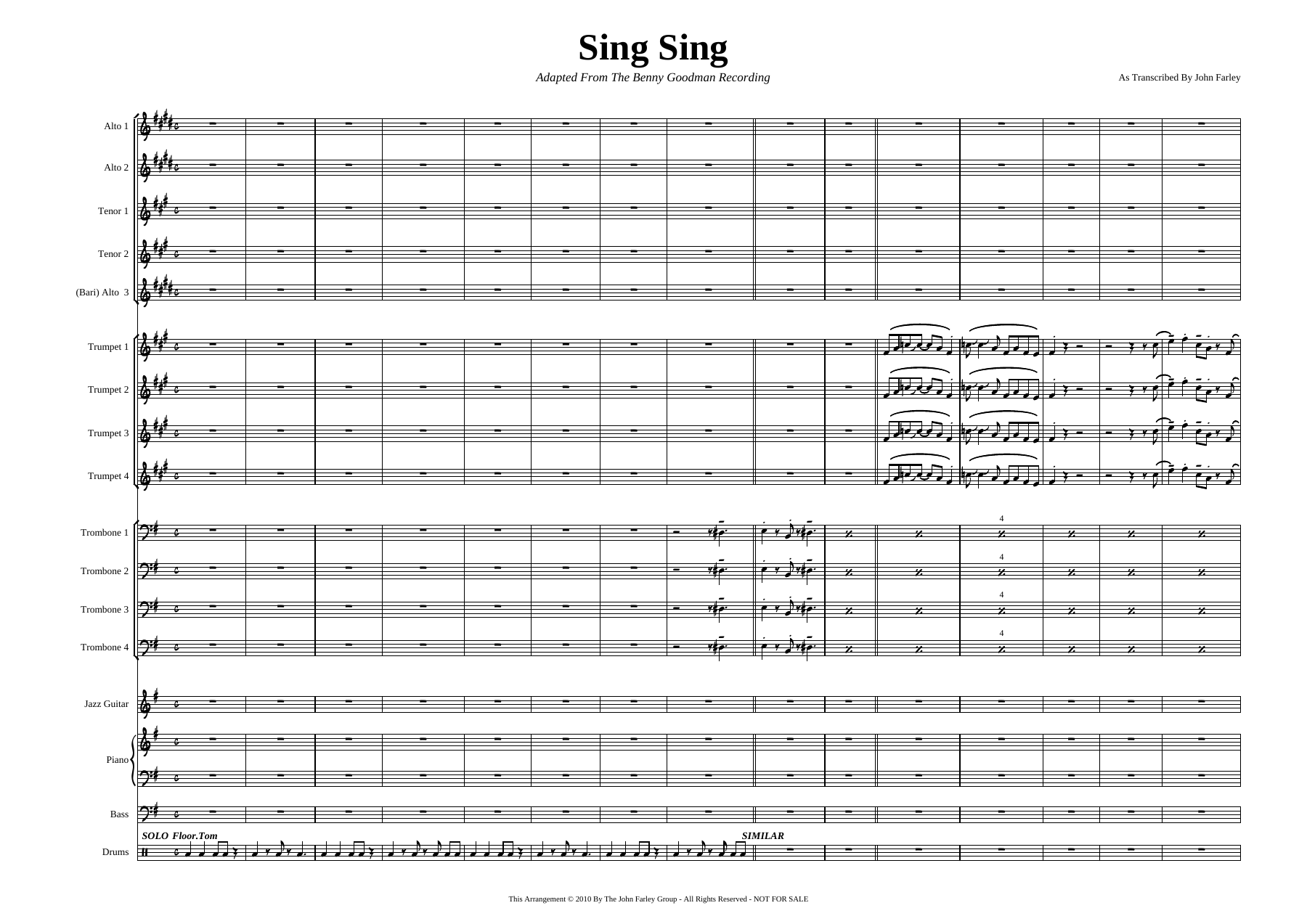
Sing Sing Sing (J.Farley) sheet music preview

Sing Sing Sing (J.Farley)

Composed by Louis Prima

Arranged by Benny Goodman

  • Ensemble: Big Band
  • Style: Jazz Standard
  • Pages: 61
  • Instruments (18): Alto Saxophone 1, Clarinet in Bb, Alto Saxophone 2, Tenor Saxophone 1, Tenor Saxophone 2, Baritone Saxophone, Trumpet 1, Trumpet 2, Trumpet 3, Trumpet 4, Trombone 1, Trombone 2, Trombone 3, Trombone 4, Jazz Guitar, Piano, Bass, Drums
  • Difficulty: advanced
  • Content: Individual Parts
  • Format: PDF Download (Instant)
  • Price: $24.99

The iconic "Sing Sing Sing," originally composed by Louis Prima in 1936, stands as an enduring anthem of the Swing Era, forever etched into the annals of jazz history. While Prima's original composition laid the groundwork, it was Benny Goodman's electrifying 1937 Carnegie Hall performance and subsequent recording that catapulted this piece into legendary status, solidifying its place as a quintessential jazz standard. Representing the vibrant energy and improvisational spirit of the Big Band era, "Sing Sing Sing" is characterized by its driving, infectious rhythm and call-and-response motifs, evoking the exhilarating atmosphere of the dance halls and concert stages of the late 1930s. Its unique structure, featuring a prominent drum solo and a relentless, building intensity, set it apart from many contemporary big band charts and continues to captivate audiences today. This particular arrangement, credited to J. Farley and notably performed and popularized by Benny Goodman's orchestra, captures the raw, unbridled energy and sophisticated orchestral voicings synonymous with the "King of Swing." Set in the key of E-flat major, the arrangement maintains a relentless, up-tempo swing feel, typically around 160-180 BPM, demanding precision and stamina from all sections. The musical character is one of jubilant exuberance and controlled chaos, building from its famous tom-tom driven introduction into a full-throttle big band showcase. Goodman's approach, as reflected in this chart, emphasizes tightly-knit ensemble playing, dynamic contrasts, and thrilling soli sections that weave intricate melodic lines through the brass and saxophones. The arrangement masterfully balances the original composition's raw energy with sophisticated big band orchestration, creating a truly exhilarating performance experience. Performance of "Sing Sing Sing (J.Farley)" is a true test of a big band's cohesion and individual musicianship. The arrangement opens with the instantly recognizable drum solo, setting the stage for the full ensemble's entrance. The melody is predominantly carried by the clarinet (often doubling with the lead alto saxophone), frequently answered by powerful brass interjections. While there isn't a traditional open solo section for improvisation, the arrangement itself functions as a virtuosic showcase for the entire band, particularly the saxophones and trumpets in their demanding soli passages. Technical challenges include the rapid-fire articulation in the saxophone section, the high-register demands on the lead trumpet, and maintaining the relentless swing feel and dynamic intensity throughout. The rewarding aspect lies in the sheer power and excitement generated, culminating in the iconic shout chorus that brings the piece to its thunderous conclusion. This arrangement is ideally suited for advanced high school, collegiate, community, and professional big bands. Its demands on ensemble precision, individual instrumental technique, and dynamic control require a seasoned group. Bands with strong lead players in the trumpet, alto saxophone, and clarinet chairs, along with a powerful and articulate rhythm section, will find this chart particularly rewarding. It serves as an excellent vehicle for showcasing a band's collective strength and historical understanding of the Swing Era's most iconic pieces. This arrangement of "Sing Sing Sing (J.Farley)" demands a relentless, up-tempo swing feel, ideally around 160-180 BPM. Conductors should emphasize a driving eighth-note pulse and crisp articulation from all sections, particularly in the saxophone soli passages. The iconic drum intro requires a strong, confident drummer capable of maintaining consistent tempo and dynamic build. Pay close attention to dynamic contrasts; the piece thrives on gradual crescendos and sudden bursts of sound. The lead trumpet and lead alto saxophone/clarinet parts are technically demanding, requiring strong embouchure and endurance for sustained high-register playing and rapid articulation. Rehearsal should focus on rhythmic precision in the unison and soli sections, ensuring clean entrances and releases. Encourage the rhythm section to provide a solid, unwavering foundation, especially during the extended ensemble sections, to support the brass and woodwind flourishes. Q: What instruments are included in this arrangement? A: This arrangement is scored for a standard 17-piece big band: Alto Saxophone 1, Alto Saxophone 2, Tenor Saxophone 1, Tenor Saxophone 2, Baritone Saxophone, Trumpet 1, Trumpet 2, Trumpet 3, Trumpet 4, Trombone 1, Trombone 2, Trombone 3, Trombone 4, Piano, Bass, Drums, and Guitar. Q: What is the difficulty level of this arrangement? A: This arrangement is considered advanced. It requires strong technical proficiency from all sections, particularly the lead trumpet and lead alto saxophone/clarinet, and a cohesive rhythm section to maintain the demanding up-tempo swing. Q: What is the musical style and historical context of "Sing Sing Sing (J.Farley)"? A: This piece is a quintessential jazz standard from the Swing Era (1930s-1940s). It embodies the high-energy, dance-oriented big band sound popularized by artists like Benny Goodman, who made this particular arrangement famous. Q: What makes this specific arrangement unique compared to other versions of "Sing Sing Sing"? A: This "J.Farley" arrangement, popularized by Benny Goodman, is distinctive for its faithful recreation of the iconic Goodman big band sound, featuring intricate saxophone soli, powerful brass interjections, and the famous drum solo intro, all contributing to its relentless, building intensity. Q: What is the typical performance duration and tempo for this piece? A: The typical performance duration for this arrangement is approximately 4-6 minutes, depending on the tempo. It is meant to be played at a fast, driving up-tempo swing, generally between 160-180 beats per minute.

Questions and answers

What is included in the Sing Sing Sing (J.Farley) PDF?
The verified current file contains a conductor score and individual parts across 61 pages.
How many instruments or parts are listed for Sing Sing Sing (J.Farley)?
The verified instrumentation list contains 18 entries for this Big Band arrangement.
Who is credited for Sing Sing Sing (J.Farley)?
Composer: Louis Prima. Arranger: Benny Goodman.
What difficulty is listed for Sing Sing Sing (J.Farley)?
The verified difficulty level is advanced.
What style is listed for Sing Sing Sing (J.Farley)?
The catalog lists the style as Jazz Standard.
Can I preview Sing Sing Sing (J.Farley) before buying?
Yes. The product page provides a preview generated from the current PDF file.
How is Sing Sing Sing (J.Farley) delivered?
After successful payment, the digital PDF is made available for download. The displayed price is $24.99.

Musicians Also Search For

Sing Sing Sing Benny Goodman PDFSing Sing Sing Benny Goodman sheet musicSing Sing Sing arranged by Benny GoodmanBenny Goodman big band chartsBenny Goodman jazz arrangements PDFSing Sing Sing Louis Prima sheet musicSing Sing Sing Louis Prima big band arrangementsLouis Prima big band chartsSing Sing Sing big band arrangementsSing Sing Sing big band PDF downloadSing Sing Sing jazz sheet musicbig band sheet music downloadSing Sing Sing conductor score PDFSing Sing Sing individual parts downloadSing Sing Sing sheet music PDFSing Sing Sing Jazz Standard chartsJazz Standard big band arrangementsbuy Sing Sing Sing sheet musicdownload Sing Sing Sing PDFSing Sing Sing jazz chartsbest Benny Goodman big band arrangementsLouis Prima arranged by Benny GoodmanSing Sing Sing printable sheet musicbig band repertoire PDF

All arrangements by Benny Goodman All Louis Prima sheet music