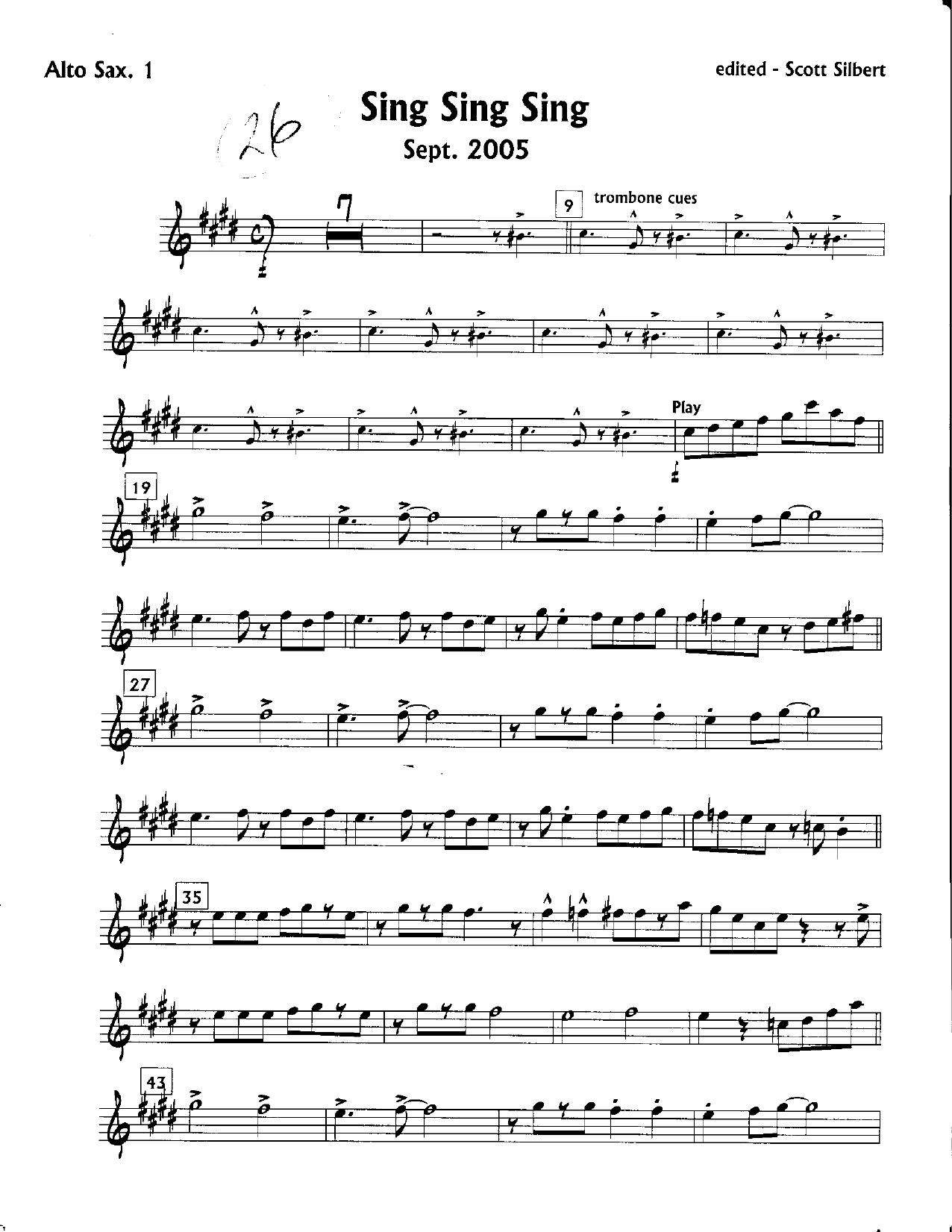
Sing, Sing, Sing (S.Silbert) sheet music preview

Sing, Sing, Sing (S.Silbert)

Composed by Louis Prima

Arranged by S.Silbert

  • Ensemble: Big Band
  • Style: Jazz Standard
  • Pages: 61
  • Instruments (16): Alto Sax. 1, Clarinet, Tenor Sax. 1, Tenor Sax. 2, Baritone Sax., Trumpet 1, Trumpet 2, Trumpet 3, Trumpet 4, Trombone 1, Trombone 2, Trombone 3, Trombone 4, Piano, Bass, Drums
  • Difficulty: advanced
  • Content: Individual Parts
  • Format: PDF Download (Instant)
  • Price: $24.99

Louis Prima’s 1936 masterpiece, “Sing, Sing, Sing (With a Swing),” remains the definitive anthem of the Swing Era, forever etched into the cultural consciousness by Benny Goodman’s historic 1938 Carnegie Hall performance. Originally conceived as a vehicle for Prima’s New Orleans-inflected vocals, the composition evolved into a sprawling instrumental showcase that redefined the role of the drum kit in jazz. As a cornerstone of the Great American Songbook, it represents the peak of big band fervor, blending minor-key mystery with a relentless, driving energy that bridged the gap between popular dance music and sophisticated orchestral jazz. Its legacy is built on the "jungle drum" aesthetic and the high-octane call-and-response between the woodwinds and brass. S. Silbert’s meticulous 61-page arrangement captures the visceral intensity of the original while providing a structured, professional framework for a 16-piece ensemble. Set in a hard-driving swing feel, the chart leans heavily into the iconic floor tom patterns and syncopated brass stabs that define the genre. Silbert distinguishes this treatment through sophisticated woodwind doublings—most notably the essential Clarinet lead—and expanded harmonic voicings in the trombone section that add modern weight to the 1930s aesthetic. The arrangement navigates the transition from the haunting A-minor head to the explosive, high-octane shout choruses with a sense of pacing that mirrors the legendary extended live versions of the Goodman era, ensuring the momentum never plateaus. Executing this score requires a clarinetist with exceptional facility and a drummer capable of sustaining a high-intensity pulse without rushing the 4/4 swing. The brass sections are tasked with demanding range requirements and precise rhythmic unisons during the climactic shout sections, where the arrangement reaches its peak volume and complexity. While the saxophone section handles intricate soli passages that demand tight articulation, the real challenge lies in the ensemble’s collective endurance across the arrangement's expansive length. Specific moments, such as the building brass crescendos and the interplay between the low reeds and the rhythm section, require a high degree of dynamic control. Given the technical rigor and the need for stylistic authenticity, this arrangement is best suited for advanced collegiate ensembles or professional big bands looking for a definitive, concert-ready version of this jazz staple. It offers a rewarding challenge for the rhythm section, specifically in managing the dynamic shifts between the driving drum solos and the lush, layered ensemble textures. For any band aiming to anchor a program with a high-impact, historically significant work, Silbert’s arrangement provides the necessary depth and detail to satisfy both performers and audiences. Success in this arrangement hinges on the drummer’s ability to maintain a consistent, driving floor-tom groove at an up-tempo swing (typically 200+ BPM). The "Sing, Sing, Sing" feel is less about light ride cymbal patterns and more about the heavy, tribal pulse of the drums. Brass players should be prepared for significant physical demands; the lead trumpet part requires consistent power in the upper register, especially during the final modulation. Conductors should focus rehearsal time on the transition points between the clarinet solos and the full-band entrances to ensure the energy remains constant. Use bucket mutes where indicated to provide tonal contrast, and emphasize the "falls" and "doits" in the shout chorus to maximize the period-accurate swing aesthetic. Precise articulation on the syncopated eighth-note lines is non-negotiable for ensemble clarity. Q: Which instruments are included in this 16-part arrangement? A: The score is written for a standard big band configuration featuring a prominent Clarinet lead, Alto Saxophone 1, two Tenor Saxophones, Baritone Saxophone, and a full complement of brass and rhythm section parts. The 61-page score provides detailed parts for every player, ensuring a thick, orchestral jazz texture. Q: What is the difficulty level of S. Silbert's "Sing, Sing, Sing"? A: This is an advanced-level arrangement (Grade 5+) intended for professional or high-level collegiate ensembles. The combination of the rapid tempo, the technical demands on the clarinet soloist, and the endurance required for the brass sections makes it a challenging but rewarding undertaking. Q: What is the musical style and historical context of this piece? A: This is a quintessential Swing Era jazz standard, originally composed by Louis Prima in 1936. It is characterized by its driving "jungle" drum beats, minor-key tonality, and high-energy ensemble writing that defined the big band sound of the late 1930s. Q: What makes the S. Silbert arrangement unique compared to other versions? A: Silbert’s arrangement is notable for its massive 61-page scope, which allows for a more developed and structured concert narrative than typical "head" arrangements. It features specific, sophisticated voicings for the 16-piece ensemble that bridge the gap between historic transcription and modern big band writing. Q: What is the recommended tempo and approximate performance duration? A: The arrangement is designed to be played at an up-tempo swing, generally between 210 and 230 BPM. Depending on the length of the featured drum and clarinet solos, the performance duration typically spans six to eight minutes.

Questions and answers

What is included in the Sing, Sing, Sing (S.Silbert) PDF?
The verified current file contains individual parts across 61 pages.
How many instruments or parts are listed for Sing, Sing, Sing (S.Silbert)?
The verified instrumentation list contains 16 entries for this Big Band arrangement.
Who is credited for Sing, Sing, Sing (S.Silbert)?
Composer: Louis Prima. Arranger: S.Silbert.
What difficulty is listed for Sing, Sing, Sing (S.Silbert)?
The verified difficulty level is advanced.
What style is listed for Sing, Sing, Sing (S.Silbert)?
The catalog lists the style as Jazz Standard.
Can I preview Sing, Sing, Sing (S.Silbert) before buying?
Yes. The product page provides a preview generated from the current PDF file.
How is Sing, Sing, Sing (S.Silbert) delivered?
After successful payment, the digital PDF is made available for download. The displayed price is $24.99.

Musicians Also Search For

Sing, Sing, Sing S.Silbert PDFSing, Sing, Sing S.Silbert sheet musicSing, Sing, Sing arranged by S.SilbertS.Silbert big band chartsS.Silbert jazz arrangements PDFSing, Sing, Sing Louis Prima sheet musicSing, Sing, Sing Louis Prima big band arrangementsLouis Prima big band chartsSing, Sing, Sing big band arrangementsSing, Sing, Sing big band PDF downloadSing, Sing, Sing jazz sheet musicbig band sheet music downloadSing, Sing, Sing individual parts downloadSing, Sing, Sing sheet music PDFSing, Sing, Sing Jazz Standard chartsJazz Standard big band arrangementsbuy Sing, Sing, Sing sheet musicdownload Sing, Sing, Sing PDFSing, Sing, Sing jazz chartsbest S.Silbert big band arrangementsLouis Prima arranged by S.SilbertSing, Sing, Sing printable sheet musicbig band repertoire PDF

All arrangements by S.Silbert All Louis Prima sheet music