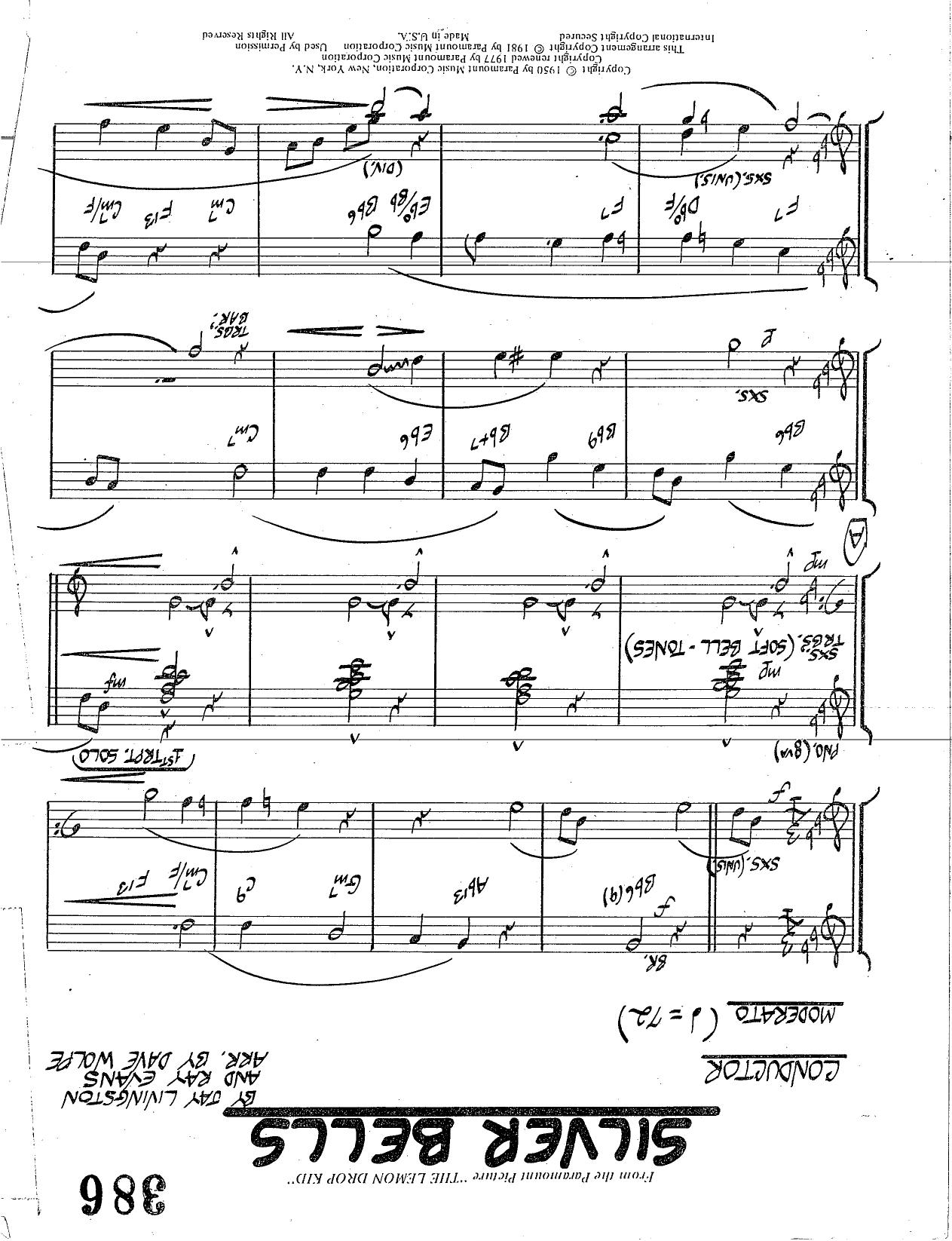
Silver Bells (D.Wolpe)
Composed by Jay Livingston
Arranged by Dave Wolpe
- Ensemble: Big Band
- Pages: 36
- Instruments (16): Conductor, 1st Eb Alto Sax, 2nd Eb Alto Sax, 1st Bb Tenor Sax, 2nd Bb Tenor Sax, Eb Baritone Sax, 1st Bb Trumpet, 2nd Bb Trumpet, 3rd Bb Trumpet, 1st Trombone, 2nd Trombone, 3rd Trombone, Piano, Guitar, Bass, Drums
- Difficulty: medium
- Content: Individual Parts
- Format: PDF Download (Instant)
- Price: $24.99
Written by Jay Livingston and Ray Evans in 1950, "Silver Bells" originally debuted in the Bob Hope and Marilyn Maxwell film *The Lemon Drop Kid* and quickly transcended its cinematic origins to become an indispensable pillar of the American holiday songbook. While countless traditional vocal and instrumental renditions exist, translating this beloved Christmas classic into a sophisticated big band chart requires a deft hand to balance seasonal nostalgia with genuine jazz credibility. The composition inherently possesses a gentle, wistful charm, anchored by a cyclical melody that lends itself beautifully to creative harmonic reharmonization and textural shifting within a standard 17-piece jazz orchestra instrumentation. Dave Wolpe’s masterwork arrangement reimagines the classic tune through a polished, swinging lens, injecting a buoyant medium-swing groove that elevates the material far beyond routine holiday fare. The chart opens with an inviting, harmonically rich introduction that establishes a warm, relaxed mood before settling into an infectious, driving rhythm section pulse. Wolpe utilizes lush, contemporary saxophone voicings and crisp brass counterlines to evoke the sophisticated stylings of classic studio orchestras and Count Basie-era phrasing. The mood shifts effortlessly between playful, walking-bass driven backgrounds and soaring, full-ensemble climaxes, capturing both the sparkling imagery of the lyrics and the sophisticated cool of mid-century jazz arranging. Throughout the chart, instrumental responsibilities are shared dynamically across the ensemble, ensuring every section enjoys engaging, well-crafted parts. The melody is initially introduced by the saxophones with subtle brass punctuation, gradually building in texture as the arrangement unfolds. A standout feature of Wolpe’s treatment is a well-placed solo section—typically allocated to tenor saxophone or trumpet—backed by crisp, swinging horn comping that keeps the momentum high. The climax arrives in the form of a jubilant shout chorus, where the full big band unites to drive the harmonic tension forward before resolving into a tasteful, glowing coda that leaves audiences thoroughly captivated. Advanced high school, collegiate, and community big bands will find this chart to be an exceptionally rewarding addition to seasonal concert programming. While the overall technical demands are approachable for groups comfortable with standard swing articulation, the arrangement places a premium on stylistic cohesion, section blend, and rhythmic precision. Directors will appreciate how Wolpe’s intelligent scoring naturally highlights weaker sections while offering enough advanced harmonic color to keep experienced players fully engaged, making it a standout centerpiece for any holiday jazz performance. Success with this arrangement hinges on establishing an authentic, relaxed medium-swing feel right from the downbeat. The tempo should not be rushed; maintaining a steady, conversational groove allows the eighth-note lines to breathe and swing naturally rather than sounding stiff. Conductors should pay close attention to the articulation markings—ensure that all backbeats (beats 2 and 4) are crisp, and encourage the rhythm section to lock in tightly with a steady, unhurried ride cymbal pattern and walking bassline. Brass players should use subtle, warm vibrato on sustained notes and execute stylistic falls and doits with restraint to maintain a polished, professional studio sound. During the saxophone soli, balance is critical; the inner voices must project clearly without covering the lead alto. Rehearsals should initially isolate the rhythm section to solidify the groove before layering in the horns, focusing intensely on dynamic contrast between the understated comping figures and the explosive shout chorus. Q: What instruments and parts are included in this big band arrangement? A: The package includes a comprehensive conductor score and 16 individual instrumental parts, covering standard big band instrumentation: 5 saxophones (two altos, two tenors, one baritone), 4 trumpets, 4 trombones, piano, bass, and drums. Q: What is the difficulty level of Dave Wolpe's "Silver Bells"? A: This arrangement is graded as medium difficulty, making it exceptionally well-suited for advanced high school jazz ensembles, college bands, and accomplished community big bands looking for accessible yet sophisticated holiday repertoire. Q: What musical style and historical era does this chart represent? A: The arrangement is set in a classic medium-swing style, drawing inspiration from the golden era of big band jazz and studio arranging while breathing new life into Jay Livingston and Ray Evans's timeless 1950 holiday standard. Q: What makes this specific arrangement of "Silver Bells" unique? A: Unlike overly simplified holiday charts, Wolpe’s version utilizes lush, contemporary harmonies, clever textural shifts between sections, and a swinging groove that successfully transforms a seasonal ballad into a legitimate jazz chart. Q: What is the approximate performance duration and tempo guideline for this piece? A: While performance time varies slightly based on chosen solo lengths, the chart runs approximately 3 to 4 minutes at a comfortable medium-swing tempo of around 116 to 124 beats per minute.
Questions and answers
- What is included in the Silver Bells (D.Wolpe) PDF?
- The verified current file contains a conductor score and individual parts across 36 pages.
- How many instruments or parts are listed for Silver Bells (D.Wolpe)?
- The verified instrumentation list contains 16 entries for this Big Band arrangement.
- Who is credited for Silver Bells (D.Wolpe)?
- Composer: Jay Livingston. Arranger: Dave Wolpe.
- What difficulty is listed for Silver Bells (D.Wolpe)?
- The verified difficulty level is medium.
- Can I preview Silver Bells (D.Wolpe) before buying?
- Yes. The product page provides a preview generated from the current PDF file.
- How is Silver Bells (D.Wolpe) delivered?
- After successful payment, the digital PDF is made available for download. The displayed price is $24.99.
Musicians Also Search For
Silver Bells Dave Wolpe PDF • Silver Bells Dave Wolpe sheet music • Silver Bells arranged by Dave Wolpe • Dave Wolpe big band charts • Dave Wolpe jazz arrangements PDF • Silver Bells Jay Livingston sheet music • Silver Bells Jay Livingston big band arrangements • Jay Livingston big band charts • Silver Bells big band arrangements • Silver Bells big band PDF download • Silver Bells jazz sheet music • big band sheet music download • Silver Bells conductor score PDF • Silver Bells individual parts download • Silver Bells sheet music PDF • buy Silver Bells sheet music • download Silver Bells PDF • Silver Bells jazz charts • best Dave Wolpe big band arrangements • Jay Livingston arranged by Dave Wolpe • Silver Bells printable sheet music • big band repertoire PDF