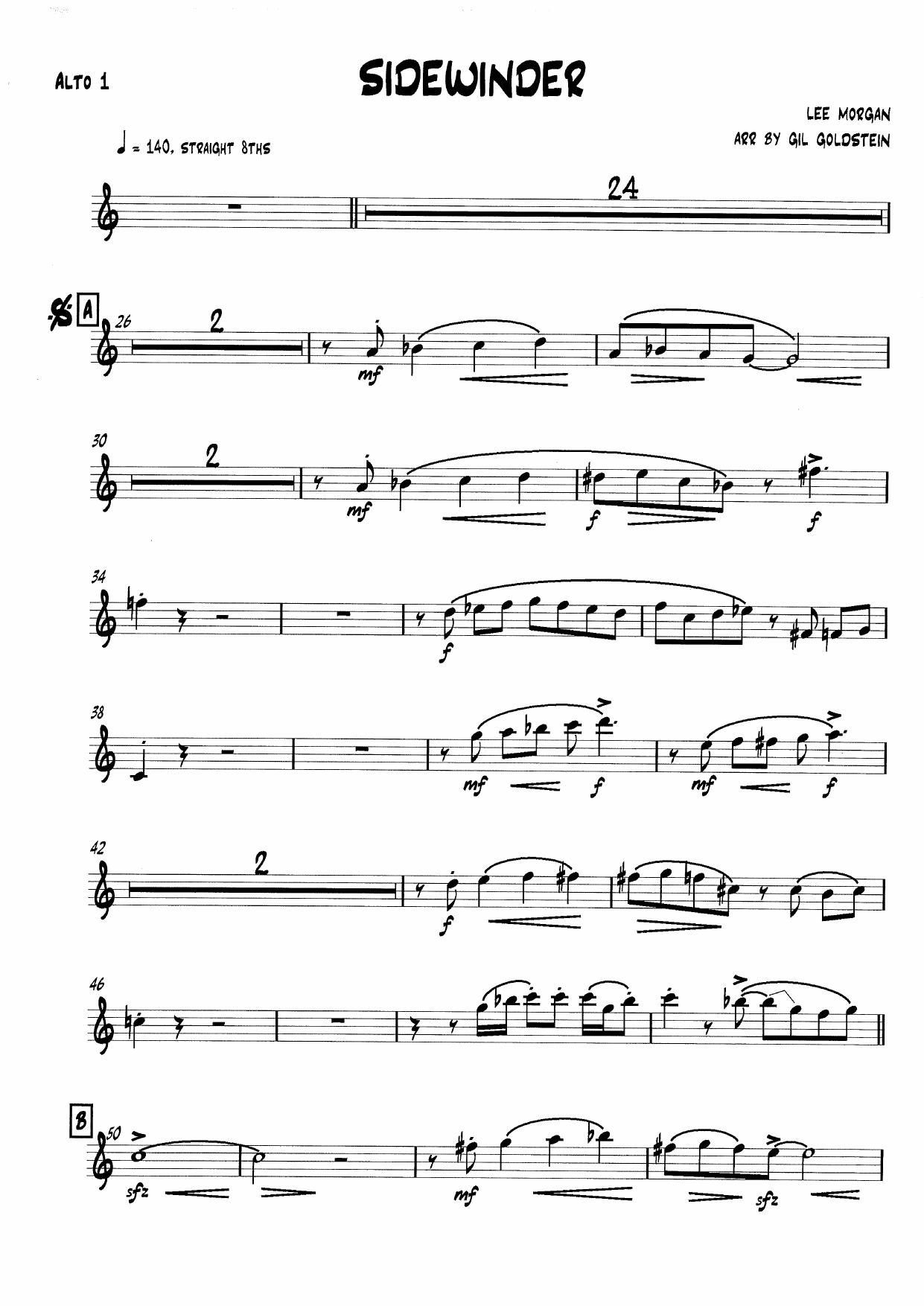
Sidewinder (G.Goldstein) sheet music preview

Sidewinder (G.Goldstein)

Composed by Lee Morgan

Arranged by Gil Goldstein

  • Ensemble: Big Band
  • Style: Jazz Standard
  • Pages: 50
  • Instruments (16): Alto 1, Alto 2, Tenor 1, Bari Sax, Trumpet 1, Trumpet 2, Trumpet 3, Trumpet 4, Trombone 1, Trombone 2, Trombone 3, Trombone 4, Guitar, Piano, Bass, Drums
  • Difficulty: advanced
  • Content: Individual Parts
  • Format: PDF Download (Instant)
  • Price: $24.99

Lee Morgan’s iconic blue-note anthem "The Sidewinder," originally recorded on the 1964 Blue Note album of the same name, stands as a monumental turning point in the evolution of 1960s soul-jazz and hard bop. Driven by its infectious, swaggering boogaloo groove and an instantly recognizable pentatonic melody, Morgan's original composition single-handedly revitalized commercial fortunes for Blue Note Records and defined an entire era of funky, blues-infused jazz. Transcending its origins as a crossover radio hit, the tune has endured as a quintessential jazz standard, celebrated for its deceptively simple head and open-ended, blues-based harmonic framework that invites deep rhythmic exploration. Master arranger Gil Goldstein breathes brilliant new life into this classic blueprint, transforming the compact quintet statement into a sprawling, multi-layered canvas for full big band. Rather than relying on a straightforward transcription of the original recording, Goldstein approaches the chart with a sophisticated harmonic palette and a modern compositional sensibility. The arrangement retains the signature swagger of the original rhythm section groove while expanding the brass and reed voicings into lush, contemporary clusters. Dynamic contrasts are sharp and deliberate, shifting effortlessly between driving, gritty backbeat grooves and intricate, harmonically advanced soli sections that showcase the entire ensemble's dynamic range and stylistic versatility. Throughout the chart, the melodic weight is cleverly distributed across the sections, with the brass and saxophones trading razor-sharp counterlines that build intense dramatic tension. Solos are open for featured horn players over the familiar blues-oriented changes, providing ample space for imaginative improvisation backed by tight, punchy background figures. Technically demanding due to its intricate syncopation, rapid-fire ensemble unisons, and the precise articulation required to nail the elusive boogaloo feel, this 50-page score rewards meticulous rehearsal with an overwhelmingly high-energy payoff. The arrangement culminates in a blistering shout chorus that reinterprets the main hook with roaring counterpoint and modern harmonic substitutions before driving hard to a dynamic final punch. Advanced university jazz ensembles, professional big bands, and elite community orchestras will find this chart an exhilarating centerpiece for a concert program. Because of its sophisticated rhythmic demands and the necessity for a rhythm section that can comfortably anchor a heavy, driving funk-shuffle feel without rushing, it requires a mature ensemble capable of balancing technical precision with deep, unyielding groove. Securing an authentic, deep-pocket groove is the single most critical element for success with this chart; the rhythm section must lock in tightly before the horns enter. The tempo should sit comfortably in a driving medium-up shuffle feel, avoiding any tendency to rush the backbeats. For the wind sections, precision in short-long articulation is paramount, particularly during the jagged unison lines and interwoven soli passages. Pay careful attention to the dynamic markings underneath the solo sections to ensure the background figures complement rather than obscure the featured soloist. Brass players should utilize standard mutes only where explicitly indicated, keeping open horns bright, focused, and punchy. Rehearsals should initially isolate the rhythm section to establish the foundational boogaloo pattern, layering the horn sections sequentially to master the complex syncopated cross-rhythms before attempting full ensemble tempo. Q: What instruments and parts are included in this big band arrangement? A: Scored for a 16-instrument big band lineup, the arrangement includes parts for two alto saxophones, two tenor saxophones, one baritone saxophone, trumpet parts 1 through standard lead requirements, and a complete rhythm section. Q: What is the difficulty level of Gil Goldstein’s arrangement of "Sidewinder"? A: This chart is graded as advanced, making it best suited for collegiate music programs, professional jazz orchestras, and highly accomplished community big bands due to its intricate syncopation and technical demands. Q: How does this arrangement relate to Lee Morgan’s original 1964 recording? A: While preserving the iconic melodies and foundational boogaloo spirit of Lee Morgan's hard bop classic, Goldstein reimagines the work through a modern compositional lens with expanded harmonies and complex ensemble voicings. Q: What makes this specific arrangement unique compared to standard big band charts? A: Goldstein’s signature approach infuses the traditional soul-jazz framework with sophisticated contemporary reharmonizations, brilliant cross-section counterpoint, and a uniquely dynamic architectural build toward the final shout chorus. Q: What is the performance duration and recommended tempo feel for this piece? A: The arrangement runs approximately 5 to 6 minutes in length and is anchored by a steady, driving medium-tempo swing-funk groove that demands unwavering internal time from all performers.

Questions and answers

What is included in the Sidewinder (G.Goldstein) PDF?
The verified current file contains individual parts across 50 pages.
How many instruments or parts are listed for Sidewinder (G.Goldstein)?
The verified instrumentation list contains 16 entries for this Big Band arrangement.
Who is credited for Sidewinder (G.Goldstein)?
Composer: Lee Morgan. Arranger: Gil Goldstein.
What difficulty is listed for Sidewinder (G.Goldstein)?
The verified difficulty level is advanced.
What style is listed for Sidewinder (G.Goldstein)?
The catalog lists the style as Jazz Standard.
Can I preview Sidewinder (G.Goldstein) before buying?
Yes. The product page provides a preview generated from the current PDF file.
How is Sidewinder (G.Goldstein) delivered?
After successful payment, the digital PDF is made available for download. The displayed price is $24.99.

Musicians Also Search For

Sidewinder Gil Goldstein PDFSidewinder Gil Goldstein sheet musicSidewinder arranged by Gil GoldsteinGil Goldstein big band chartsGil Goldstein jazz arrangements PDFSidewinder Lee Morgan sheet musicSidewinder Lee Morgan big band arrangementsLee Morgan big band chartsSidewinder big band arrangementsSidewinder big band PDF downloadSidewinder jazz sheet musicbig band sheet music downloadSidewinder individual parts downloadSidewinder sheet music PDFSidewinder Jazz Standard chartsJazz Standard big band arrangementsbuy Sidewinder sheet musicdownload Sidewinder PDFSidewinder jazz chartsbest Gil Goldstein big band arrangementsLee Morgan arranged by Gil GoldsteinSidewinder printable sheet musicbig band repertoire PDF

All arrangements by Gil Goldstein All Lee Morgan sheet music