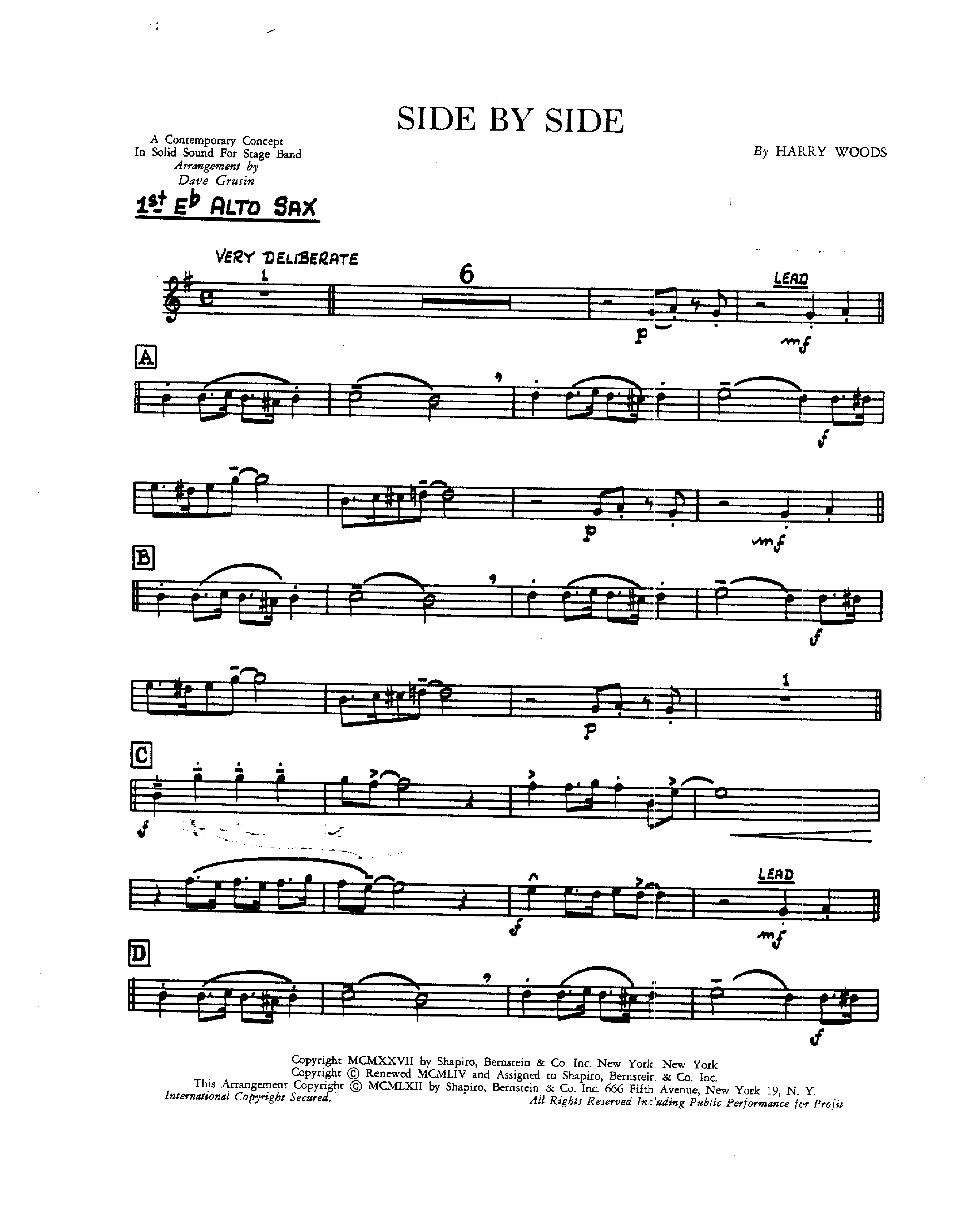
Side By Side (D.Grusin)
Composed by Harry Woods
Arranged by D. Grusin
- Ensemble: Big Band Dance
- Style: Quickstep
- Pages: 37
- Instruments (17): Alto Saxophone 1, Alto Saxophone 2, Tenor Saxophone 1, Tenor Saxophone 2, Baritone Saxophone, Trumpet 1, Trumpet 2, Trumpet 3, Trumpet 4, Trombone 1, Trombone 2, Trombone 3, Bass Trombone, Piano, Bass, Drums, Guitar
- Difficulty: medium
- Content: Individual Parts
- Format: PDF Download (Instant)
- Price: $24.99
Harry Woods' timeless composition, "Side By Side," first charmed audiences in 1927, quickly becoming a quintessential example of early 20th-century American popular song. Its infectious melody and optimistic lyrics resonated deeply during the Jazz Age, making it a beloved standard embraced by countless artists across genres. While not strictly a jazz tune in its initial conception, its enduring popularity and simple, singable structure made it a natural fit for jazz interpretation, particularly within the dance band tradition. The piece embodies the spirit of the Quickstep, a lively ballroom dance characterized by its brisk tempo and lighthearted feel, reflecting the exuberance of the era. Its appeal lies in its straightforward yet memorable melodic contour, which lends itself beautifully to both vocal and instrumental treatments. D. Grusin's arrangement of "Side By Side" masterfully reimagines this classic for the modern big band dance ensemble, preserving its inherent charm while infusing it with sophisticated jazz sensibilities. This arrangement is conceived as an up-tempo swing, typically performed around 180-200 BPM, maintaining the Quickstep's energetic pulse. Grusin's signature approach is evident in the rich, often harmonically adventurous voicings that elevate the original melody without obscuring it. Expect lush saxophone soli sections that showcase the full breadth of the reed section, punctuated by crisp brass figures. The arrangement primarily resides in a bright, accessible key, likely F or Bb major, allowing for maximum brilliance and clarity. The overall mood is undeniably joyous and energetic, designed to get feet tapping and evoke the golden age of big band dance orchestras. The performance journey of this arrangement begins with the melody often presented by a unison or harmonized saxophone section, establishing the iconic theme with warmth and precision. As the piece develops, Grusin introduces compelling call-and-response passages between the brass and reeds, building dynamic tension and release. A standout feature is likely a well-crafted shout chorus, where the entire ensemble coalesces into a powerful, driving statement, often utilizing extended harmonies and rhythmic punches that are characteristic of Grusin's writing. While specific solo sections are not explicitly detailed, it is common for such arrangements to feature a brief, accessible solo over the form, perhaps for tenor saxophone or trumpet, providing an opportunity for improvisation within the established swing feel. Technical challenges include maintaining precise articulation at a brisk tempo, navigating intricate soli lines, and achieving a unified, powerful ensemble sound, particularly in the brass. The reward lies in performing a beloved classic with a fresh, sophisticated twist that is both challenging and incredibly satisfying. This arrangement is ideally suited for college-level jazz ensembles, advanced community big bands, and professional dance orchestras. Its comprehensive scoring for 17 instruments (5 saxophones, 4 trombones, 4 trumpets, piano, bass, drums, guitar) demands a full and capable ensemble. The technical demands, particularly in the brass range and the intricate soli passages, require experienced players who can execute with precision and stylistic authenticity. High school bands with exceptionally strong sections and a dedicated director might tackle it, but it would present a significant stretch. Its blend of historical reverence and contemporary big band arranging makes it a valuable addition to any ensemble's repertoire, offering both a nod to tradition and a vibrant, engaging performance experience. Conductors should prioritize establishing a consistent, driving up-tempo swing feel from the outset, aiming for a metronome marking between 180-200 BPM to capture the Quickstep essence. Articulation is paramount; ensure crisp, unified attacks and releases, particularly in the brass figures and saxophone soli sections. Pay close attention to dynamic contrasts, building intensity through the shout choruses and allowing for breath in the melodic statements. Rehearsal time should be dedicated to balancing the intricate voicings, ensuring all parts contribute to the overall harmonic tapestry without one section overpowering another. While no specific special techniques like plunger mutes are typically required for this style, encourage a bright, open brass sound and a rich, blended saxophone tone. Emphasis on rhythmic precision in the rhythm section will provide the essential foundation for the entire ensemble's energetic delivery. Q: What instruments are included in this arrangement? A: This arrangement is scored for a full 17-piece big band dance ensemble, including Alto Saxophone 1, Alto Saxophone 2, Tenor Saxophone 1, Tenor Saxophone 2, Baritone Saxophone, Trumpet 1-4, Trombone 1-4, Piano, Bass, Drums, and Guitar. Q: What is the difficulty level of "Side By Side (D. Grusin)"? A: This arrangement is considered advanced, suitable for college-level jazz ensembles, advanced community big bands, and professional dance orchestras, due to its brisk tempo, intricate voicings, and technical demands on all sections. Q: What is the musical style and historical context of this arrangement? A: This is an up-tempo swing arrangement of Harry Woods' classic 1927 composition "Side By Side." It captures the energetic and lighthearted spirit of the Quickstep dance, reimagined with sophisticated big band jazz sensibilities. Q: What makes D. Grusin's arrangement of "Side By Side" unique? A: Grusin's arrangement is distinguished by its sophisticated harmonic voicings, dynamic call-and-response between sections, and a powerful shout chorus, all while maintaining the original tune's infectious, optimistic character. Q: What is the typical performance duration and tempo for this piece? A: The typical performance duration for this arrangement is approximately 3-4 minutes. It is designed to be performed at an up-tempo swing feel, generally between 180-200 BPM.
Musicians Also Search For
Side By Side D. Grusin PDF • Side By Side D. Grusin sheet music • Side By Side arranged by D. Grusin • D. Grusin big band dance charts • D. Grusin jazz arrangements PDF • Side By Side Harry Woods sheet music • Side By Side Harry Woods big band dance arrangement • Harry Woods big band dance charts • Side By Side big band dance arrangement • Side By Side big band dance PDF download • Side By Side jazz ensemble sheet music • big band dance sheet music instant download • Side By Side individual parts download • Side By Side sheet music with parts • Side By Side Quickstep chart • Quickstep big band dance arrangements • buy Side By Side sheet music online • download Side By Side PDF • Side By Side jazz chart • best D. Grusin big band dance arrangements • Harry Woods songs arranged by D. Grusin • Side By Side printable sheet music • big band dance repertoire PDF