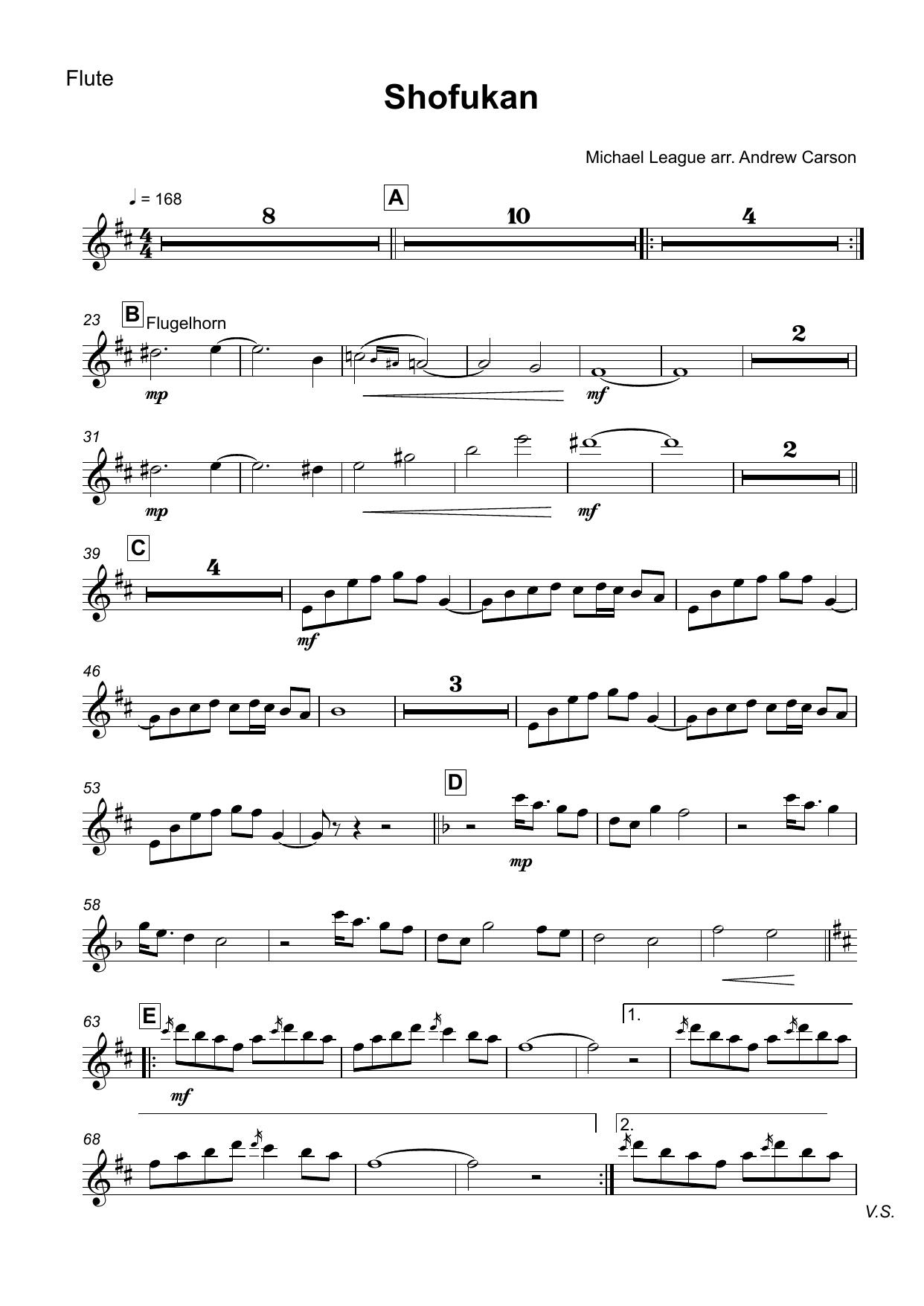
Shofukan (A.Carson)
Composed by Adam Carson
Arranged by A.Carson
- Ensemble: Big Band
- Style: Jazz Standard
- Pages: 45
- Instruments (20): Flute, Alto 1, Alto 2, Tenor 1, Tenor 2, Bari. Sax., Trumpet 1, Trumpet 2 (Solo), Trumpet 3 (Flugel), Trumpet 4 (Flugel), Trombone 1, Trombone 2, Trombone 3, Bass Trombone, Vibraphone, Guitar, Piano, Bass Guitar, Drums, Aux Percussion
- Difficulty: medium
- Content: Individual Parts
- Format: PDF Download (Instant)
- Price: $24.99
"Shofukan," originally composed by contemporary jazz artist Adam Carson, bridges modern creative jazz composition with the rich, harmonically expansive tradition of the modern big band. The work first gained attention through dynamic live performances and studio recordings that highlighted Carson's penchant for intricate, interwoven melodic lines and shifting metric pulses. While drawing inspiration from the post-bop sensibilities of the late 20th century and the contemporary New York jazz scene, the piece establishes its own distinct identity through a blend of driving rhythmic vitality and deeply lyrical, modal harmonic frameworks. It represents a vital addition to the contemporary large ensemble repertoire, appealing to audiences accustomed to both traditional swing complexity and modern groove-oriented jazz. Driven by an infectious, pulsing contemporary groove—interspersing straight-eighth sections with pockets of luminous swing feel—the arrangement opens in a luminous minor key before expanding into sweeping, modal harmonic territory. The mood shifts masterfully from introspective, atmospheric textures featuring sparse horn voicings to high-octane, explosive ensemble passages. Carson’s arrangement treats the twenty-piece big band not merely as a block-chord machine, but as a chamber orchestra of jazz voices. Lush, extended voicings in the brass recall the sophisticated color palettes of Bob Brookmeyer and Maria Schneider, while tight woodwind integration—anchored by doubling on flute—adds an impressionistic sheen to the ensemble's upper register. The melodic narrative unfolds through a carefully orchestrated dialogue between the alto and tenor saxophones, before the full ensemble enters to expand upon the primary motif. A standout feature of this chart is an extended soli section for the saxophone section that demands pristine intonation, agile articulation, and unified phrasing. Solo opportunities are provided for tenor saxophone and piano, allowing featured improvisers to stretch out over an open modal vamp underpinned by a dynamic rhythm section. Technical challenges center primarily on complex syncopation, rapid dynamic shifts, and maintaining a weightless, driving feel during the faster transitional meters. The climax arrives in a meticulously crafted shout chorus that builds layer by layer, utilizing upper-structure triads and striking cross-rhythms before resolving into a breathtaking, punchy coda. Advanced collegiate ensembles, top-tier high school jazz bands, and professional repertory orchestras will find this chart an exhilarating centerpiece for a concert program. The demands placed on the rhythm section—requiring steady time-keeping beneath shifting metric accents—alongside the advanced reading skills required for the woodwind and brass sections, make it best suited for groups comfortable with contemporary jazz idioms. Directors looking to showcase ensemble cohesion, mature stylistic versatility, and sophisticated harmonic awareness will discover exceptional artistic rewards within these forty-five pages of score and parts. The primary technical challenge of "Shofukan" lies in executing the intricate, interlocking syncopated figures between the brass and saxophones without dragging the tempo. Conductors should establish a crisp, internal pulse before the count-off, keeping a sharp focus on the understated, driving nature of the contemporary groove. The tempo should remain steady, avoiding rushed accelerations during dense tutti passages. Saxophones must rehearse their soli section isolated from the rhythm section first, ensuring that scalar runs and articulated accents speak uniformly across both altos and tenors. Brass players should approach high-register entrances with controlled breath support rather than forced volume, preserving the warm, rounded voicing intended by the arranger. Pay close attention to dynamic markings: the contrast between the hushed, atmospheric sub-tones and the roaring full-ensemble peaks dictates the emotional arc of the piece. Standard jazz articulations apply, but players should favor clean, articulate staccatos over heavy accents during straight-eighth grooves. Q: What instruments and parts are included in this 45-page big band arrangement? A: The 20-instrument instrumentation includes a full jazz brass and reed complement featuring Flute, Alto Saxophone 1, Alto Saxophone 2, Tenor Saxophone 1, Tenor Saxophone 2, Baritone Saxophone, 4 Trumpets, 4 Trombones, Bass Trombone, Guitar, Piano, Bass, and Drums. Q: What is the difficulty level of A.Carson's arrangement of "Shofukan"? A: This arrangement is designated as advanced, making it ideal for collegiate jazz ensembles, advanced high school bands, and professional community big bands with strong reading and improvisational skills. Q: What is the musical style and historical context of this piece? A: Rooted in the contemporary jazz tradition, the piece balances post-bop harmonic complexity with modern groove elements, reflecting the compositional voice of modern artist Adam Carson. Q: What makes this specific arrangement by A.Carson unique? A: It stands out through its sophisticated integration of flute doubling, lush extended brass voicings, an intricate saxophone soli, and a carefully constructed shout chorus built on upper-structure triads. Q: What is the performance duration and general tempo feel of the arrangement? A: The piece runs approximately 6 to 7 minutes in length and features a driving contemporary groove that blends straight-eighth feels with dynamic swing sections.
Questions and answers
- What is included in the Shofukan (A.Carson) PDF?
- The verified current file contains individual parts across 45 pages.
- How many instruments or parts are listed for Shofukan (A.Carson)?
- The verified instrumentation list contains 20 entries for this Big Band arrangement.
- Who is credited for Shofukan (A.Carson)?
- Composer: Adam Carson. Arranger: A.Carson.
- What difficulty is listed for Shofukan (A.Carson)?
- The verified difficulty level is medium.
- What style is listed for Shofukan (A.Carson)?
- The catalog lists the style as Jazz Standard.
- Can I preview Shofukan (A.Carson) before buying?
- Yes. The product page provides a preview generated from the current PDF file.
- How is Shofukan (A.Carson) delivered?
- After successful payment, the digital PDF is made available for download. The displayed price is $24.99.
Musicians Also Search For
Shofukan A.Carson PDF • Shofukan A.Carson sheet music • Shofukan arranged by A.Carson • A.Carson big band charts • A.Carson jazz arrangements PDF • Shofukan Adam Carson sheet music • Shofukan Adam Carson big band arrangements • Adam Carson big band charts • Shofukan big band arrangements • Shofukan big band PDF download • Shofukan jazz sheet music • big band sheet music download • Shofukan individual parts download • Shofukan sheet music PDF • Shofukan Jazz Standard charts • Jazz Standard big band arrangements • buy Shofukan sheet music • download Shofukan PDF • Shofukan jazz charts • best A.Carson big band arrangements • Adam Carson arranged by A.Carson • Shofukan printable sheet music • big band repertoire PDF