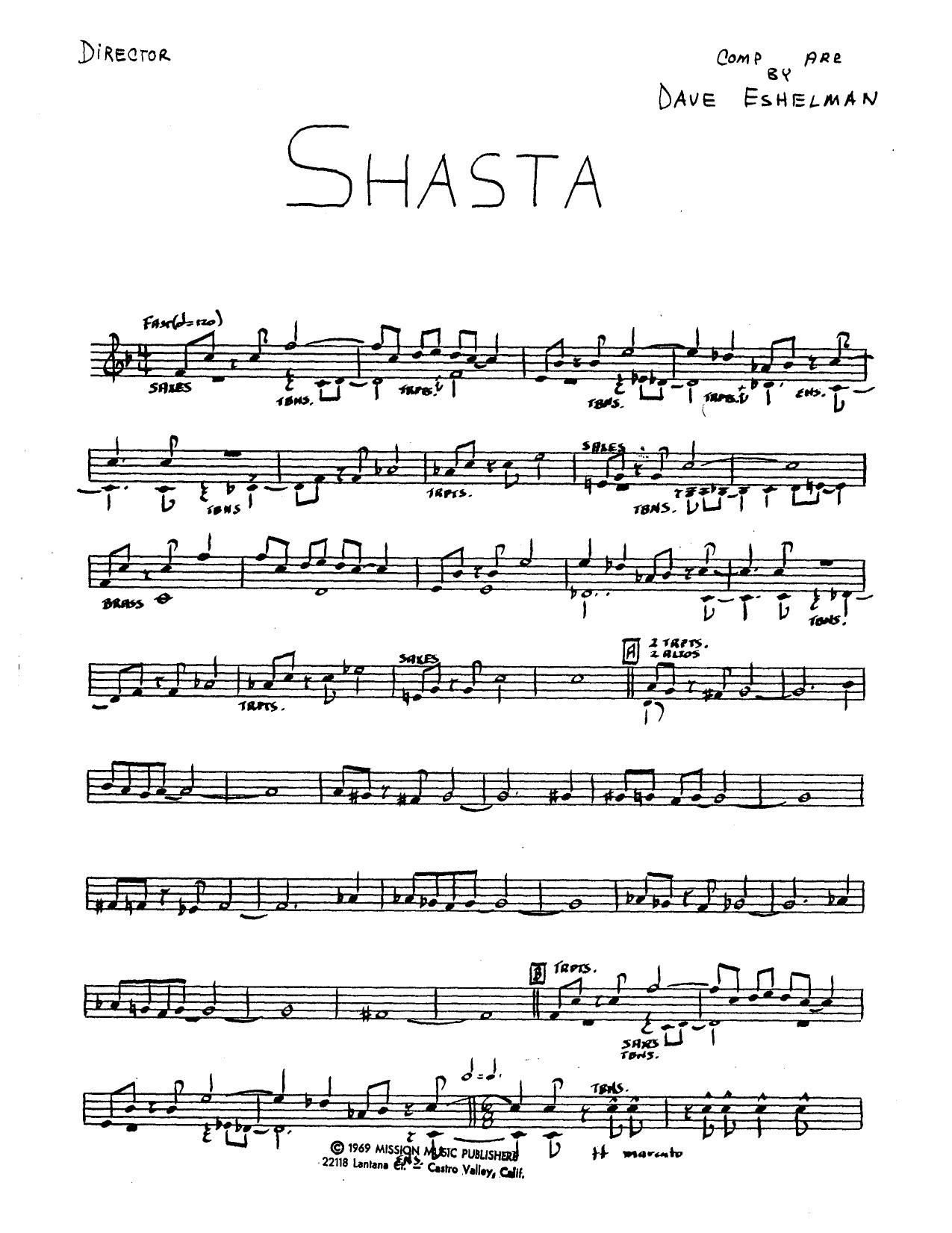
Shasta (D.Eshelman)
Composed by Dave Eshelman
Arranged by Dave Eshelman
- Ensemble: Big Band
- Style: Jazz Standard
- Pages: 61
- Instruments (19): Director, Alto I, Alto II, Tenor I, Tenor II, Bari, Trumpet I, Trumpet II, Trumpet III, Trumpet IV, Trumpet V, Trombone I, Trombone II, Trombone III, Trombone IV, Trombone V, Piano, Bass, Drums
- Difficulty: advanced
- Content: Individual Parts
- Format: PDF Download (Instant)
- Price: $24.99
Composed and originally recorded by acclaimed West Coast jazz composer, trombonist, and educator Dave Eshelman, "Shasta" stands out as a brilliant exemplar of modern contemporary big band writing. Emerging from the vibrant California jazz composition scene where Eshelman’s Jazz Garden Big Band made significant waves, this piece bridges the gap between traditional swing-era ensemble textures and sophisticated, harmonically rich post-bop modal jazz. While not an older Tin Pan Alley standard, "Shasta" has earned its reputation among advanced contemporary repertoires as a modern standard for collegiate and professional ensembles looking to stretch their stylistic boundaries beyond conventional blues and rhythm changes. The musical character of "Shasta" is defined by a driving, energetic medium-up swing groove characterized by sophisticated rhythmic interplay and lush, expansive harmonic structures. Driven by an insistent, pulsating rhythm section, the composition evokes the majestic, sweeping grandeur of its namesake California mountain range, alternating between wide-open, soaring intervallic lines and tight, muscular ensemble unisons. The mood shifts masterfully between contemplative, modal atmospheric passages and high-octane, burning swing sections that demand absolute precision and rhythmic agility from every chair in the band. Eshelman’s arranging approach is immediately recognizable through his masterful deployment of modern chord extensions, subtle voice-leading, and dynamic contrast. Rather than relying on predictable block-voicing, Eshelman utilizes contemporary counterpoint and stratified textures, where the saxophones, trumpets, and trombones engage in intricate conversational dialogues. The chart features a brilliant brass-and-reed soli that showcases the ensemble's blend and articulation, building dynamically toward a meticulously crafted, multi-layered shout chorus. This climax avoids heavy-handed bombast in favor of intricate rhythmic displacement and sophisticated harmonic shifts that keep both listeners and performers on the edge of their seats. Designed specifically for advanced college, university, and professional jazz orchestras, this 16-instrument big band arrangement requires seasoned players who are comfortable with complex modern swing idioms. The lead trumpet parts navigate high registers with tasteful authority, while the saxophone section—featuring doubles or robust unison lines across two altos, two tenors, and baritone—must execute nimble, bebop-inflected scalar passages with clarity. Solo opportunities are provided for featured improvisers, allowing strong soloists to stretch out over contemporary harmonic changes. Performing "Shasta" offers a deeply rewarding challenge, uniting rigorous compositional craftsmanship with an undeniable, crowd-pleasing kinetic energy. Navigating "Shasta" successfully requires meticulous attention to articulation, balance, and stylistic consistency within the rhythm section. The tempo should be locked into a driving, confident medium-up swing; avoid rushing the peaks of phrases, especially during the intricate syncopated ensemble hits. The rhythm section is the engine of this chart: the drummer should maintain a crisp, conversational ride cymbal pattern that supports the horns without overpowering the underlying modal harmony, while the bassist lays down a solid, acoustic-style walking foundation that anchors the chromatic chord movements. Horns must give careful attention to short-long articulations and clean, unified placement of the off-beat accents prevalent in Eshelman’s writing. Brass players should approach high-register passages with a focused, centered tone rather than forced volume, ensuring that the inner voicings remain audible through the dense harmonic clusters. Rehearsal should begin by isolating the complex transitional interludes at a slower tempo before bringing the entire ensemble up to performance speed, ensuring that the dynamic contours—ranging from hushed subterranean whispers to roaring, full-ensemble climaxes—are fully realized. Q: What instrumentation and parts are included in this arrangement? A: This 16-instrument big band chart includes standard full instrumentation featuring Alto Saxophone 1, Alto Saxophone 2, Tenor Saxophone 1, Tenor Saxophone 2, and Baritone Saxophone, alongside the complete brass and rhythm sections, plus a comprehensive conductor score spanning 61 pages. Q: What is the difficulty level of this Dave Eshelman arrangement? A: This piece is written at an advanced level, making it best suited for collegiate, university, and professional jazz orchestras due to its complex modern harmonies, demanding ranges, and intricate rhythmic unisons. Q: What is the musical style and historical context of "Shasta"? A: "Shasta" is a contemporary jazz composition written by Dave Eshelman that reflects the sophisticated West Coast big band tradition, blending post-bop modal aesthetics with driving, high-energy modern swing. Q: What makes this specific arrangement unique? A: The arrangement is distinguished by Eshelman’s signature transparent voicings, conversational counterpoint between sections, and a meticulously structured shout chorus that utilizes advanced harmonic shifts rather than traditional heavy-handed bombast. Q: What is the performance tempo and expected duration of the piece? A: The arrangement is set to a driving medium-up swing feel, and while exact performance duration depends on the length of improvised solo choruses, it typically runs between 6 to 7 minutes.
Questions and answers
- What is included in the Shasta (D.Eshelman) PDF?
- The verified current file contains a conductor score and individual parts across 61 pages.
- How many instruments or parts are listed for Shasta (D.Eshelman)?
- The verified instrumentation list contains 19 entries for this Big Band arrangement.
- Who is credited for Shasta (D.Eshelman)?
- Composer: Dave Eshelman. Arranger: Dave Eshelman.
- What difficulty is listed for Shasta (D.Eshelman)?
- The verified difficulty level is advanced.
- What style is listed for Shasta (D.Eshelman)?
- The catalog lists the style as Jazz Standard.
- Can I preview Shasta (D.Eshelman) before buying?
- Yes. The product page provides a preview generated from the current PDF file.
- How is Shasta (D.Eshelman) delivered?
- After successful payment, the digital PDF is made available for download. The displayed price is $24.99.
Musicians Also Search For
Shasta Dave Eshelman PDF • Shasta Dave Eshelman sheet music • Shasta arranged by Dave Eshelman • Dave Eshelman big band charts • Dave Eshelman jazz arrangements PDF • Shasta Dave Eshelman big band arrangements • Shasta big band arrangements • Shasta big band PDF download • Shasta jazz sheet music • big band sheet music download • Shasta conductor score PDF • Shasta individual parts download • Shasta sheet music PDF • Shasta Jazz Standard charts • Jazz Standard big band arrangements • buy Shasta sheet music • download Shasta PDF • Shasta jazz charts • best Dave Eshelman big band arrangements • Shasta printable sheet music • big band repertoire PDF