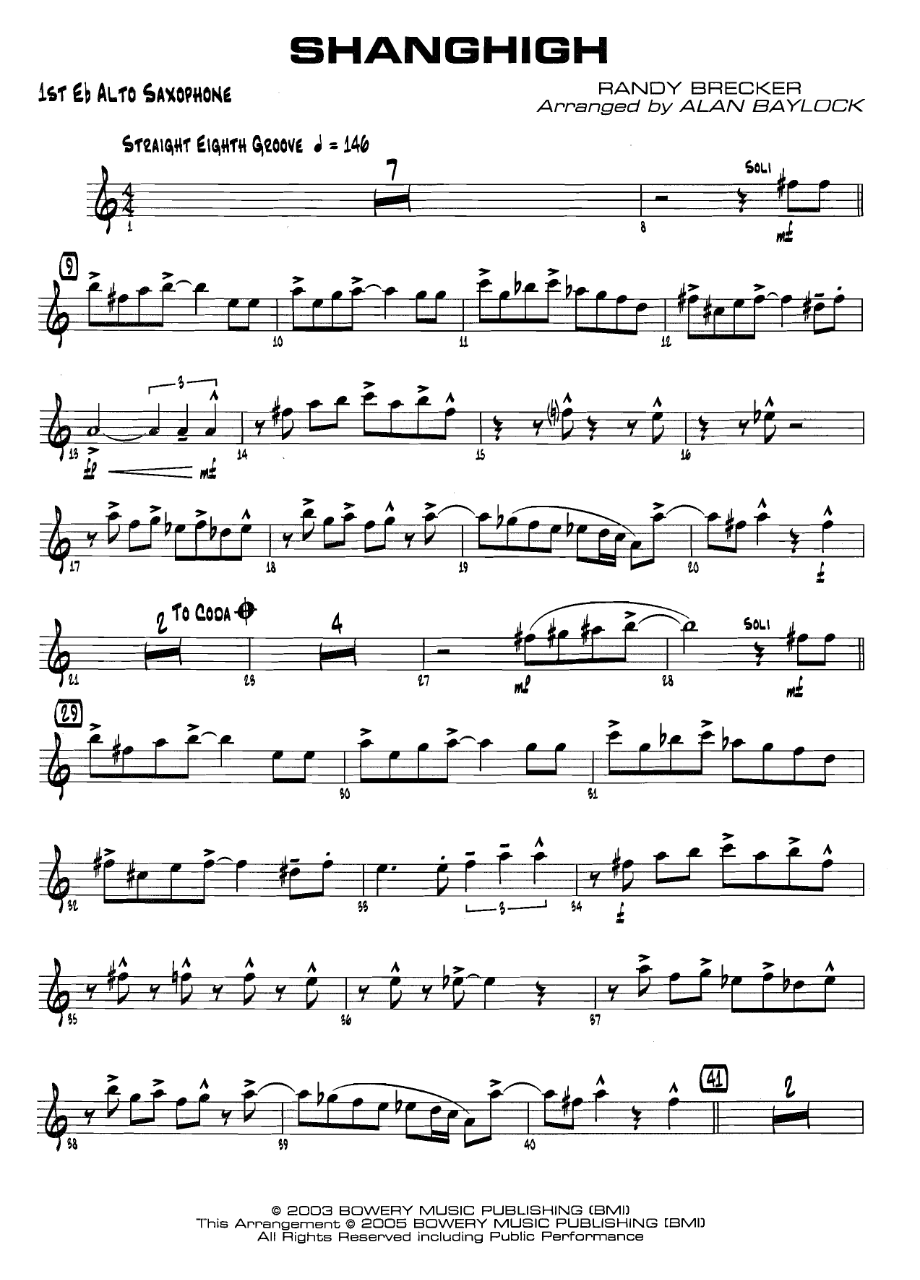
Shanghigh (A.Baylock)
Composed by Alan Baylock
Arranged by Alan Baylock
- Ensemble: Big Band
- Style: Jazz Standard
- Pages: 89
- Instruments (17): Alto Saxophone 1, Alto Saxophone 2, Tenor Saxophone 1, Tenor Saxophone 2, Baritone Saxophone, Trumpet 1, Trumpet 2, Trumpet 3, Trumpet 4, Trombone 1, Trombone 2, Trombone 3, Trombone 4, Guitar, Drums, Bass, Piano
- Difficulty: advanced
- Content: Individual Parts
- Format: PDF Download (Instant)
- Price: $24.99
Alan Baylock's "Shanghigh" stands as a vibrant, original contribution to the contemporary big band repertoire, embodying the energetic spirit of a modern jazz standard while showcasing Baylock's signature compositional prowess. Though an original composition rather than a reinterpretation of an older tune, "Shanghigh" is crafted with the structural integrity and melodic memorability that define the most enduring jazz standards. It reflects a sophisticated understanding of the big band tradition, filtered through a contemporary lens, making it instantly recognizable as a fresh, yet classic-sounding, addition to any concert or festival program. The piece is a testament to Baylock's ability to create new material that feels both innovative and deeply rooted in the swing idiom, designed to engage both performers and audiences with its infectious groove and imaginative orchestration. Musically, "Shanghigh" bursts forth as an up-tempo swing number, typically performed at a brisk tempo around quarter note = 200-220 bpm. The primary key, often C minor or a related mode, provides a sophisticated harmonic palette, allowing for both driving energy and moments of rich, expressive harmony. The mood is exhilarating and propulsive, characterized by tightly knit ensemble figures, punchy brass articulations, and a relentless rhythmic drive. Baylock masterfully employs dynamic contrasts and textural shifts, moving seamlessly from unison lines to complex voicings, ensuring the energy never wanes. The piece evokes a sense of thrilling momentum, reminiscent of a high-speed chase or an exhilarating urban landscape, maintaining a sophisticated edge throughout its energetic journey. Alan Baylock's arrangement of "Shanghigh" is a masterclass in modern big band writing. His distinctive approach is evident in the intricate sectional voicings, particularly in the saxophone soli sections which are often harmonically dense yet remarkably clear. The brass writing is characteristically powerful, featuring soaring trumpet lines and robust trombone figures, frequently utilizing tight, unison-octave passages that cut through the ensemble. Baylock's shout choruses are a highlight, building with an almost cinematic intensity, employing layered rhythmic motifs and escalating dynamics to create climactic moments that are both thrilling and meticulously constructed. The arrangement features open solo sections, typically for tenor saxophone and trumpet, providing ample opportunity for improvisation over the sophisticated harmonic progression. These solo spots are strategically placed to offer contrast before the ensemble drives towards its powerful conclusion, often punctuated by a final, impactful ensemble hit. Performing "Shanghigh" is a rewarding experience for a big band capable of executing its technical demands. The melody is initially carried by the saxophones, often in unison or tight harmony, before being passed to the brass. Technical challenges include rapid sixteenth-note passages in the saxophone section, precise articulation and dynamic control across all sections, and the endurance required for the sustained up-tempo swing feel. The lead trumpet part extends into the upper register (often to a high D or E), demanding a strong player. The rhythm section is crucial, needing to lay down a solid, driving foundation with a crisp swing feel. This arrangement is ideally suited for advanced high school, collegiate, community, and professional big bands seeking a challenging yet incredibly satisfying piece that showcases the full power and agility of the modern jazz orchestra. "Shanghigh" demands a consistently driving, up-tempo swing feel, ideally around quarter note = 200-220 bpm. The rhythm section must establish a strong, unwavering foundation, emphasizing a crisp ride cymbal pattern and a propulsive bass line. Drummers should focus on precise hi-hat work and dynamic snare accents to energize the ensemble. Articulation is paramount; brass players need clear, unified attacks and releases, particularly in the rapid ensemble figures. Saxophone sections should strive for blend and intonation, especially in the harmonically rich soli passages, ensuring that the intricate lines speak with clarity. Lead trumpet players must possess strong upper-register endurance and control for the sustained high notes. Rehearsal time should be dedicated to isolating and perfecting the intricate ensemble hits and ensuring seamless transitions between sections, particularly into and out of the solo breaks. Q: What instruments and parts are included in the "Shanghigh" arrangement? A: This big band arrangement includes parts for 17 instruments: Alto Saxophone 1, Alto Saxophone 2, Tenor Saxophone 1, Tenor Saxophone 2, Baritone Saxophone, Trumpet 1, Trumpet 2, Trumpet 3, Trumpet 4, Trombone 1, Trombone 2, Trombone 3, Trombone 4, Guitar, Piano, Bass, and Drums. Q: What is the difficulty level of Alan Baylock's "Shanghigh"? A: "Shanghigh" is considered advanced, suitable for collegiate, advanced high school, community, and professional big bands. It requires strong technical proficiency from all sections, particularly in articulation, ensemble precision, and upper brass range. Q: What musical style and historical context does "Shanghigh" represent? A: "Shanghigh" is an original composition by Alan Baylock, written in the contemporary big band jazz style. While not an older standard, it embodies the energetic, sophisticated characteristics of modern jazz standards with its up-tempo swing feel and intricate harmonic language. Q: What makes this arrangement of "Shanghigh" unique or distinctive? A: This arrangement is unique for its sophisticated, driving up-tempo swing feel, Alan Baylock's signature intricate sectional voicings, powerful brass writing, and climactic shout choruses. It showcases Baylock's ability to create fresh, challenging, and highly engaging original big band material. Q: What is the typical performance duration and tempo for "Shanghigh"? A: The typical performance duration for "Shanghigh" is approximately 4-5 minutes, depending on the length of the improvised solos. It is designed to be performed at a brisk, up-tempo swing feel, generally around quarter note = 200-220 bpm.
Musicians Also Search For
Shanghigh Alan Baylock PDF • Shanghigh Alan Baylock sheet music • Shanghigh arranged by Alan Baylock • Alan Baylock big band charts • Alan Baylock jazz arrangements PDF • Shanghigh Alan Baylock big band arrangement • Shanghigh big band arrangement • Shanghigh big band PDF download • Shanghigh jazz ensemble sheet music • big band sheet music instant download • Shanghigh individual parts download • Shanghigh sheet music with parts • Shanghigh Jazz Standard chart • Jazz Standard big band arrangements • buy Shanghigh sheet music online • download Shanghigh PDF • Shanghigh jazz chart • best Alan Baylock big band arrangements • Shanghigh printable sheet music • big band repertoire PDF