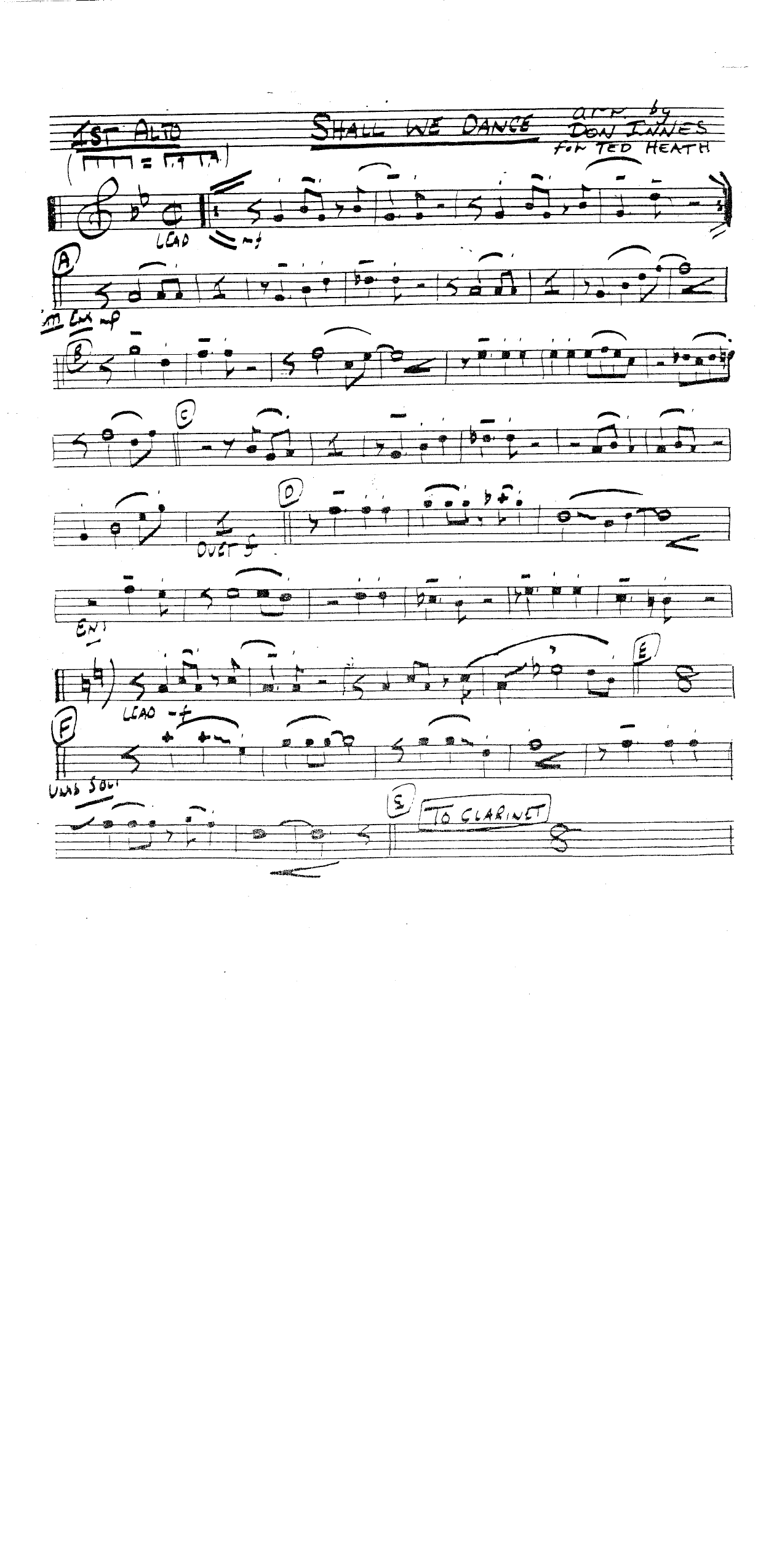
Shall We Dance (D.Lines)
Composed by Jimmy Heath
Arranged by Ted Heath
- Ensemble: Big Band
- Pages: 30
- Instruments (16): 1st Alto Saxophone, 2nd Alto Saxophone, 1st Tenor Saxophone, 2nd Tenor Saxophone, Baritone Saxophone, 1st Trumpet, 2nd Trumpet, 3rd Trumpet, 4th Trumpet, 1st Trombone, 2nd Trombone, 3rd Trombone, 4th Trombone, Piano, Bass, Drums
- Difficulty: medium
- Content: Individual Parts
- Format: PDF Download (Instant)
- Price: $24.99
Rooted in the sophisticated British modern-dance-orchestra tradition yet thoroughly grounded in American jazz idioms, "Shall We Dance (D.Lines)" captures the brilliance of the Ted Heath Orchestra. Composed by master bebop saxophonist and writer Jimmy Heath, this selection bridges the gap between sleek, highly polished swing and intricate modern jazz composition. Originally brought to life through the prolific recording units of the mid-20th century, the piece reflects the sophisticated compositional voice of the Heath family, where intricate linear writing meets infectious big band propulsion. It stands out as a fascinating entry in the modern jazz canon, offering an alternative perspective on traditional song forms through advanced harmonic exploration and tightly woven contrapuntal lines. Musically, the arrangement moves with a brisk, energetic medium-up tempo feel in 4/4 time, anchored by a driving swing groove that demands precision and stamina. The mood is exhilarating and urbane, shifting dynamically between cascading linear motifs and soaring brass counter-melodies that evoke the electric atmosphere of a premier metropolitan jazz club. The key center facilitates bright, ringing sonorities, allowing the upper brass and saxophone sections to punch through with immense clarity. The harmonic vocabulary utilizes extended and altered chords characteristic of post-bop writing, yet retains a rhythmic vitality that keeps toes tapping and performers deeply engaged. Arranger Ted Heath approaches the score with his signature penchant for pristine section blend, crystalline articulation, and immaculate balance. The chart features dense, interwoven "D.Lines"—linear counterpoint passages where individual horn sections execute independent, highly melodic trajectories that lock together vertically. Instead of relying solely on block-chord padding, the arrangement treats each instrumental voice as an active melodic agent. The woodwinds enjoy intricate soli sections that highlight nimble fingerwork, while the brass interject with sharp, well-placed stabs and majestic sustained swells that build tension before powerful ensemble releases. The melody is shared fluidly across the ensemble, passing dynamically from the saxophones to the trumpet section before a full collective realization. Featured solo space allows improvisers to stretch out over sophisticated changes, pushing the rhythm section to maintain a buoyant, interactive pulse. Technical challenges include navigating rapid chromatic passages, maintaining consistent swing subdivision at faster tempos, and balancing the inner voices within the dense contrapuntal textures. Advanced high school, collegiate, and professional big bands will find this chart exceptionally rewarding, as it forces sections to listen intently across the ensemble while offering a masterclass in dynamic control, articulation uniformity, and classic British-American jazz hybridization. Navigating "Shall We Dance (D.Lines)" requires meticulous attention to rhythmic precision and section articulation. The rhythm section must establish a lean, driving swing feel without over-driving the tempo; the drummer should favor crisp ride-cymbal patterns with light hi-hat chokes on beats two and four. Horn players need to execute short notes with a dry, focused, bop-inflected tongue, ensuring that all linear counterpoint lines speak clearly without blurring. Pay close attention to the dynamic markings underneath the dense contrapuntal passages; background figures must remain strictly subservient to whichever section carries the primary thematic material. Rehearsal should begin slowly, isolating the interlocking woodwind and brass lines to lock in intonation before working up to the target performance tempo. No extreme extended techniques like plunger mutes or unconventional effects are required, allowing the ensemble to focus entirely on pure tone quality, intonation, and seamless swing phrasing. Q: What instruments and parts are included in this arrangement? A: This 30-page publication features parts for an 8-instrument big band instrumentation, explicitly including Alto Saxophone, Tenor Saxophone, Baritone Saxophone, Trumpet, and Trombone, alongside a fully realized rhythm section framework. Q: What is the difficulty level of this arrangement? A: This piece is best suited for advanced high school, collegiate, and professional big bands due to its intricate linear counterpoint, rapid bebop-inspired lines, and required section independence. Q: What is the style and historical context of the piece? A: Written by Jimmy Heath and arranged in the signature style of British bandleader Ted Heath, the piece represents the sophisticated intersection of 1950s/60s modern swing and post-bop jazz orchestration. Q: What makes this specific arrangement unique? A: It is defined by its clever "D.Lines"—interwoven, contrapuntal linear writing that treats every section as an active, independent melodic voice rather than relying purely on traditional block-chord voicing. Q: What is the typical performance tempo or duration? A: The arrangement is set to a brisk, driving medium-up swing tempo in 4/4 time, typically clocking in at around 2.5 to 3 minutes of high-energy performance time.
Questions and answers
- What is included in the Shall We Dance (D.Lines) PDF?
- The verified current file contains individual parts across 30 pages.
- How many instruments or parts are listed for Shall We Dance (D.Lines)?
- The verified instrumentation list contains 16 entries for this Big Band arrangement.
- Who is credited for Shall We Dance (D.Lines)?
- Composer: Jimmy Heath. Arranger: Ted Heath.
- What difficulty is listed for Shall We Dance (D.Lines)?
- The verified difficulty level is medium.
- Can I preview Shall We Dance (D.Lines) before buying?
- Yes. The product page provides a preview generated from the current PDF file.
- How is Shall We Dance (D.Lines) delivered?
- After successful payment, the digital PDF is made available for download. The displayed price is $24.99.
Musicians Also Search For
Shall We Dance Ted Heath PDF • Shall We Dance Ted Heath sheet music • Shall We Dance arranged by Ted Heath • Ted Heath big band charts • Ted Heath jazz arrangements PDF • Shall We Dance Jimmy Heath sheet music • Shall We Dance Jimmy Heath big band arrangements • Jimmy Heath big band charts • Shall We Dance big band arrangements • Shall We Dance big band PDF download • Shall We Dance jazz sheet music • big band sheet music download • Shall We Dance individual parts download • Shall We Dance sheet music PDF • buy Shall We Dance sheet music • download Shall We Dance PDF • Shall We Dance jazz charts • best Ted Heath big band arrangements • Jimmy Heath arranged by Ted Heath • Shall We Dance printable sheet music • big band repertoire PDF