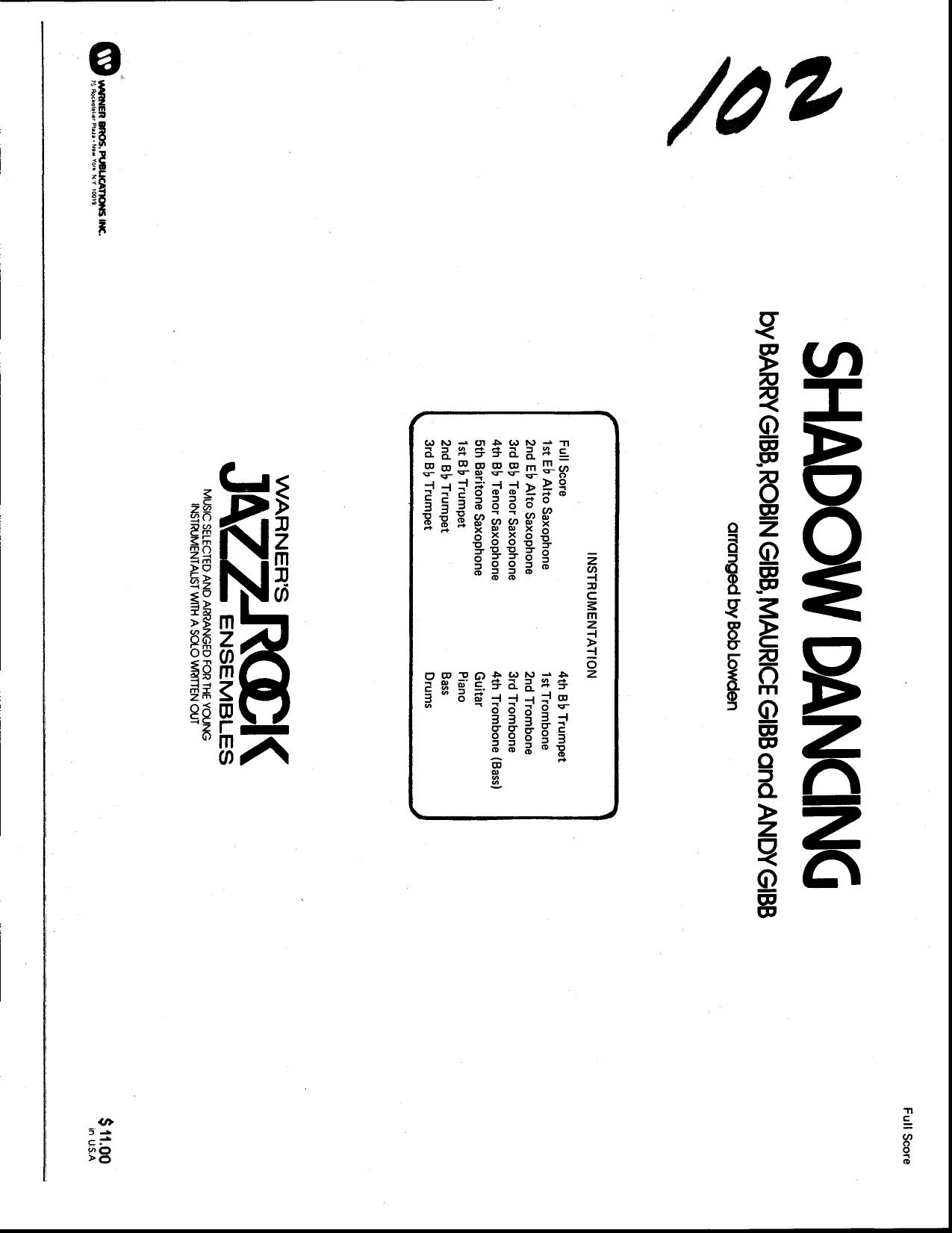
Shadow Dancing (B.Lowden)
Composed by Barry Gibb
Arranged by Bob Lowden
- Ensemble: Big Band
- Pages: 32
- Instruments (17): 1st Eb Alto Saxophone, 2nd Eb Alto Saxophone, 1st Bb Tenor Saxophone, 2nd Bb Tenor Saxophone, Eb Baritone Saxophone, 1st Bb Trumpet, 2nd Bb Trumpet, 3rd Bb Trumpet, 4th Bb Trumpet, 1st Trombone, 2nd Trombone, 3rd Trombone, 4th Trombone, Bass, Drums, Piano, Guitar
- Difficulty: medium
- Content: Individual Parts
- Format: PDF Download (Instant)
- Price: $24.99
Originally recorded by Andy Gibb in 1978 and co-written by Barry Gibb, "Shadow Dancing" stands as one of the defining touchstones of the late-seventies pop landscape, capturing the infectious, syncopated pulse of the disco era while possessing a sophisticated harmonic framework ripe for jazz reinterpretation. Barry Gibb’s melodic genius—characterized by soaring vocal lines and compelling upward-resolving suspensions—translates remarkably well to the big band idiom, bridging the gap between mainstream crossover appeal and driving instrumental jazz energy. Bob Lowden’s masterwork transforms this pop-disco staple into a vibrant, high-energy big band chart driven by a crisp, syncopated Latin-funk groove rather than a traditional straight-ahead swing feel. Set in a bright, driving tempo in a favorable concert key, the arrangement immediately establishes its momentum through a rhythm section vamp featuring rhythmic, punctuated brass hits. The mood is exuberant, theatrical, and relentlessly upbeat, evoking the sophisticated dancehalls and studio-orchestra glamour of the late-seventies crossover jazz scene. The dynamic contour builds steadily from subtle, rhythm-section-backed horn ostinatos to full-ensemble explosions. Lowden approaches the familiar melody with a keen ear for instrumental color, utilizing rich block-chord saxophone solis and punchy brass counter-lines that elevate the source material far beyond a simple cover. Rather than leaning heavily on extended avant-garde modulations, Lowden relies on clever metric shifts, crisp articulation demands, and interlocking syncopations between the brass and saxophones to create interest. The arrangement features dynamic interplay where the saxophones carry the primary melodic weight in the opening statements, quickly handing off to soaring trumpet leads and a collective brass counter-melody that thickens the texture before a driving, multi-tiered shout chorus. Ensembles will find this 32-page chart exceptionally rewarding due to its brilliant balance of accessibility and rhythmic discipline. The piece demands tight section playing, particularly in aligning the 16-instrument standard big band roster (which includes dual altos, dual tenors, and baritone saxophones alongside standard brass and rhythm) through the intricate syncopated figures. While there are open solo opportunities for confident improvisers over accessible changes, the true core of the piece lies in its ensemble precision, make-up of crisp articulations, and buoyant energy. Advanced high school ensembles, collegiate jazz bands, and professional community big bands will find "Shadow Dancing" an ideal concert closer or high-impact second-set opener. Its immediate audience appeal combined with genuine big band compositional craftsmanship ensures it remains a standout crowd-pleaser that challenges the rhythm section and horns to lock into an unbreakable groove. Unlocking the vibrant potential of this arrangement requires absolute precision from the rhythm section, which serves as the engine for the entire chart. The drummer should maintain a crisp, driving Latin-funk groove rather than a traditional swing beat, utilizing a steady hi-hat on beats two and four with active ghost notes on the snare to keep the propulsion light and danceable. Brass players must pay meticulous attention to marked articulations—short, accented staccatos must contrast sharply with smooth, connected legato lines to capture Lowden's intended stylistic flair. Conductors should rehearse the saxophones and brass independently during initial sectionals to master the interlocking syncopations before combining them, ensuring that the background figures never overpower the primary melodic statements. Watch closely for dynamic control during the transitional builds; holding back slightly on the mid-section dynamics will guarantee that the final shout chorus achieves maximum, room-filling impact. Q: What instruments and parts are included in this big band arrangement? A: The arrangement is scored for a standard 16-instrument big band lineup, consisting of Alto Saxophone 1, Alto Saxophone 2, Tenor Saxophone 1, Tenor Saxophone 2, Baritone Saxophone, Trumpets 1 through 4, Trombones 1 through 4, and a full rhythm section including piano, guitar, bass, and drums. Q: What is the difficulty level of this chart? A: This arrangement is graded as medium to medium-advanced, making it ideal for accomplished high school bands, collegiate ensembles, and professional community big bands that have a strong grasp of syncopated rhythms. Q: What style and historical era does this arrangement draw from? A: It adapts Barry Gibb’s 1978 pop-disco chart into a vibrant, high-energy jazz-funk big band vehicle, blending late-seventies crossover sensibilities with traditional jazz arranging techniques. Q: What makes Bob Lowden's arrangement of "Shadow Dancing" unique? A: Lowden brilliantly reimagines a vocal pop-disco hit into an instrumental tour-de-force by utilizing rich saxophone soli sections, clever brass counter-lines, and interlocking syncopations that give the familiar melody fresh harmonic depth. Q: What is the recommended performance tempo and duration? A: The chart is designed to be played at a bright, energetic Latin-funk tempo (approximately 120-126 BPM), resulting in a performance duration of roughly 3 to 4 minutes depending on solo extensions.
Questions and answers
- What is included in the Shadow Dancing (B.Lowden) PDF?
- The verified current file contains a conductor score and individual parts across 32 pages.
- How many instruments or parts are listed for Shadow Dancing (B.Lowden)?
- The verified instrumentation list contains 17 entries for this Big Band arrangement.
- Who is credited for Shadow Dancing (B.Lowden)?
- Composer: Barry Gibb. Arranger: Bob Lowden.
- What difficulty is listed for Shadow Dancing (B.Lowden)?
- The verified difficulty level is medium.
- Can I preview Shadow Dancing (B.Lowden) before buying?
- Yes. The product page provides a preview generated from the current PDF file.
- How is Shadow Dancing (B.Lowden) delivered?
- After successful payment, the digital PDF is made available for download. The displayed price is $24.99.
Musicians Also Search For
Shadow Dancing Bob Lowden PDF • Shadow Dancing Bob Lowden sheet music • Shadow Dancing arranged by Bob Lowden • Bob Lowden big band charts • Bob Lowden jazz arrangements PDF • Shadow Dancing Barry Gibb sheet music • Shadow Dancing Barry Gibb big band arrangements • Barry Gibb big band charts • Shadow Dancing big band arrangements • Shadow Dancing big band PDF download • Shadow Dancing jazz sheet music • big band sheet music download • Shadow Dancing conductor score PDF • Shadow Dancing individual parts download • Shadow Dancing sheet music PDF • buy Shadow Dancing sheet music • download Shadow Dancing PDF • Shadow Dancing jazz charts • best Bob Lowden big band arrangements • Barry Gibb arranged by Bob Lowden • Shadow Dancing printable sheet music • big band repertoire PDF