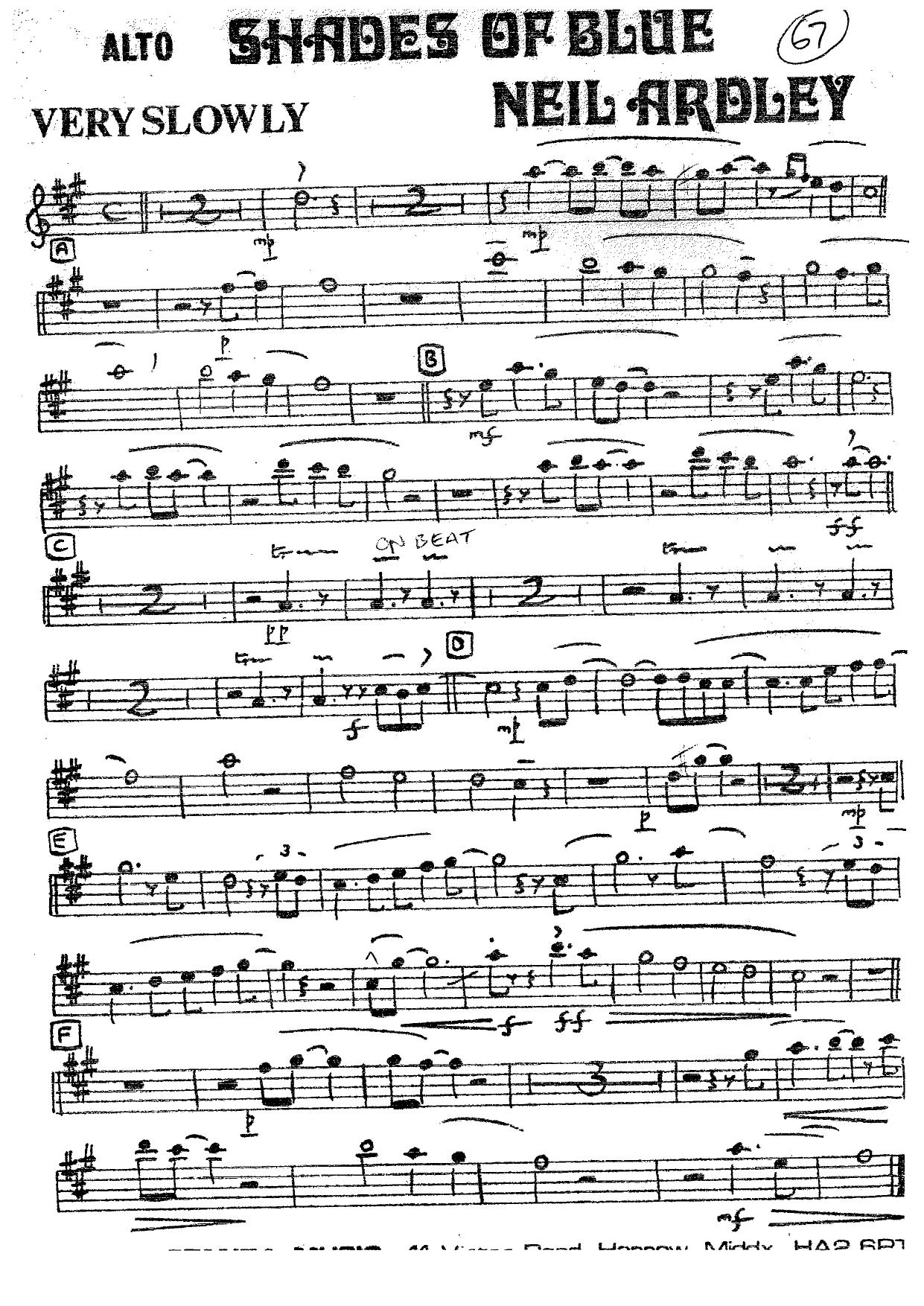
Shades Of Blue (N.Ardley)
Composed by Neil Ardley
Arranged by N.Ardley
- Ensemble: Big Band
- Style: Jazz Standard
- Pages: 20
- Instruments (20): Alto Saxophone, Clarinet 1, Clarinet 2, Tenor Saxophone 1, Tenor Saxophone 2, Baritone Saxophone, Trumpet 1, Trumpet 2, Trumpet 3, Trumpet 4, Flugelhorn, Trombone 1, Trombone 2, Trombone 3, Trombone 4, Trombone 5, Tuba, Piano, Bass, Drums
- Difficulty: easy
- Content: Individual Parts
- Format: PDF Download (Instant)
- Price: $24.99
Composed during the vibrant mid-1960s British jazz renaissance, "Shades Of Blue" stands as one of Neil Ardley’s most enduring contributions to modern large-ensemble writing. Originally brought to prominence through benchmark recordings by the Don Rendell/Ian Carr Quintet and interpreted through Ardley’s visionary work with the New Jazz Orchestra, the piece captures the sophisticated bridge between modal jazz exploration and lush, post-bop orchestrations. Reflecting an era when UK arrangers were aggressively expanding the stylistic boundaries of the jazz standard format, Ardley injected the repertoire with a distinctive, forward-thinking harmonic palette that drew inspiration from contemporary classical impressionism and the expansive voicings of Gil Evans. Musically, the piece unfolds at a sophisticated, contemplative medium-swing tempo, characterized by a cool, atmospheric mood and an underlying subterranean tension. The writing evokes deep emotional resonance, shifting seamlessly between introspective, misty modal passages and bursts of driving, urban energy. The harmony is rich with extended chord structures, sus-extensions, and subtle chromatic shifts that give the piece its characteristic shifting color spectrum—true to its evocative title. The arrangement utilizes a 19-instrument big band instrumentation, featuring flexible reed configurations including dual clarinets alongside traditional saxophones, which allows for unique timbral blending that separates it from standard American big band scoring conventions. Ardley’s compositional approach prioritizes texture, counterpoint, and dynamic contrast over predictable section-writing. Rather than relying solely on standard tutti shout choruses, the arrangement splits thematic material across interlocking woodwind and brass layers, creating transparent, shifting textures where clarinets interweave fluidly with alto and tenor saxophones. The melodic weight is frequently distributed across the woodwind section before opening up into soaring brass interventions. Featured solo spaces allow expressive improvisers to stretch over modal vamps and sophisticated harmonic turnarounds, demanding both linear inventiveness and emotional restraint. The technical challenges lie primarily in maintaining pristine intonation through dense chord clusters, executing fluid dynamic shifts, and balancing the delicate dialogue between the clarinets and the heavier brass voicings. Advanced collegiate, community, and professional jazz orchestras will find exceptional value in programming this arrangement. It provides a compelling departure from standard swing-era charts, offering mature ensembles a chance to explore sophisticated British modernism. Directors seeking to challenge their players’ blend, tonal flexibility, and phrasing nuance will discover that "Shades Of Blue" rewards meticulous rehearsal with a mesmerizing, highly atmospheric performance experience. * **Tempo & Feel:** Approach the primary groove with an unhurried, relaxed medium-swing feel (approx. Quarter Note = 112–116). Avoid rushing the backbeat; the tension of the piece relies heavily on a restrained, floating pulse. * **Intonation & Balance:** The integration of two clarinets into the reed section creates unique voicing challenges. Ensure that clarinet lines blend smoothly with the saxophones during exposed unison and harmony passages without overpowering the alto and tenors. * **Articulation:** Keep articulation light and linear in the modal sections. Use subtle, warm vibrato on sustained notes, reserving aggressive accents for designated dynamic climaxes to preserve the cool-jazz aesthetic. * **Rehearsal Strategy:** Isolate the rhythm section first to lock in the modal vamps and modal shifts. Rehearse the horns in sectional groups to balance the dense cluster voicings before merging them with the broader ensemble texture. Q: What instruments and parts are included in this 19-instrument big band arrangement? A: The scoring accommodates a 19-piece ensemble, featuring parts for Alto Saxophone, Clarinet 1, Clarinet 2, Tenor Saxophone 1, Tenor Saxophone 2, along with standard big band brass and rhythm section components across a 20-page master score and parts set. Q: What is the difficulty level of this arrangement? A: This arrangement is graded as advanced, making it best suited for college, conservatory, advanced high school, and professional jazz orchestras capable of handling sophisticated modern harmonies and intricate woodwind doubling or blending. Q: What is the historical style and background of "Shades Of Blue"? A: Written by prominent British composer and arranger Neil Ardley during the mid-1960s, it reflects the innovative cross-pollination of modal jazz, classical impressionism, and advanced British big band writing popularized by the New Jazz Orchestra. Q: What makes this specific arrangement by Neil Ardley unique? A: It breaks away from traditional swing-era formulas by incorporating dual clarinets into the reed section, utilizing dense modal harmonies, and emphasizing transparent, shifting instrumental textures reminiscent of Gil Evans's orchestral writing. Q: What is the performance duration and recommended tempo feel? A: The arrangement runs approximately 5 to 6 minutes and is designed around a cool, unhurried medium-swing tempo that prioritizes atmospheric mood and subtle dynamic shading over high-speed velocity.
Questions and answers
- What is included in the Shades Of Blue (N.Ardley) PDF?
- The verified current file contains individual parts across 20 pages.
- How many instruments or parts are listed for Shades Of Blue (N.Ardley)?
- The verified instrumentation list contains 20 entries for this Big Band arrangement.
- Who is credited for Shades Of Blue (N.Ardley)?
- Composer: Neil Ardley. Arranger: N.Ardley.
- What difficulty is listed for Shades Of Blue (N.Ardley)?
- The verified difficulty level is easy.
- What style is listed for Shades Of Blue (N.Ardley)?
- The catalog lists the style as Jazz Standard.
- Can I preview Shades Of Blue (N.Ardley) before buying?
- Yes. The product page provides a preview generated from the current PDF file.
- How is Shades Of Blue (N.Ardley) delivered?
- After successful payment, the digital PDF is made available for download. The displayed price is $24.99.
Musicians Also Search For
Shades Of Blue N.Ardley PDF • Shades Of Blue N.Ardley sheet music • Shades Of Blue arranged by N.Ardley • N.Ardley big band charts • N.Ardley jazz arrangements PDF • Shades Of Blue Neil Ardley sheet music • Shades Of Blue Neil Ardley big band arrangements • Neil Ardley big band charts • Shades Of Blue big band arrangements • Shades Of Blue big band PDF download • Shades Of Blue jazz sheet music • big band sheet music download • Shades Of Blue individual parts download • Shades Of Blue sheet music PDF • Shades Of Blue Jazz Standard charts • Jazz Standard big band arrangements • buy Shades Of Blue sheet music • download Shades Of Blue PDF • Shades Of Blue jazz charts • best N.Ardley big band arrangements • Neil Ardley arranged by N.Ardley • Shades Of Blue printable sheet music • big band repertoire PDF