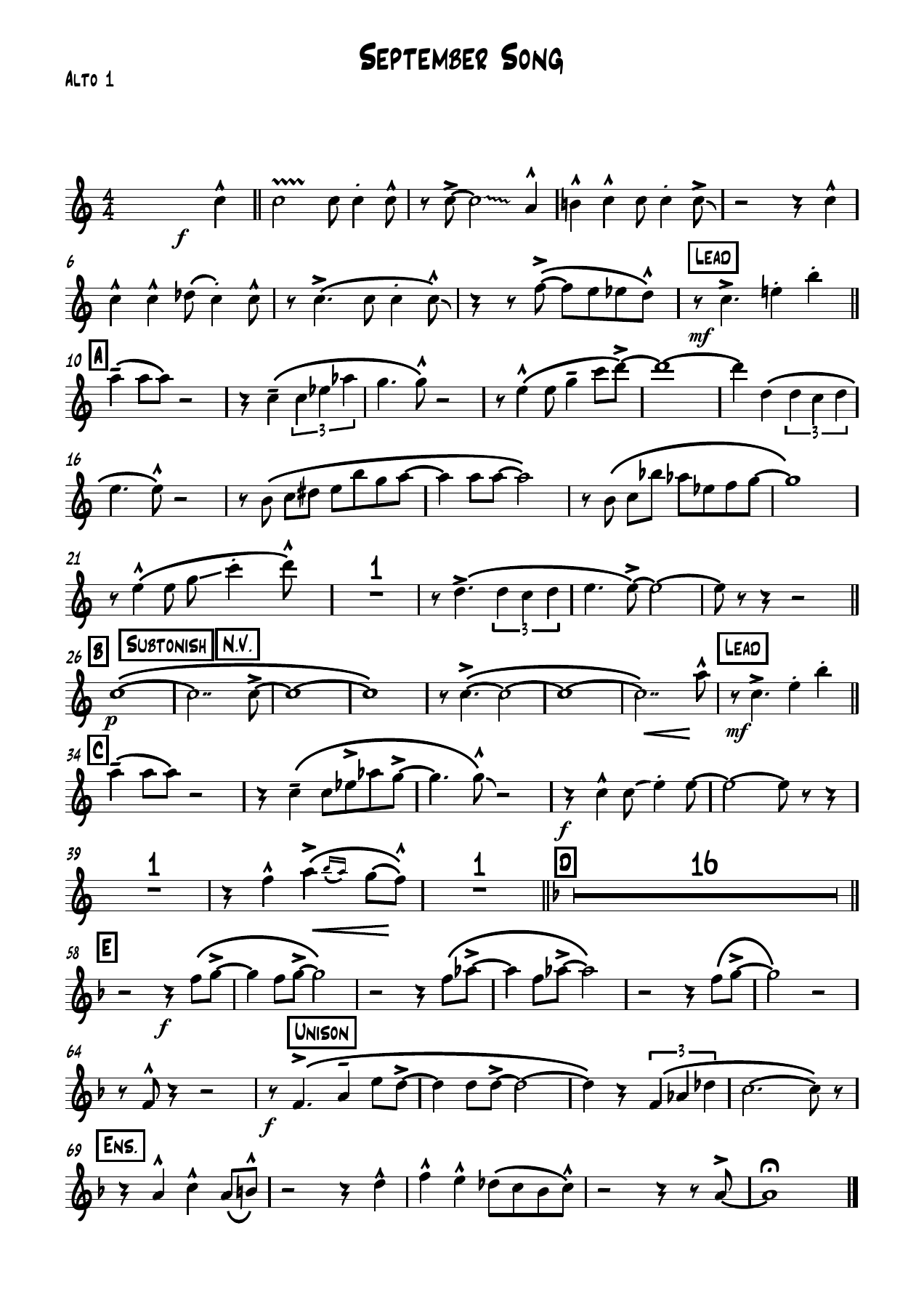
September Song (B.Eberhart) sheet music preview

September Song (B.Eberhart)

Composed by Kurt Weill

Arranged by Bob Eberhart

  • Ensemble: Big Band
  • Style: Jazz Standard
  • Pages: 22
  • Instruments (17): Alto 1, Alto 2, Tenor 1, Tenor 2, Bari. Sax., Trumpet 1, Trumpet 2, Trumpet 3, Trumpet 4, Trombone 1, Trombone 2, Trombone 3, Trombone 4, Bass Trombone, Piano / Guitar, Bass, Drums
  • Difficulty: medium
  • Content: Individual Parts
  • Format: PDF Download (Instant)
  • Price: $24.99

Kurt Weill's "September Song," originally composed in 1938 for the Broadway musical *Knickerbocker Holiday*, stands as a poignant testament to the enduring power of melody and lyrical depth. While initially overshadowed by the show's political satire, the song quickly transcended its theatrical origins to become a beloved jazz standard. Its melancholic yet hopeful reflection on the passage of time, particularly the autumn of life, resonated deeply with audiences and musicians alike. Artists such as Frank Sinatra, Sarah Vaughan, and Nat King Cole cemented its place in the jazz canon, each bringing their unique interpretive genius to its timeless narrative. The piece embodies the sophisticated vocal jazz tradition of the mid-20th century, characterized by rich harmony, expressive phrasing, and a profound emotional core, making it a staple in the repertoire of any serious jazz ensemble. Bob Eberhart's big band arrangement of "September Song" masterfully reinterprets this classic with a sophisticated, medium-swing feel that balances reverence for the original with contemporary jazz sensibilities. Set in the key of F major, the arrangement opens with a tender, expressive statement of the melody, primarily carried by the alto saxophone, evoking a reflective and warm mood. Eberhart's signature approach to voicings is evident throughout, featuring lush, close-knit harmonies in the saxophone section and brass, creating a full, resonant sound that supports the emotional arc of the piece. The energy builds subtly, moving from a gentle introspection to a more expansive, yet always controlled, swing feel, making it an ideal vehicle for showcasing a band's dynamic control and interpretive maturity. This arrangement is a showcase for both ensemble precision and individual soloistic expression. The melody is intelligently distributed, initially featuring Alto Saxophone 1, then transitioning to a beautifully voiced saxophone soli section that adds depth and texture. A featured solo opportunity is provided for Tenor Saxophone 1, offering space for improvisation over Eberhart's harmonically rich chord changes, which include extended harmonies and thoughtful reharmonizations that keep the standard fresh and engaging. The arrangement culminates in a powerful yet controlled shout chorus, demonstrating the full breadth of the big band's capabilities without ever becoming overbearing. Technical challenges include precise articulation in the swing figures, careful balance within the layered voicings, and maintaining a consistent, relaxed medium-swing groove throughout. "September Song (B.Eberhart)" is ideally suited for advanced high school, college, community, and professional jazz ensembles. Its demands for nuanced phrasing, dynamic control, and harmonic understanding make it an excellent educational tool for developing musicality, while its sophisticated sound and engaging solo section ensure it will be a rewarding performance piece for experienced groups. The arrangement's thoughtful structure and rich harmonic palette provide ample opportunity for a band to demonstrate its collective artistry and interpretive depth, making it a standout addition to any concert program. Conductors should emphasize a relaxed, medium-swing feel from the outset, ensuring a consistent pulse without rushing. The opening alto saxophone melody requires a warm, expressive tone and careful attention to phrasing, allowing the natural ebb and flow of the line. Brass sections should focus on blend and intonation, particularly in the sustained chords that underpin the melody, and practice precise articulation in the swing figures. The saxophone soli sections demand tight rhythmic unison and balanced voicings; woodwind players should listen across the section to achieve a cohesive sound. The Tenor Saxophone 1 soloist should be encouraged to explore the harmonic richness of the changes, utilizing extended harmonies. Rehearsal time should be dedicated to dynamic contrasts, ensuring the build to the shout chorus is gradual and controlled, and that the final chords resolve with warmth and clarity. No special mutes or techniques are explicitly required beyond standard jazz articulation and phrasing. Q: What instruments and parts are included in this arrangement? A: This big band arrangement includes parts for 17 instruments: Alto Saxophone 1, Alto Saxophone 2, Tenor Saxophone 1, Tenor Saxophone 2, Baritone Saxophone, Trumpet 1, Trumpet 2, Trumpet 3, Trumpet 4, Trombone 1, Trombone 2, Trombone 3, Trombone 4, Piano, Bass, Drums, and Guitar. Q: What is the difficulty level of "September Song (B.Eberhart)"? A: This arrangement is considered advanced, suitable for college, community, and professional jazz ensembles. It requires strong technical proficiency, advanced harmonic understanding, and mature interpretive skills from all sections. Q: What is the musical style and historical context of this piece? A: "September Song" is a classic jazz standard, originally composed by Kurt Weill in 1938. Bob Eberhart's arrangement reimagines it with a sophisticated, medium-swing big band style, reflecting the rich harmonic and melodic traditions of mid-20th century vocal jazz. Q: What makes Bob Eberhart's arrangement of "September Song" unique? A: Eberhart's arrangement is distinguished by its lush, close-knit voicings, thoughtful reharmonizations, and intelligent distribution of the melody. It features a prominent Alto Saxophone 1 lead, a beautifully crafted saxophone soli, and a compelling Tenor Saxophone 1 solo section, all contributing to a rich, expressive interpretation of the standard. Q: What is the typical performance duration and tempo for this arrangement? A: The arrangement is designed for a medium-swing tempo, typically around 120-130 beats per minute. The performance duration is approximately 4-5 minutes, depending on the length of the improvised solo.

Questions and answers

What is included in the September Song (B.Eberhart) PDF?
The verified current file contains individual parts across 22 pages.
How many instruments or parts are listed for September Song (B.Eberhart)?
The verified instrumentation list contains 17 entries for this Big Band arrangement.
Who is credited for September Song (B.Eberhart)?
Composer: Kurt Weill. Arranger: Bob Eberhart.
What difficulty is listed for September Song (B.Eberhart)?
The verified difficulty level is medium.
What style is listed for September Song (B.Eberhart)?
The catalog lists the style as Jazz Standard.
Can I preview September Song (B.Eberhart) before buying?
Yes. The product page provides a preview generated from the current PDF file.
How is September Song (B.Eberhart) delivered?
After successful payment, the digital PDF is made available for download. The displayed price is $24.99.

Musicians Also Search For

September Song Bob Eberhart PDFSeptember Song Bob Eberhart sheet musicSeptember Song arranged by Bob EberhartBob Eberhart big band chartsBob Eberhart jazz arrangements PDFSeptember Song Kurt Weill sheet musicSeptember Song Kurt Weill big band arrangementsKurt Weill big band chartsSeptember Song big band arrangementsSeptember Song big band PDF downloadSeptember Song jazz sheet musicbig band sheet music downloadSeptember Song individual parts downloadSeptember Song sheet music PDFSeptember Song Jazz Standard chartsJazz Standard big band arrangementsbuy September Song sheet musicdownload September Song PDFSeptember Song jazz chartsbest Bob Eberhart big band arrangementsKurt Weill arranged by Bob EberhartSeptember Song printable sheet musicbig band repertoire PDF

All arrangements by Bob Eberhart All Kurt Weill sheet music