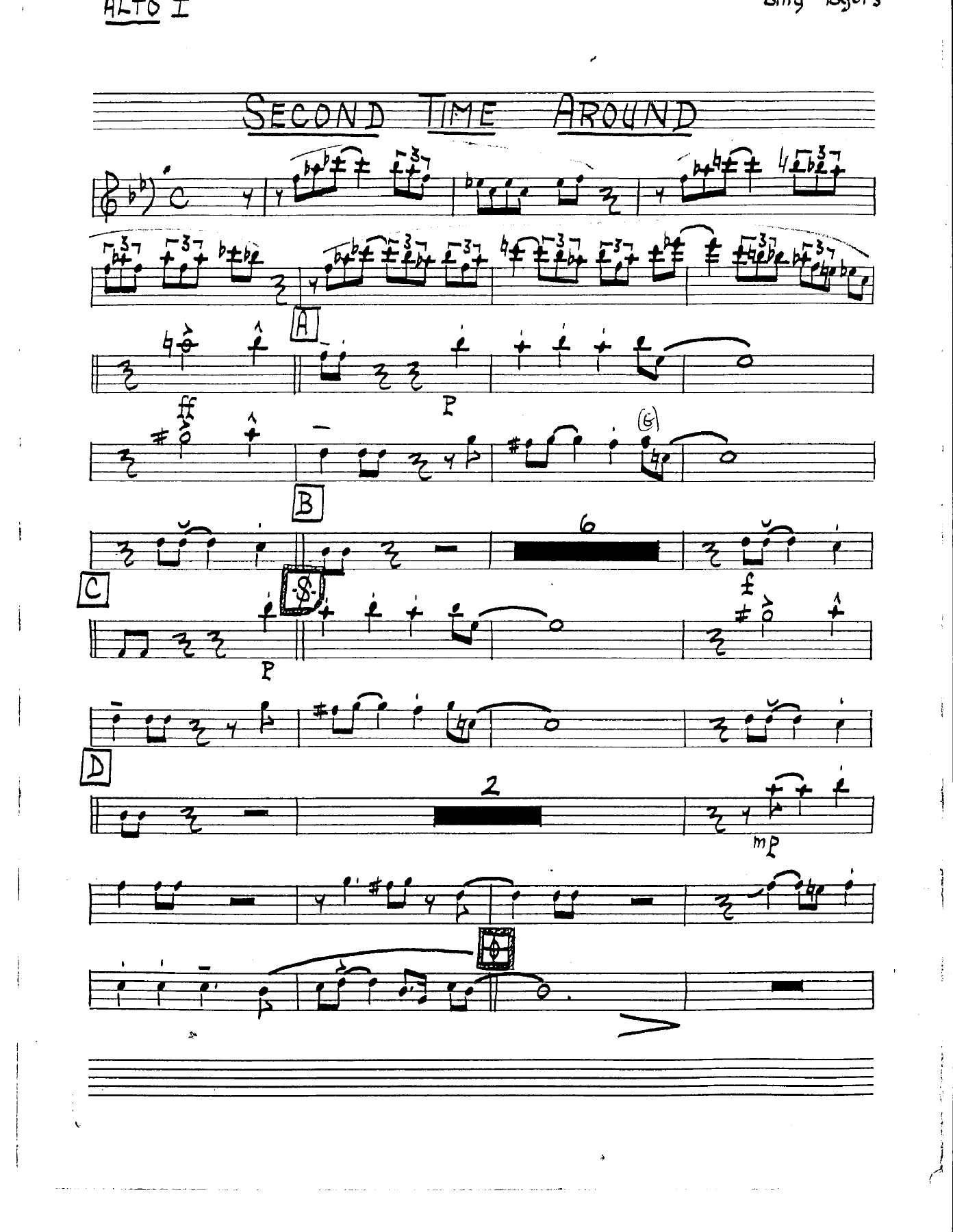
Second Time Around (B.Byers) sheet music preview

Second Time Around (B.Byers)

Composed by Jimmy Van Heusen

Arranged by Billy Byers

  • Ensemble: Big Band
  • Style: Jazz Standard
  • Pages: 34
  • Instruments (17): Alto Saxophone I, Alto Saxophone II, Tenor Saxophone I, Tenor Saxophone II, Baritone Saxophone, Trumpet I, Trumpet II, Trumpet III, Trumpet IV, Trombone I, Trombone II, Trombone III, Trombone IV, Piano, Guitar, Bass, Drums
  • Difficulty: medium
  • Content: Individual Parts
  • Format: PDF Download (Instant)
  • Price: $24.99

"The Second Time Around," composed by Jimmy Van Heusen with lyrics by Sammy Cahn, emerged in 1960 as a poignant jazz standard, initially introduced by Bing Crosby in the film *High Time*. While Crosby’s rendition brought it to the public, it was Frank Sinatra who truly cemented its place in the jazz canon, recording it multiple times, including as the inaugural single for his newly founded Reprise Records in 1961. The song's theme, celebrating renewed love and experience, resonated deeply, earning it an Academy Award nomination for Best Original Song. Its enduring melodic beauty and lyrical depth have made it a favorite among vocalists and instrumentalists alike, ensuring its status as a timeless piece within the Great American Songbook and a staple in jazz repertoire. Billy Byers’ arrangement of "Second Time Around" for big band captures the sophisticated, swinging essence of the early 1960s, a period when big band jazz was evolving with greater harmonic complexity and rhythmic precision. Byers, a highly respected trombonist, composer, and arranger, was renowned for his taut, hip, and punchy arrangements, often working behind the scenes for major artists like Frank Sinatra and the Count Basie Orchestra. This particular chart is a fantastic medium-slow swing tune, embodying the classic Basie-esque feel, characterized by its effortless groove and refined execution. The mood is one of elegant romance and understated joy, evoking the golden age of big band jazz. Byers' distinctive arranging approach is evident throughout this 17-instrument orchestration. He masterfully employs rich, often closed voicings within the brass and saxophone sections, creating a full and resonant sound that is both lush and articulate. Expect to find meticulously crafted soli sections where the saxophones or brass move in tight, harmonized lines, showcasing the ensemble's precision. While specific details of this arrangement's solos are not universally documented, Byers typically integrates featured soloists seamlessly, often providing ample space for improvisation over the sophisticated harmonic progression. His arrangements are known for their clarity, allowing each section to shine while contributing to a cohesive, swinging whole, often culminating in powerful, yet controlled, shout choruses that build excitement without sacrificing musicality. Performing this arrangement offers significant rewards for a big band. The melody is typically carried by the saxophone section, often with brass interjections and counter-melodies, requiring excellent blend and intonation. Technical challenges include maintaining a consistent, relaxed medium-swing feel, precise articulation in the soli passages, and navigating Byers' often extended harmonies. The chart is suitable for advanced high school, college, community, and professional big bands. Its musical depth and the nuanced demands on ensemble playing make it an excellent vehicle for developing sophisticated musicality and a deep understanding of classic big band arranging. The satisfaction comes from bringing to life Byers' elegant interpretation of a beloved standard, delivering a performance that is both musically engaging and historically informed. To achieve the authentic Billy Byers sound in "Second Time Around," emphasize a relaxed, medium-slow swing feel, ensuring the rhythm section lays down a solid, unhurried foundation. The tempo should be around quarter note = 110-120 BPM, allowing for the rich harmonies to breathe. Key technical challenges include the precise execution of the saxophone and brass soli sections, which require meticulous attention to blend, balance, and articulation. Encourage players to listen across sections to achieve Byers' signature tight voicings. Trumpet players should focus on warm, controlled tones in the upper register, avoiding harshness. There are no specific extended techniques like plungers or falls explicitly noted for this arrangement, but a tasteful use of subtle scoops and fall-offs, particularly in the brass, can enhance the authentic jazz aesthetic. During rehearsals, isolate soli passages and practice them slowly, gradually increasing tempo, to ensure rhythmic accuracy and harmonic clarity. Pay close attention to dynamics, as Byers' charts often feature nuanced swells and diminuendos that contribute significantly to the overall mood. **Q: What instruments are included in this arrangement?** A: This big band arrangement is scored for 17 instruments, including Alto Saxophone 1, Alto Saxophone 2, Tenor Saxophone 1, Tenor Saxophone 2, Baritone Saxophone, 4 Trumpets, 4 Trombones, Guitar, Piano, Bass, and Drums. **Q: What is the difficulty level of this arrangement?** A: This arrangement is suitable for advanced high school, college, community, and professional big bands, requiring proficient instrumentalists and a solid understanding of jazz ensemble playing. **Q: What is the musical style and historical context of "Second Time Around (B.Byers)"?** A: This is a jazz standard from the 1960s, originally composed by Jimmy Van Heusen, arranged by Billy Byers in a classic, medium-slow swing style, reminiscent of the Count Basie Orchestra's sound. **Q: What makes this Billy Byers arrangement unique?** A: Billy Byers' treatment features his characteristic rich, often closed voicings, meticulously crafted soli sections, and a sophisticated harmonic approach that maintains a relaxed yet precise medium-swing feel, embodying the elegance of the era. **Q: What is the typical performance duration or tempo for this piece?** A: "Second Time Around" is a medium-slow swing, typically performed at a tempo of approximately 110-120 beats per minute, resulting in a performance duration that allows for the full development of its melodic and harmonic content.

Questions and answers

What is included in the Second Time Around (B.Byers) PDF?
The verified current file contains individual parts across 34 pages.
How many instruments or parts are listed for Second Time Around (B.Byers)?
The verified instrumentation list contains 17 entries for this Big Band arrangement.
Who is credited for Second Time Around (B.Byers)?
Composer: Jimmy Van Heusen. Arranger: Billy Byers.
What difficulty is listed for Second Time Around (B.Byers)?
The verified difficulty level is medium.
What style is listed for Second Time Around (B.Byers)?
The catalog lists the style as Jazz Standard.
Can I preview Second Time Around (B.Byers) before buying?
Yes. The product page provides a preview generated from the current PDF file.
How is Second Time Around (B.Byers) delivered?
After successful payment, the digital PDF is made available for download. The displayed price is $24.99.

Musicians Also Search For

Second Time Around Billy Byers PDFSecond Time Around Billy Byers sheet musicSecond Time Around arranged by Billy ByersBilly Byers big band chartsBilly Byers jazz arrangements PDFSecond Time Around Jimmy Van Heusen sheet musicSecond Time Around Jimmy Van Heusen big band arrangementsJimmy Van Heusen big band chartsSecond Time Around big band arrangementsSecond Time Around big band PDF downloadSecond Time Around jazz sheet musicbig band sheet music downloadSecond Time Around individual parts downloadSecond Time Around sheet music PDFSecond Time Around Jazz Standard chartsJazz Standard big band arrangementsbuy Second Time Around sheet musicdownload Second Time Around PDFSecond Time Around jazz chartsbest Billy Byers big band arrangementsJimmy Van Heusen arranged by Billy ByersSecond Time Around printable sheet musicbig band repertoire PDF

All arrangements by Billy Byers All Jimmy Van Heusen sheet music