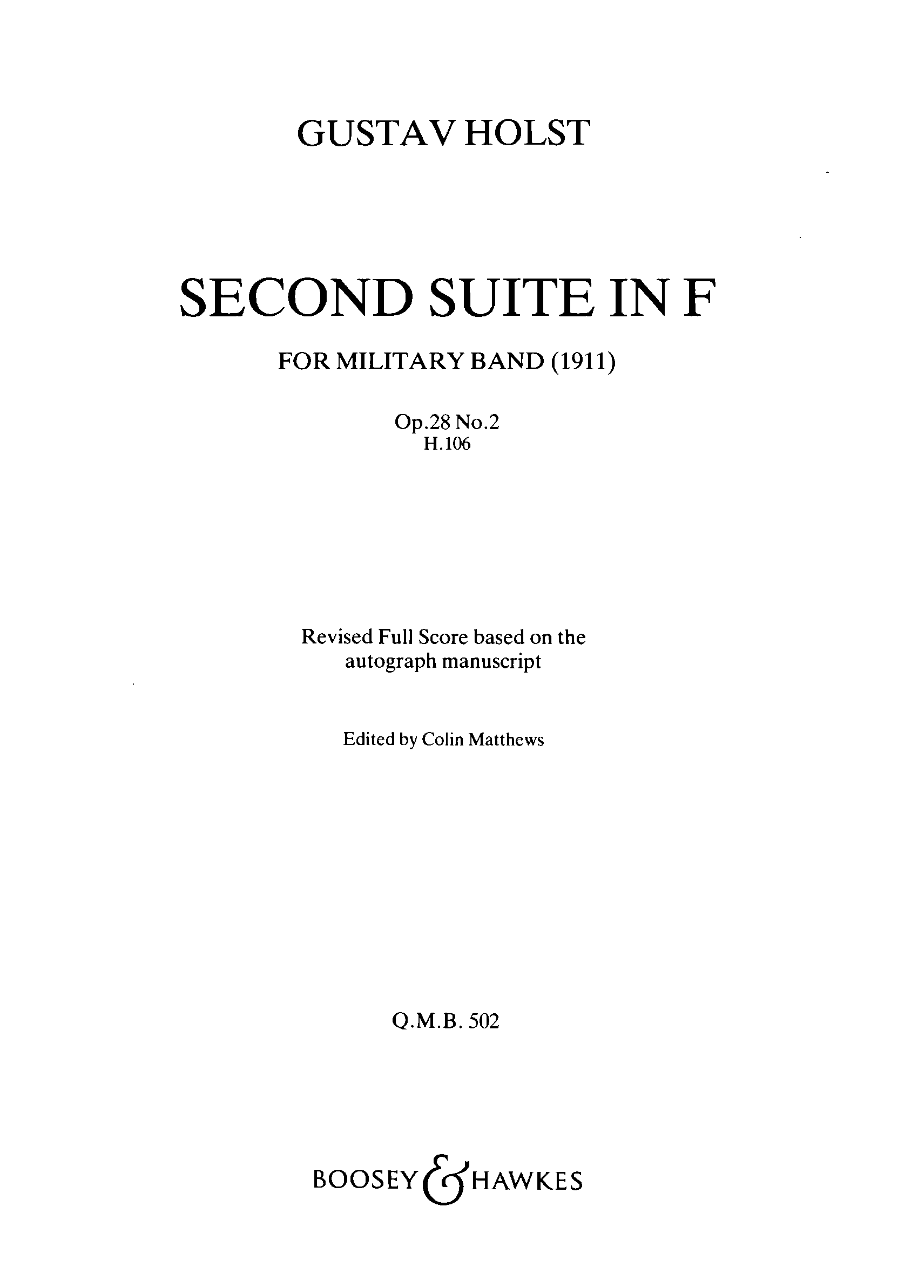
Second Suite In F (G.Holst) sheet music preview

Second Suite In F (G.Holst)

Composed by Gustav Holst

Arranged by G.Holst

  • Ensemble: Concert Band
  • Style: Traditional
  • Pages: 141
  • Difficulty: advanced
  • Content: Sheet Music
  • Format: PDF Download (Instant)
  • Price: $22.99

Gustav Holst's "Second Suite in F for Military Band, Op. 28, No. 2" stands as a monumental work in the wind band repertoire, composed in 1911. This original composition, not a jazz arrangement in the traditional sense, represents the pinnacle of early 20th-century British wind band writing, deeply rooted in English folk song tradition and classical compositional techniques. Its four movements – "March," "Fantasia on the Dargason," "Song Without Words: I'll Love My Love," and "Fantasia on the Dargason" (reprise with "Greensleeves") – showcase Holst's masterful orchestration, melodic invention, and innovative use of counterpoint. The suite's enduring popularity stems from its vibrant energy, evocative melodies, and sophisticated yet accessible structure, making it a cornerstone for concert bands worldwide and a testament to Holst's profound influence on the genre. This particular edition, also attributed to G. Holst, is presented as the definitive original work for concert band, preserving the composer's exact intentions and musical vision. It is not an arrangement *of* the suite into a jazz idiom, but rather the foundational, traditional concert band suite itself. The musical character is decidedly traditional, reflecting the early 20th-century British classical style. Tempos vary across the movements, from the stately allegro of the "March" to the lyrical andante of "Song Without Words," and the spirited allegro moderato of the "Fantasia." The suite is primarily in F major, with excursions into related keys, maintaining a bright and often triumphant mood, interspersed with moments of tender lyricism and intricate counterpoint. The energy is dynamic, ranging from powerful full-ensemble statements to delicate chamber-like textures. As the original composer, G. Holst's approach is inherently distinctive; he is the architect of the piece's structure, harmony, and orchestration. There are no "arranger's voicings" or "shout choruses" in the jazz sense, but rather Holst's iconic scoring for military band. He masterfully utilizes the full spectrum of wind and percussion instruments, employing rich brass fanfares, soaring woodwind melodies, and intricate contrapuntal lines that weave through the ensemble. The first movement's "March" features prominent melody lines in cornets and clarinets, often supported by robust low brass. The "Fantasia on the Dargason" is a brilliant display of melodic layering, featuring the titular folk tune alongside "Greensleeves" in a complex yet transparent texture. Technical challenges include precise articulation, dynamic control across a wide range, and intricate rhythmic interplay, particularly in the faster movements. The reward lies in performing a historically significant work that is both intellectually stimulating and deeply moving, allowing musicians to engage with Holst's genius directly. This suite is highly suitable for advanced high school, collegiate, community, and professional concert bands. Its demands on individual musicianship, ensemble balance, and interpretive depth make it an excellent choice for developing sophisticated musicality. The extensive score (141 pages) provides ample detail for conductors and musicians to delve into Holst's intricate counterpoint and rich harmonic language. Performing "Second Suite in F" offers a comprehensive musical experience, challenging every section of the band while delivering an immensely satisfying and historically resonant performance. The "Second Suite in F" demands meticulous attention to articulation, balance, and dynamic contrast. Conductors should emphasize rhythmic precision, particularly in the "March" and "Fantasia" movements, where intricate counterpoint requires clear individual lines to emerge without obscuring the overall texture. The lyrical movements, such as "Song Without Words," necessitate expressive phrasing and seamless legato playing, especially from the woodwinds and euphonium. Intonation across the full ensemble, particularly in sustained chords, is paramount. There are no special jazz techniques like plunger mutes or falls required, as this is a traditional concert band work. Rehearsal time should be dedicated to isolating contrapuntal lines, ensuring each voice is heard and balanced, and building dynamic swells and diminuendos with precision. Pay close attention to Holst's specific tempo indications and character markings for each section to capture the authentic spirit of the piece. Q: What instruments and parts are included in this arrangement? A: This is the original score and parts for a standard concert band (military band) instrumentation, typically including flutes, oboes, clarinets, bassoons, saxophones, trumpets/cornets, horns, trombones, euphonium, tuba, and percussion. The 141-page score provides comprehensive detail for all instrumental parts. Q: What is the difficulty level of "Second Suite In F (G.Holst)"? A: This suite is considered advanced (Grade 5-6) for concert bands. It requires strong technical proficiency from all sections, advanced musicianship, and a mature understanding of ensemble balance, intonation, and interpretation. Q: What is the musical style and historical context of this piece? A: The "Second Suite in F" is a seminal work of the early 20th-century British wind band repertoire, composed in 1911. Its style is traditional classical, heavily influenced by English folk melodies, and is a cornerstone piece for concert bands worldwide. Q: What makes this specific arrangement unique or distinctive? A: This is not a jazz arrangement, but rather the original, authoritative edition of Gustav Holst's "Second Suite in F." Its uniqueness lies in being the composer's direct and complete musical vision, serving as the definitive source for performing this iconic work. Q: What is the typical performance duration and overall tempo feel of the suite? A: The complete suite typically has a performance duration of approximately 11-13 minutes. It encompasses a variety of tempo feels, from the allegro of the "March" and "Fantasia" movements to the lyrical andante of "Song Without Words," offering diverse musical characters.

Musicians Also Search For

Second Suite In F G.Holst PDFSecond Suite In F G.Holst sheet musicSecond Suite In F arranged by G.HolstG.Holst concert band chartsG.Holst jazz arrangements PDFSecond Suite In F Gustav Holst sheet musicSecond Suite In F Gustav Holst concert band arrangementGustav Holst concert band chartsSecond Suite In F concert band arrangementSecond Suite In F concert band PDF downloadSecond Suite In F jazz ensemble sheet musicconcert band sheet music instant downloadSecond Suite In F sheet music with partsSecond Suite In F Traditional chartTraditional concert band arrangementsbuy Second Suite In F sheet music onlinedownload Second Suite In F PDFSecond Suite In F jazz chartbest G.Holst concert band arrangementsGustav Holst songs arranged by G.HolstSecond Suite In F printable sheet musicconcert band repertoire PDF

All arrangements by G.Holst All Gustav Holst sheet music