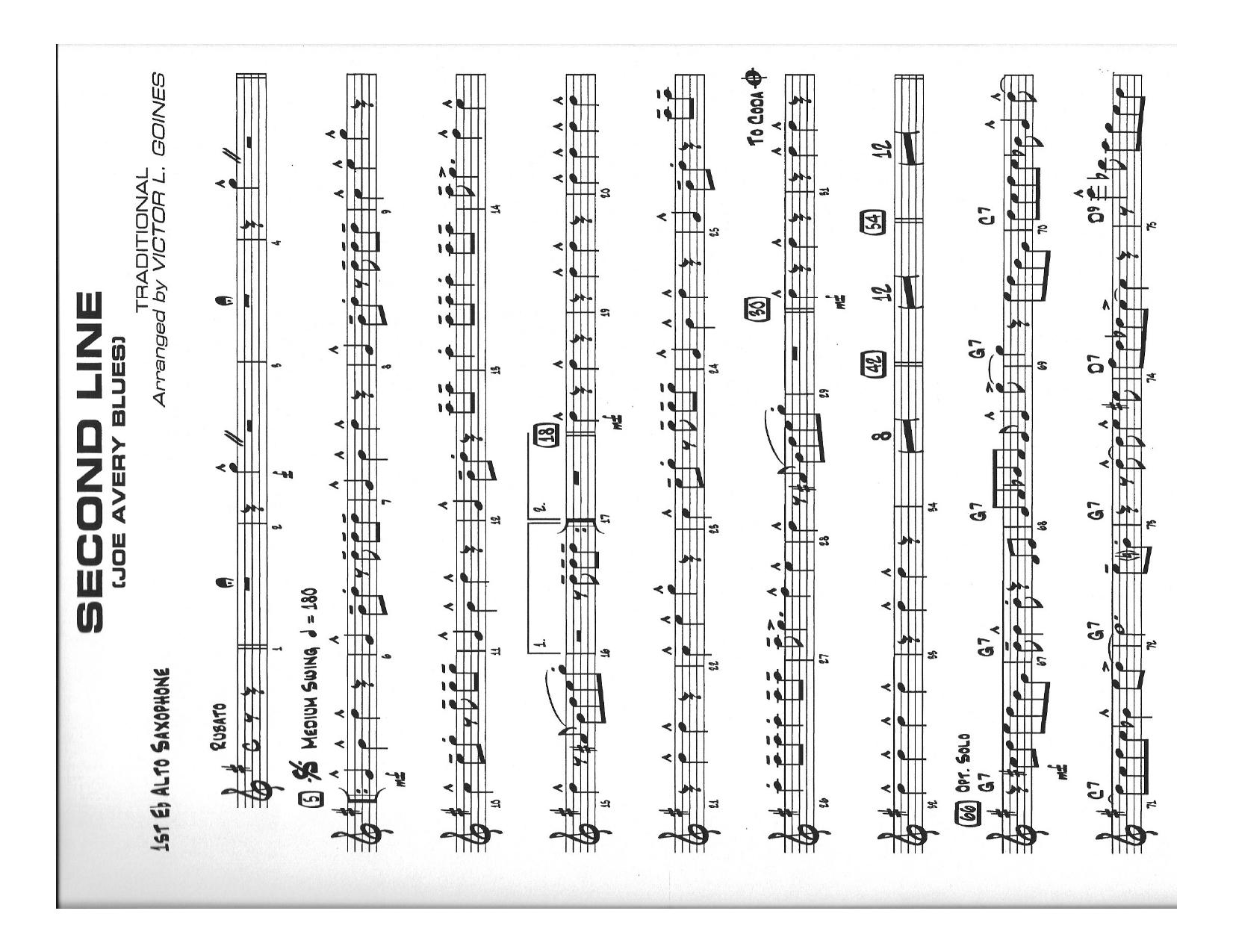
Second Line (V.Goines)
Composed by Victor Goines
Arranged by V.Goines
- Ensemble: Big Band
- Style: Jazz Standard
- Pages: 40
- Instruments (17): 1st Eb Alto Saxophone, 2nd Eb Alto Saxophone, Eb Baritone Saxophone, Bass, Drums, Guitar, Piano, 1st Bb Tenor Saxophone, 2nd Bb Tenor Saxophone, 1st Trombone, 2nd Trombone, 3rd Trombone, 4th Trombone, 1st Bb Trumpet, 2nd Bb Trumpet, 3rd Bb Trumpet, 4th Bb Trumpet
- Difficulty: medium
- Content: Individual Parts
- Format: PDF Download (Instant)
- Price: $24.99
Rooted deeply in the rich, syncopated soil of New Orleans tradition and modern straight-ahead jazz, "Second Line" by acclaimed reedist, composer, and educator Victor Goines bridges the historic street-beat culture of Louisiana with sophisticated big band arranging. Originally conceived to capture the celebratory, communal energy of traditional New Orleans jazz funerals and parade processions, Goines's composition translates the iconic, driving percussion groove of the street into a formidable modern big band vehicle. As a long-standing member of the Jazz at Lincoln Center Orchestra and a protégé of master stylists, Goines brings an authentic vocabulary that honors traditional roots while infusing the sophisticated harmonies and dynamic orchestration of contemporary jazz composition. Propelled by an infectious, driving groove that swings with an unmistakable second-line parade cadence, the work opens with high-energy polyrhythms in the percussion section before the full ensemble enters with a bold, declarative theme. The harmonic language skillfully blends traditional blues inflections with rich, extended modern chord structures, creating an atmosphere that is simultaneously joyful, soulful, and intellectually engaging. The arrangement moves seamlessly between jubilant ensemble tutti sections, transparent rhythm-section breakdowns, and intricate horn solis that demand absolute precision and stylistic unity from the entire brass and reed sections. Goines’s characteristic arranging style shines through in the meticulous voice-leading and the conversational interplay between the brass and saxophone sections. The saxophones, anchored by two altos, two tenors, and a baritone, frequently handle nimble, bebop-inflected counterlines, while the trumpets and trombones deliver punchy, rhythmic punctuations that emulate the call-and-response nature of traditional marching bands. Open solo sections provide dedicated space for featured improvisers—traditionally spotlighting trumpet and tenor saxophone—to stretch out over straight-ahead blues or modal changes. The arrangement builds relentlessly toward a high-octane shout chorus that reincorporates the initial street beat motif, driving the energy to a roaring, thunderous climax before a crisp, punchy ending. Advanced high school ensembles with strong rhythm sections, collegiate jazz orchestras, and professional big bands will find this chart to be an invigorating challenge and a massive crowd-pleaser. While the technical demands on individual players require a solid grasp of syncopated phrasing and extended range, the primary hurdle lies in capturing the authentic, buoyant feel of the groove without rushing. Delivering this chart successfully requires musicians to master the delicate balance between tight, disciplined section playing and the loose, celebratory abandon inherent to the New Orleans second-line tradition, making it an unforgettable centerpiece for any concert program. Achieving an authentic performance of "Second Line" hinges entirely on the rhythm section's ability to lock in the iconic New Orleans syncopated groove without dragging or rushing. The drummer must capture the characteristic snare drum and bass drum interplay that mimics a street parade, avoiding a stiff, straight-eighth interpretation in favor of a bouncy, buoyant feel that breathes. Brass players should utilize a warm, articulate tone, employing precise articulation—such as controlled doits and natural staccatos—rather than heavy, over-exaggerated effects. Conductors should rehearse the ensemble in sections first, ensuring that the intricate counterlines in the saxophones balance effectively against the punchy brass backgrounds. Pay close attention to dynamic contrasts; the sudden drops in volume must be executed cleanly to heighten the dramatic impact of the subsequent shout choruses. Soloists should be encouraged to lean into the blues tradition, building their improvisational arcs organically to match the escalating energy of the arrangement. Q: What instruments and parts are included in this big band arrangement? A: The 40-page arrangement is scored for a standard 17-instrument big band, featuring Alto Saxophone 1, Alto Saxophone 2, Tenor Saxophone 1, Tenor Saxophone 2, Baritone Saxophone, 4 Trumpets, 4 Trombones, Piano, Bass, Drum Set, and auxiliary percussion parts tailored to the second-line groove. Q: What is the difficulty level of this arrangement? A: This piece is graded as advanced, making it best suited for college jazz ensembles, advanced high school bands, and professional big bands that possess strong section reading skills and a rhythm section comfortable with stylistic groove changes. Q: What is the musical style and historical context of "Second Line"? A: Composed by Victor Goines, the piece is a contemporary jazz standard that reimagines the traditional New Orleans street parade and jazz funeral second-line groove through the lens of modern big band arranging. Q: What makes this particular arrangement by Victor Goines unique? A: It uniquely bridges authentic New Orleans traditional street rhythms with sophisticated contemporary big band harmony, utilizing conversational horn voicings and dynamic sectional interplay that honor historical roots while remaining fiercely modern. Q: What is the performance duration and recommended tempo feel? A: While performance time varies based on solo choruses, the piece typically runs between 5 to 7 minutes at a bright, driving medium-up tempo with a persistent, infectious swing and parade-feel groove.
Questions and answers
- What is included in the Second Line (V.Goines) PDF?
- The verified current file contains individual parts across 40 pages.
- How many instruments or parts are listed for Second Line (V.Goines)?
- The verified instrumentation list contains 17 entries for this Big Band arrangement.
- Who is credited for Second Line (V.Goines)?
- Composer: Victor Goines. Arranger: V.Goines.
- What difficulty is listed for Second Line (V.Goines)?
- The verified difficulty level is medium.
- What style is listed for Second Line (V.Goines)?
- The catalog lists the style as Jazz Standard.
- Can I preview Second Line (V.Goines) before buying?
- Yes. The product page provides a preview generated from the current PDF file.
- How is Second Line (V.Goines) delivered?
- After successful payment, the digital PDF is made available for download. The displayed price is $24.99.
Musicians Also Search For
Second Line V.Goines PDF • Second Line V.Goines sheet music • Second Line arranged by V.Goines • V.Goines big band charts • V.Goines jazz arrangements PDF • Second Line Victor Goines sheet music • Second Line Victor Goines big band arrangements • Victor Goines big band charts • Second Line big band arrangements • Second Line big band PDF download • Second Line jazz sheet music • big band sheet music download • Second Line individual parts download • Second Line sheet music PDF • Second Line Jazz Standard charts • Jazz Standard big band arrangements • buy Second Line sheet music • download Second Line PDF • Second Line jazz charts • best V.Goines big band arrangements • Victor Goines arranged by V.Goines • Second Line printable sheet music • big band repertoire PDF