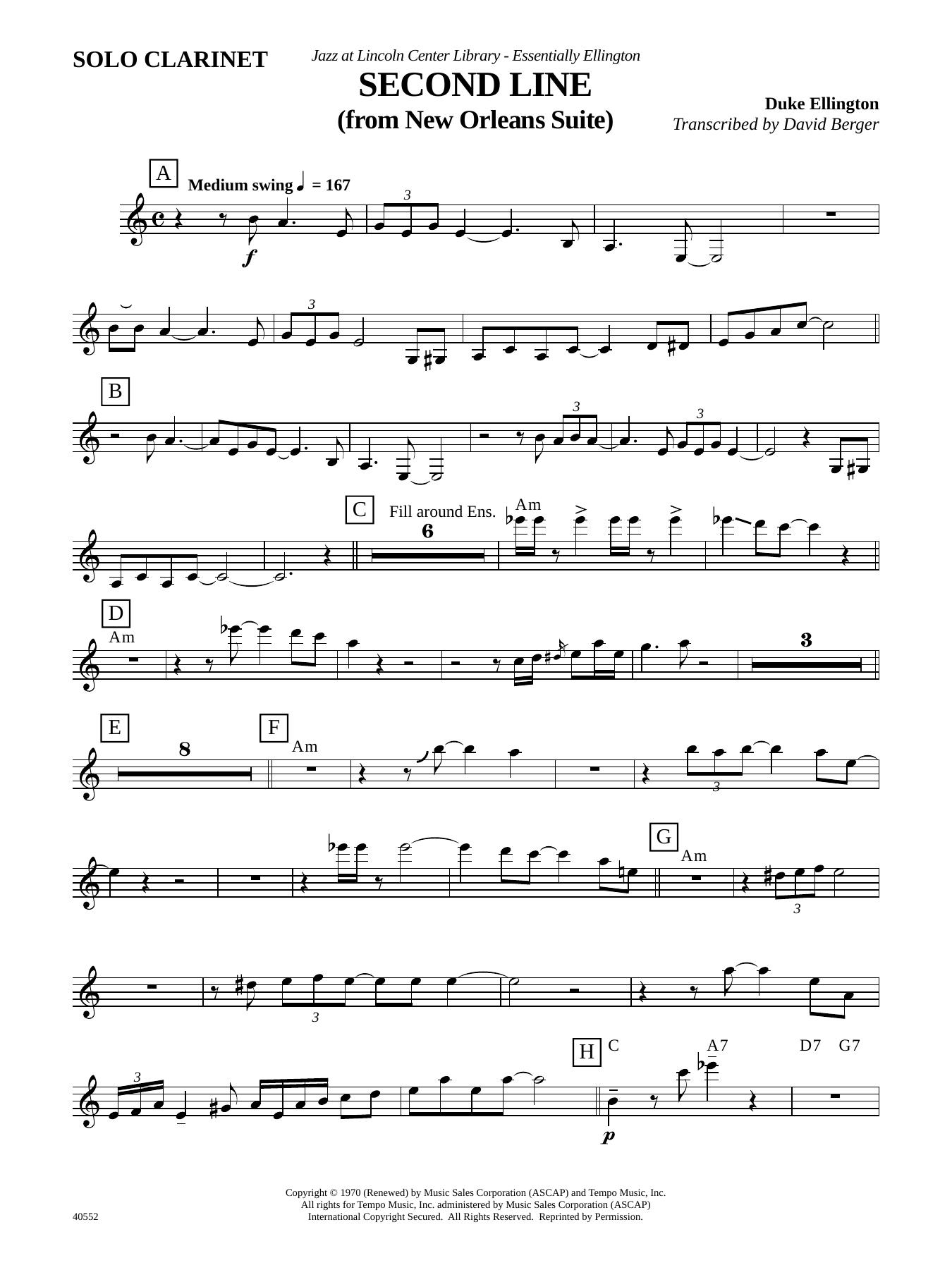
Second Line (D.Ellington) D.Berger (from New Orleans Suite)
Composed by Duke Ellington
Arranged by Duke Ellington & B.Strayhorn.D.Berger
- Ensemble: Big Band
- Pages: 118
- Instruments (16): Solo Clarinet, Reed 1 Alto Sax, Reed 2 Alto Sax, Reed 3 Tenor Sax, Reed 4 Tenor Sax, Reed 5 Baritone Sax, Trumpet 1, Trumpet 2, Trumpet 3, Trumpet 4, Trombone 1, Trombone 2, Trombone 3 (Bass Trombone), Piano, Bass, Drums
- Difficulty: advanced
- Content: Individual Parts
- Format: PDF Download (Instant)
- Price: $24.99
Duke Ellington’s *New Orleans Suite*, recorded in May 1970 for Atlantic Records, stands as one of the master composer's late-career triumphs, serving as a vibrant sonic homage to the cradle of jazz. Within this suite, "Second Line"—subtitled as a tribute to Sidney Bechet—captures the buoyant, syncopated street rhythms of traditional New Orleans funeral processions and celebratory parades, filtered through Ellington and Billy Strayhorn's sophisticated mid-century harmonic lens. The piece bridges historical Dixieland roots with modern big band orchestration, translating the street-level pulse of brass bands into a richly textured, swinging canvas that remains a high-water mark of Ellington’s compositional maturity. Dynamic and infectious, this movement thrives on an authentic second-line groove juxtaposed with swinging 4/4 sections, driven by an irrepressible rhythmic bounce. The mood shifts effortlessly from joyful, celebratory ensemble outbursts to sultry, blues-drenched interludes that evoke the sultry atmosphere of the French Quarter. The key centers pulse with modal color and Ellingtonian chromaticism, creating an intoxicating blend of celebratory exuberance and sophisticated blues feeling. The overall energy is high-octane yet deeply rooted in tradition, demanding a rhythm section that can seamlessly lock into a marching-style snare beat while maintaining an elastic, swinging momentum. In this meticulous transcription and adaptation by David Berger, the collaborative spirit of the Ellington-Strayhorn writing team is faithfully preserved and illuminated. Berger, renowned for his work with the Jazz at Lincoln Center Orchestra, approaches the score with deep archival fidelity, capturing the unique timbre of Ellington’s reed section—often featuring clarinet doubles and rich voicing across the saxophones. The arrangement utilizes dense, gorgeous cluster harmonies in the brass, signature plunger effects, and call-and-response figures that mimic the traditional New Orleans marching band structure. Rather than a modern reharmonization, Berger’s treatment honors the original recording's specific instrumental interplay, highlighting the conversational nature of Ellingtonian counterpoint where melody and accompaniment constantly shift between sections. Carried primarily by the robust reed section—with prominent roles for alto and tenor saxophones—the chart features electrifying ensemble *soli* sections and ample space for featured soloists to stretch out over authentic blues changes. Technical challenges center around stylistic authenticity: achieving the right articulation, capturing the unwritten nuances of the second-line groove, and executing the wide dynamic range required from whisper-quiet backgrounds to explosive shout choruses. The 118-page score and parts offer a masterclass in ensemble blend and stylistic versatility, making it immensely rewarding for groups willing to dig past the notes into the stylistic nuances. Advanced college ensembles, top-tier high school bands, and professional repertory orchestras will find this chart an exceptional vehicle for developing stylistic awareness, ensemble blend, and historical appreciation. Because it requires a mature rhythm section capable of driving a nuanced groove and horns comfortable with Ellingtonian vernacular, it is best suited for groups with strong section playing and confident soloists. The primary challenge of "Second Line" lies in mastering the rhythmic duality between the traditional New Orleans street beat (dotted-eighth and sixteenth-note feels) and straight-ahead medium swing. The rhythm section must anchor this groove without dragging, ensuring the hi-hat on beats 2 and 4 snaps cleanly while the bass lays down a robust, walking foundation. Conductor focus should be directed toward section balance, particularly ensuring that the low reed parts (baritone sax and bass clarinet, if utilized) project clearly to anchor the rich, low-interval cluster voicings. Trumpets and trombones must make liberal use of bucket mutes, cup mutes, and plunger technique where indicated to capture the vocalized, growling timbre characteristic of the Ellington orchestra. Rehearsal should begin by separating the rhythm section and horns to lock in the syncopated second-line figures before attempting full-ensemble passages. Emphasize short, punchy articulations on the thematic statements, and push the dynamic contrast during the transitional interludes to maximize the dramatic, celebratory impact of the shout choruses. Q: What instruments and parts are included in this arrangement? A: This 118-page publication includes a full conductor's score and individual parts for an 8-instrument core ensemble, specifically featuring Alto Saxophone, Tenor Saxophone, Baritone Saxophone, Trumpet, Trombone, and a complete rhythm section. Q: What is the difficulty level of this chart? A: This arrangement is rated at an advanced level, best suited for collegiate ensembles, advanced high school bands, and professional repertory groups due to its intricate stylistic demands, rhythmic shifts, and exposed solo sections. Q: What is the style and historical context of the music? A: Composed by Duke Ellington as part of his celebrated 1970 *New Orleans Suite*, the piece blends traditional New Orleans street-beat parade music with sophisticated big band jazz, serving as a direct musical tribute to jazz pioneer Sidney Bechet. Q: What makes this specific arrangement by David Berger unique? A: David Berger's transcription meticulously reconstructs the original Ellington recording, preserving the authentic voicings, call-and-response textures, and specific plunger-mute orchestrations that define the late-period Ellington sound. Q: What is the approximate performance duration and tempo feel? A: The arrangement typically clocks in at around 4 to 5 minutes, driven by a medium-tempo swing feel interwoven with a buoyant, infectious second-line street groove.
Questions and answers
- What is included in the Second Line (D.Ellington) D.Berger (from New Orleans Suite) PDF?
- The verified current file contains a conductor score and individual parts across 118 pages.
- How many instruments or parts are listed for Second Line (D.Ellington) D.Berger (from New Orleans Suite)?
- The verified instrumentation list contains 16 entries for this Big Band arrangement.
- Who is credited for Second Line (D.Ellington) D.Berger (from New Orleans Suite)?
- Composer: Duke Ellington. Arranger: Duke Ellington & B.Strayhorn.D.Berger.
- What difficulty is listed for Second Line (D.Ellington) D.Berger (from New Orleans Suite)?
- The verified difficulty level is advanced.
- Can I preview Second Line (D.Ellington) D.Berger (from New Orleans Suite) before buying?
- Yes. The product page provides a preview generated from the current PDF file.
- How is Second Line (D.Ellington) D.Berger (from New Orleans Suite) delivered?
- After successful payment, the digital PDF is made available for download. The displayed price is $24.99.
Musicians Also Search For
Second Line Duke Ellington & B.Strayhorn.D.Berger PDF • Second Line Duke Ellington & B.Strayhorn.D.Berger sheet music • Second Line arranged by Duke Ellington & B.Strayhorn.D.Berger • Duke Ellington & B.Strayhorn.D.Berger big band charts • Duke Ellington & B.Strayhorn.D.Berger jazz arrangements PDF • Second Line Duke Ellington sheet music • Second Line Duke Ellington big band arrangements • Duke Ellington big band charts • Second Line big band arrangements • Second Line big band PDF download • Second Line jazz sheet music • big band sheet music download • Second Line conductor score PDF • Second Line individual parts download • Second Line sheet music PDF • buy Second Line sheet music • download Second Line PDF • Second Line jazz charts • best Duke Ellington & B.Strayhorn.D.Berger big band arrangements • Duke Ellington arranged by Duke Ellington & B.Strayhorn.D.Berger • Second Line printable sheet music • big band repertoire PDF