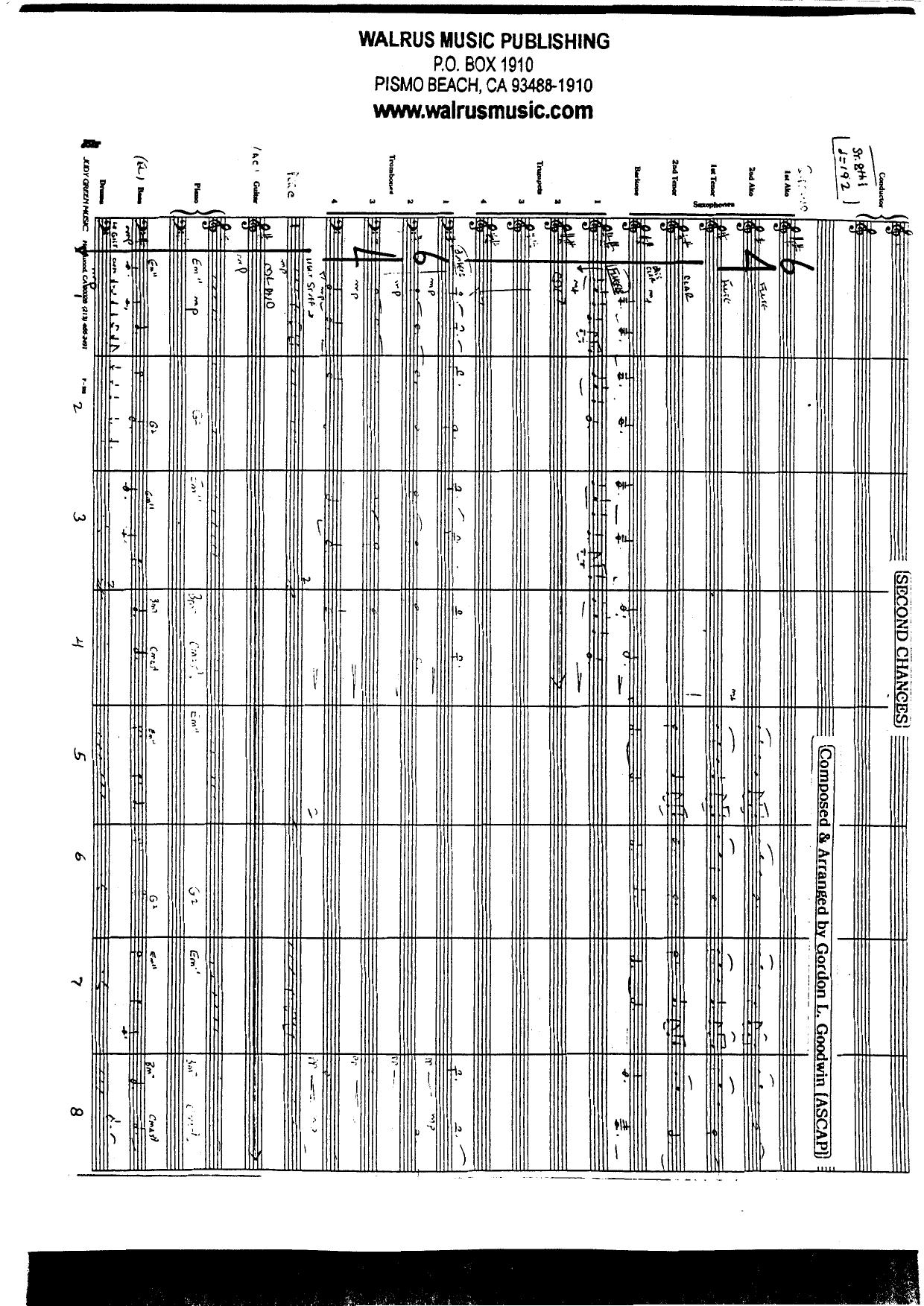
Second Chances (G.Goodwin) sheet music preview

Second Chances (G.Goodwin)

Composed by Gordon Goodwin

Arranged by Gordon Goodwin

  • Ensemble: Big Band
  • Pages: 85
  • Instruments (19): Conductor Score, Alto Saxophone 1 (doubling Soprano Saxophone), Alto Saxophone 2 (doubling Flute), Tenor Saxophone 1 (doubling Flute), Tenor Saxophone 2 (doubling Clarinet), Baritone Saxophone (doubling Bass Clarinet), Trumpet 1 (doubling Flugelhorn), Trumpet 2 (doubling Flugelhorn), Trumpet 3, Trumpet 4, Trombone 1, Trombone 2, Trombone 3, Trombone 4, Guitar, Piano, Electric Bass, Drums, Percussion
  • Difficulty: advanced
  • Content: Individual Parts
  • Format: PDF Download (Instant)
  • Price: $24.99

Gordon Goodwin’s "Second Chances" stands as a masterclass in contemporary big band writing, capturing the sophisticated yet high-octane aesthetic that has defined the Gordon Goodwin’s Big Phat Band since its inception. Emerging from the vibrant West Coast studio scene of the late 20th and early 21st centuries, Goodwin’s compositions bridge the gap between traditional swing-era density and modern, fusion-inflected jazz orchestration. "Second Chances" exemplifies the composer's knack for marrying intricate, harmonically rich writing with an infectious groove, making it a staple for advanced ensembles looking to stretch their technical and stylistic boundaries. Driven by a relentless, contemporary medium-up swing feel, the work opens with a crisp, punchy rhythmic motif that immediately establishes an energetic and optimistic mood. The harmonic landscape is quintessential Goodwin: lush extended chord voicings, unexpected modal shifts, and dense brass cluster chords that resolve with brilliant clarity. The arrangement wastes no time building momentum, transitioning seamlessly from tight, conversational ensemble figures into expansive, flowing melodic lines carried predominantly by the saxophones. The emotional trajectory shifts dynamically between moments of introspective, cool-toned lyricism and explosive, high-energy outbursts that demand absolute precision from every section. Goodwin’s signature arranging style is on full display through meticulous counterpoint and cleverly structured section solis. The saxophones navigate intricate, bebop-infused unison lines that require absolute technical synchronization, while the brass section utilizes a palette of smart articulations—including deliberate falls, sharp staccatos, and warm, muted sustains—to color the background. A standout shout chorus serves as the structural climax, building tension through escalating syncopated rhythms and shifting tonal centers before releasing into a triumphant restatement of the primary theme. Featured solo opportunities provide ample room for expressive improvisation, allowing standout players in the rhythm section or horn lines to stretch out over modern, sophisticated chord changes. Tailored specifically for advanced collegiate, community, and professional big bands, this chart demands a mature rhythm section capable of locking into a driving pocket while maintaining a light, elastic touch. Horn players must possess nimble fingerwork, excellent breath support for extended phrasing, and a strong command of contemporary big band articulation. Rehearsing "Second Chances" rewards ensembles with a deeper understanding of ensemble blend, dynamic control, and modern jazz phrasing, ensuring it remains an unforgettable highlight of any concert program. Conductors tackling "Second Chances" should prioritize rhythmic precision and articulation consistency across all sections. The tempo is set at a driving medium-up swing; avoid rushing the pulse, as the groove relies heavily on the rhythm section maintaining a relaxed yet urgent forward momentum. Drummers should favor a crisp ride cymbal pattern with a feathered bass drum technique, keeping the hi-hat tight on beats two and four. The primary technical challenge lies in the intricate syncopated figures traded between the brass and reeds. Rehearsal should begin slowly, isolating the complex ensemble hits to ensure that short notes are properly clipped and long notes maintain a consistent, supported core sound. Trumpets and trombones must execute falls and doits with clean intonation, avoiding sloppy pitch drops that muddy the texture. Pay close attention to internal balance during the dynamic swells; the accompanying horns must dynamically drop away to let the melody or soloists soar without forcing their tone. Q: What instruments and parts are included in this arrangement? A: The 85-page comprehensive publication includes a full conductor score alongside standard big band instrumentation for 18 instruments, featuring two alto saxophones, two tenor saxophones, baritone saxophone, four trumpets, four trombones, and a full four-piece rhythm section (piano, guitar, bass, and drums). Q: What is the difficulty level of "Second Chances"? A: This arrangement is graded as advanced, making it best suited for college ensembles, advanced high school jazz bands, community big bands, and professional groups due to its intricate syncopation, fast tempo, and demanding technical passages. Q: What is the musical style and historical background of this piece? A: Written by renowned composer and arranger Gordon Goodwin, the piece is a modern contemporary big band chart that blends traditional swing sensibilities with progressive, fusion-influenced harmonies and high-energy West Coast attitude. Q: What makes this specific arrangement unique within Goodwin's catalog? A: It features Goodwin's trademark sophisticated extended chord voicings and a tightly woven counterpoint structure, balancing intricate, bebop-inspired saxophone solis with a powerful, dynamic shout chorus. Q: What is the approximate performance duration and tempo feel? A: While performance time varies slightly based on improvised solo choruses, the arrangement is designed around a driving, energetic medium-up swing tempo that typically spans between 5 to 6 minutes.

Questions and answers

What is included in the Second Chances (G.Goodwin) PDF?
The verified current file contains a conductor score and individual parts across 85 pages.
How many instruments or parts are listed for Second Chances (G.Goodwin)?
The verified instrumentation list contains 19 entries for this Big Band arrangement.
Who is credited for Second Chances (G.Goodwin)?
Composer: Gordon Goodwin. Arranger: Gordon Goodwin.
What difficulty is listed for Second Chances (G.Goodwin)?
The verified difficulty level is advanced.
Can I preview Second Chances (G.Goodwin) before buying?
Yes. The product page provides a preview generated from the current PDF file.
How is Second Chances (G.Goodwin) delivered?
After successful payment, the digital PDF is made available for download. The displayed price is $24.99.

Musicians Also Search For

Second Chances Gordon Goodwin PDFSecond Chances Gordon Goodwin sheet musicSecond Chances arranged by Gordon GoodwinGordon Goodwin big band chartsGordon Goodwin jazz arrangements PDFSecond Chances Gordon Goodwin big band arrangementsSecond Chances big band arrangementsSecond Chances big band PDF downloadSecond Chances jazz sheet musicbig band sheet music downloadSecond Chances conductor score PDFSecond Chances individual parts downloadSecond Chances sheet music PDFbuy Second Chances sheet musicdownload Second Chances PDFSecond Chances jazz chartsbest Gordon Goodwin big band arrangementsSecond Chances printable sheet musicbig band repertoire PDF

All arrangements by Gordon Goodwin All Gordon Goodwin sheet music